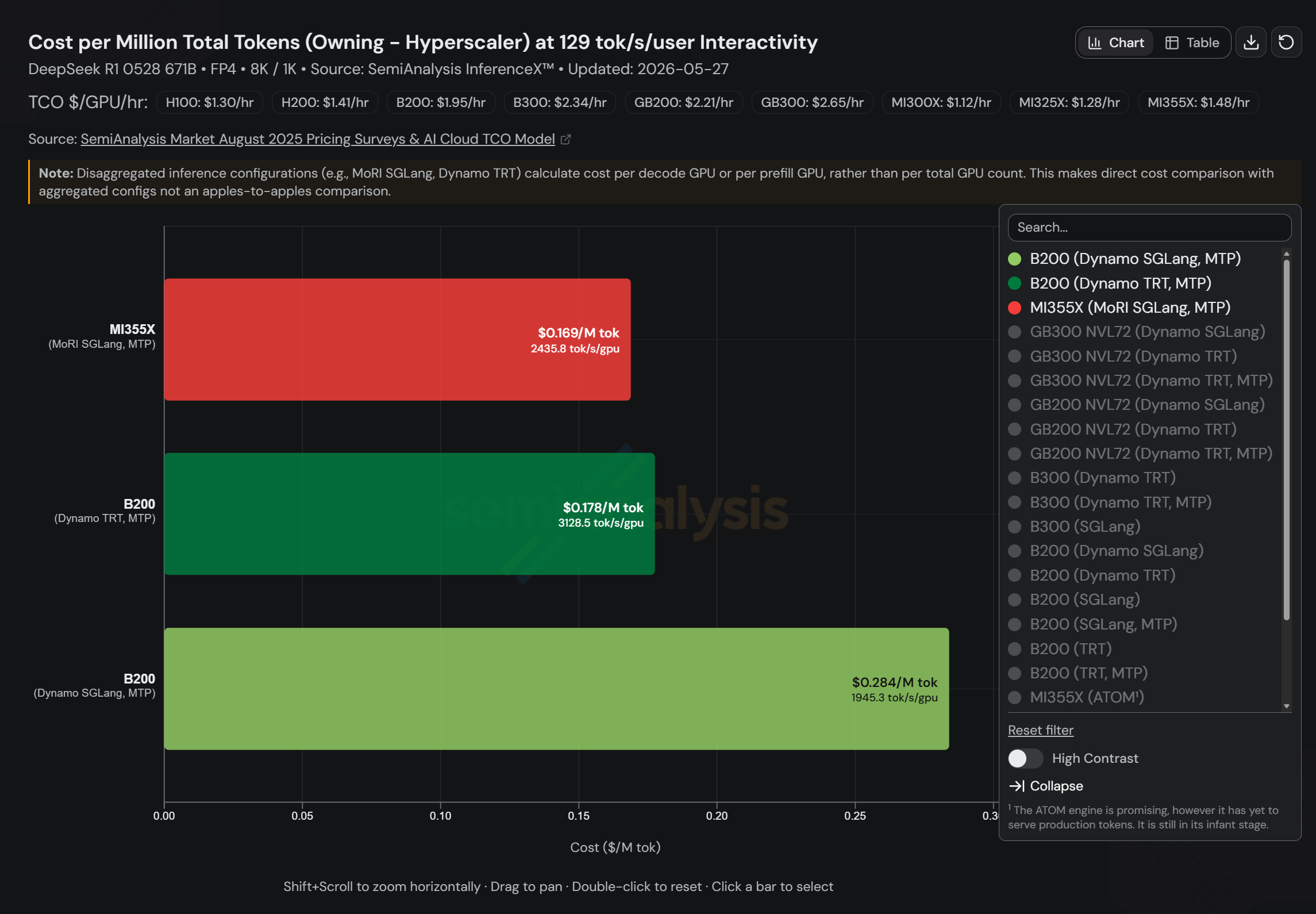
Executive Takeaways
- Total Cost of Ownership (TCO) Shift: AMD’s integration of the Instinct™ MI355X accelerator with SGLang and Mixture-of-Routing-Experts (MoRI) fundamentally alters enterprise AI capital allocation by slashing distributed inference costs.
- Architectural Breakthrough: MoRI overcomes traditional interconnect bottlenecks in massive Large Language Model (LLM) deployments, maximizing GPU utilization across multi-node clusters.
- Market Disruption: This technical milestone challenges NVIDIA's near-monopoly on high-performance inference infrastructure, directly impacting data center procurement strategies and corporate valuation multiples.
- Enterprise ROI: CTOs and Chief Financial Officers now have a viable, cost-competitive path to scale real-world generative AI systems without prohibitive infrastructure outlays.
The economics of artificial intelligence are undergoing a brutal, necessary reckoning. As enterprise adoption shifts from exploratory proof-of-concepts to heavy, mission-critical production workloads, the conversation in corporate boardrooms has pivoted sharply from raw model capability to infrastructure scalability and financial sustainability. For chief financial officers and chief technology officers alike, high-performance computing (HPC) budgets are no longer bottomless. The central dilemma facing modern enterprise architecture is clear: how to scale distributed inference for massive Large Language Models (LLMs) without compressing profit margins or inflating capital expenditure (CapEx).
Into this high-stakes environment steps Advanced Micro Devices (AMD) with a calculated, multi-layered counter-offensive. By pairing the high-density compute capabilities of the AMD Instinct™ MI355X accelerator with the optimized execution of SGLang and the innovative Mixture-of-Routing-Experts (MoRI) framework, AMD is targeting the holy grail of data center economics: uncompromising throughput paired with radical TCO reduction. This development is not merely an incremental hardware refresh; it represents a fundamental recalibration of cloud compute architecture designed to democratize high-end generative AI deployment.
The Inference Bottleneck: Why Traditional Distributed Systems Fail on Cost
To understand the magnitude of AMD’s engineering push, one must examine the current friction points in enterprise AI infrastructure. While training frontier models commands massive headline figures, inference—the act of running trained models in production to serve user queries—represents the lion's share of ongoing operational expenditure (OpEx). As model parameter counts scale into the hundreds of billions, fitting an entire LLM onto a single accelerator becomes physically impossible, necessitating distributed inference across sprawling multi-node clusters.
In distributed setups, inter-GPU communication bandwidth becomes the primary performance bottleneck. Latency spikes, memory fragmentation, and inefficient KV-cache management routinely hobble cluster efficiency, leaving expensive silicon idle while waiting for token generation or routing decisions. For enterprises managing strict Service Level Agreements (SLAs), these inefficiencies force over-provisioning. Companies buy more GPUs than mathematically required simply to absorb latency spikes, destroying enterprise ROI and bloating cloud compute bills.
Furthermore, the market dominance of legacy proprietary architectures has given rise to high vendor lock-in and steep pricing models. For procurement executives striving to optimize balance sheets and mitigate regulatory and supply chain risks, dependency on a single hardware supplier creates severe balance-sheet vulnerability. The market has been starved of a high-performance, cost-competitive alternative capable of handling enterprise-grade transformer architectures at scale.
Engineering the Shift: AMD Instinct™ MI355X Meets SGLang and MoRI
AMD’s strategic response centers on the synergistic deployment of the Instinct™ MI355X accelerator, the high-performance SGLang serving framework, and the Mixture-of-Routing-Experts (MoRI) optimization technique. Released to address the rigorous demands of modern generative AI, this triad attacks the root causes of inference inefficiency.
The AMD Instinct™ MI355X brings immense memory capacity and high-bandwidth memory (HBM) density to the table, allowing massive model weights to reside closer to the compute engine. However, hardware alone is insufficient. Software optimization is the true differentiator in modern AI infrastructure. SGLang—a structured generation language and serving framework—optimizes execution graphs and KV-cache reuse, dramatically reducing time-to-first-token and increasing token generation throughput per second per dollar.
The secret weapon in this stack is MoRI (Mixture-of-Routing-Experts). By intelligently managing how tokens are routed across distributed expert networks in advanced Mixture-of-Experts (MoE) architectures, MoRI minimizes unnecessary cross-node communication overhead. Instead of flooding the interconnect fabric with redundant data, MoRI dynamically predicts and directs computational workloads to the most optimal processing nodes. The result is near-linear scaling across cluster expansions, transforming what was once an unmanageable networking bottleneck into a streamlined, high-efficiency data pipeline.
| Metric / Parameter | Legacy Distributed Inference | AMD MI355X + SGLang + MoRI Stack | Enterprise Impact |
|---|---|---|---|
| Memory Bandwidth & Capacity | Frequent off-chip paging, high memory fragmentation | High HBM density, localized weight retention | Reduced hardware footprint per token served |
| Interconnect Overhead | High latency in multi-node MoE routing | Optimized dynamic routing via MoRI framework | Maximized GPU utilization, lower latency |
| Total Cost of Ownership (TCO) | High CapEx and bloated OpEx due to over-provisioning | Significant reduction in cost-per-query | Accelerated payback period on AI infrastructure |
| Ecosystem Openness | Proprietary software stacks with high lock-in | Open-standard support, robust SGLang integration | Enhanced procurement leverage and risk mitigation |
Industry and Market Implications: Who Wins, Who Loses
The commercial rollout of this hardware-software integration carries profound implications for global financial markets and the competitive landscape of semiconductor manufacturing. For enterprise buyers, the emergence of a viable, cost-competitive high-performance alternative shifts market liquidity and pricing power away from entrenched monopolies. Chief Information Officers can now enter vendor negotiations with genuine leverage, using AMD’s hardware-software stack as a benchmark to rein in runaway infrastructure costs.
The Winners: Enterprise consumers and cloud service providers (CSPs) emerge as primary beneficiaries. By lowering the marginal cost of intelligence, companies across financial services, healthcare, and retail can deploy sophisticated autonomous agents and real-time LLM applications without damaging quarterly operating margins. Furthermore, system integrators and open-source AI developers gain a robust, highly optimized platform that rewards algorithmic efficiency over brute-force hardware spending.
The Challengers: Incumbent hardware manufacturers, particularly NVIDIA, face a disciplined, aggressive challenger in the enterprise data center. While NVIDIA maintains a formidable moat in software maturity and proprietary developer ecosystems, AMD’s relentless push on open frameworks like SGLang and MoRI chips away at that defensive barrier. For Wall Street analysts tracking valuation multiples, this dynamic signals that gross margins in the AI accelerator market will face increasing competitive pressure as enterprise buyers demand cost-parity.
Frequently Asked Questions (People Also Ask)
What is the primary advantage of combining AMD Instinct™ MI355X with SGLang and MoRI?
The primary advantage is a dramatic reduction in the Total Cost of Ownership (TCO) for distributed AI inference. By pairing the high-density memory and compute of the MI355X with SGLang’s execution efficiency and MoRI’s intelligent expert-routing algorithms, organizations achieve significantly higher throughput and lower latency across multi-node clusters, minimizing hardware over-provisioning.
How does MoRI (Mixture-of-Routing-Experts) improve distributed LLM inference?
MoRI optimizes the communication overhead inherent in large Mixture-of-Experts (MoE) models. Instead of broadcasting token data indiscriminately across all nodes, MoRI intelligently predicts and directs computational workloads to the exact hardware units housing the relevant expert parameters, slashing interconnect congestion and boosting overall cluster utilization.
How does this development impact enterprise AI capital allocation and ROI?
By lowering the cost-per-query and maximizing token generation efficiency, enterprises can scale their generative AI deployments without expanding their infrastructure budgets linearly. This accelerates the return on investment (ROI) for enterprise AI projects, transforming generative models from high-cost experimental centers into profitable operational engines.
Is the AMD Instinct MI355X ecosystem compatible with existing enterprise software stacks?
Yes. AMD has heavily prioritized open software standards and deep integration with popular frameworks like SGLang and PyTorch. This ensures that enterprise engineering teams can migrate or deploy workloads onto AMD infrastructure with minimal friction, avoiding proprietary vendor lock-in.
Future Outlook: Milestones to Watch in Enterprise AI Infrastructure
As we look toward the horizon of enterprise technology deployment, the metric of success will no longer be measured solely by model parameter size or raw FLOPS, but by economic efficiency and operational resilience. The success of AMD’s MI355X paired with SGLang and MoRI marks a pivotal turning point in how data centers are architected for the age of autonomous agents and reasoning models.
Over the next twelve to eighteen months, market watchers and financial analysts should monitor three critical milestones:
- Tier-1 Cloud Adoption Rates: Track the speed at which major hyperscalers and tier-1 cloud providers incorporate MI355X clusters into their publicly available instance offerings for enterprise inference.
- MoE Scaling Benchmarks: Observe independent benchmarks testing MoRI against proprietary interconnect architectures in massive, multi-thousand node configurations running frontier-class MoE models.
- Enterprise Margin Impact: Evaluate corporate earnings reports from early-adopter enterprises to measure tangible reductions in cloud compute OpEx resulting from optimized TCO inference stacks.
Ultimately, AMD’s calculated push proves that the future of enterprise AI will not belong solely to the manufacturer with the highest-priced silicon, but to the ecosystem that delivers the lowest cost per reliable, intelligent token. For corporate leadership teams navigating capital allocation in an increasingly competitive global economy, that distinction is worth billions.