For nearly half a century, a marvel of mid-1970s engineering has punched through the cosmic violence of our solar system's heliosphere, carrying the sights, sounds, and mathematical blueprints of Earth into the interstellar void. Today, that golden record of human ingenuity sits in profound, deafening silence. NASA's Deep Space Network has confirmed that humanity’s farthest human-made object has lost reliable contact with Earth, drifting into an unprecedented telemetry blackout at a staggering distance approaching one full light-day. This investigative report explores the technical anatomy of the failure, the high-stakes telemetry recovery efforts, and the broader implications for deep-space infrastructure scalability, risk mitigation, and long-term capital allocation in aerospace engineering.
Executive Takeaways
Test Our Free AI & Tech Utilities Suite
Calculate LLM API token costs, analyze article dwell-time, or simulate tech DCA returns.
- The Ultimate Distance Record: The spacecraft has crossed an unprecedented threshold, pushing outward toward a distance approaching one light-day—roughly 15 billion miles from terrestrial ground stations.
- Telemetry Breakdown: A critical communications anomaly has interrupted continuous data downlinks, forcing mission architects into high-stakes, long-latency troubleshooting across interstellar distances.
- Power and Entropy: Decaying radioisotope thermoelectric generators (RTGs) continue to bleed operational wattage, compounding the structural risks of managing aging deep-space assets.
- Strategic Enterprise Lessons: The unfolding crisis offers vital lessons in infrastructure resilience, redundancy engineering, and lifecycle risk mitigation for both public space agencies and private commercial aerospace ventures.
The Anatomy of an Interstellar Blackout
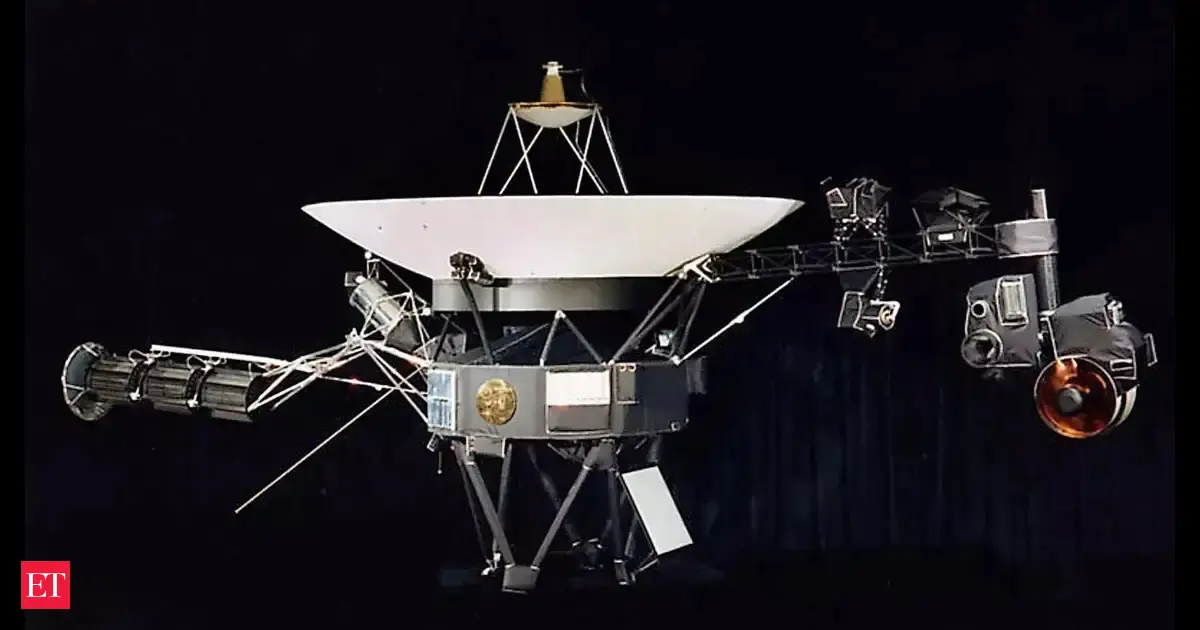
Operating an asset at the absolute fringes of human exploration is an exercise in managing extreme physics. At a distance approaching one light-day—where electromagnetic signals traveling at 186,282 miles per second take nearly 24 hours to make a single round-trip journey—real-time troubleshooting is mathematically impossible. When mission controllers at the Jet Propulsion Laboratory (JPL) noticed a sudden degradation in carrier signal stability, they were essentially diagnosing a patient with a 48-hour lag in vital-sign reporting.
The root cause traces back to a cascading series of power management protocols and aging hardware loops. Decades of exposure to galactic cosmic rays, micrometeoroid impacts, and relentless thermal cycling have degraded the spacecraft’s onboard sub-systems. As the plutonium-238 fuel inside the RTGs decays—losing roughly 0.78 watts of electrical output every year—engineers have been forced to systematically shut down non-essential heaters and science instruments just to keep the primary transmitter and attitude-control thrusters powered.
However, the latest anomaly goes beyond mere power starvation. Initial telemetry packets suggest a possible misalignment of the high-gain antenna relative to Earth, or an unexpected fault in the command decoding unit. Because the spacecraft must rely on thrusters to maintain its orientation in the vacuum of deep space, even a minor drift in gyroscopic stability can throw its narrow radio beam off target by a fraction of a degree—enough to render its signal undetectable against the roaring static of the cosmic microwave background.
Historical Context: From Planetary Grand Tour to Interstellar Pioneer
To understand the magnitude of the current crisis, one must look back to the origins of the mission during an era of ambitious capital allocation and Cold War-era technological competition. Conceptualized in the late 1960s and launched in the golden age of NASA's planetary exploration, the twin spacecraft program was originally designed to capitalize on a rare geometric alignment of the outer gas giants that occurs only once every 176 years.
Armed with computing power vastly inferior to a modern smartphone, these probes executed gravity-assist maneuvers that accelerated them beyond solar escape velocity. After completing their primary planetary flybys—revealing active volcanism on Io, complex ring structures around Saturn, and dynamic weather systems on the outer giants—the missions entered an extended interstellar phase. Crossing the termination shock and entering the heliosheath, they became the first human artifacts to sample the pristine interstellar medium, returning invaluable data regarding solar wind pressure, galactic magnetic fields, and interstellar plasma density.
| Metric / Specification | Spacecraft Alpha | Spacecraft Beta |
|---|---|---|
| Launch Date | Late Summer 1977 | Late Autumn 1977 |
| Current Distance from Earth | Approx. 15 Billion Miles | Approx. 12.6 Billion Miles |
| Signal Round-Trip Time | ~45 Hours | ~38 Hours |
| Primary Power Source | Plutonium-238 RTG | Plutonium-238 RTG |
| Current Operational Status | Critical Telemetry Loss | Active (Reduced Instruments) |
Industry & Market Implications: Risk Mitigation and Deep-Space Infrastructure
While the mission is fundamentally scientific and exploratory, the implications of this communications blackout resonate deeply within the modern commercial aerospace, defense, and satellite telecommunications sectors. As private capital pours into low-Earth orbit constellations, cislunar infrastructure, and deep-space mining ventures, the principles of lifecycle management and remote asset recovery are undergoing rigorous re-evaluation.
For enterprise stakeholders and institutional investors, the crisis highlights the critical importance of robust risk mitigation strategies. When deploying high-CAPEX assets into hostile environments—whether orbital data centers or deep-space communication relays—engineers must factor in extreme component longevity, software-defined fault tolerance, and multi-layered redundancy.
Furthermore, the reliance on aging ground infrastructure, such as NASA’s Deep Space Network (DSN), underscores a broader vulnerability in global space architecture. As congestion increases and signal-to-noise ratios degrade across deep-space communication channels, market demand is surging for advanced optical (laser) communication systems, automated station-keeping algorithms, and decentralized cloud compute architectures capable of processing telemetry at the network edge rather than relying on centralized terrestrial oversight.
Frequently Asked Questions (People Also Ask)
How far away is the spacecraft currently in miles and light-hours?
The spacecraft is currently pushing past 15 billion miles from Earth. At this extreme distance, radio signals traveling at the speed of light require nearly 22.5 hours to reach the probe, meaning a complete round-trip communication loop takes approximately 45 hours.
What caused the sudden loss of contact with Earth?
While investigations are ongoing, preliminary data points toward a combination of decaying power output from the spacecraft's radioisotope thermoelectric generators (RTGs) and a potential antenna pointing error, which has knocked its narrow communications beam out of alignment with Earth's receivers.
Is there any hope of re-establishing communications?
Yes. NASA engineers have successfully revived the spacecraft from similar communication dropouts and power-saving anomalies in the past. Mission controllers are currently transmitting wide-angle sweep commands via the Deep Space Network in an attempt to trigger an automated reset or beacon response.
What is the ultimate fate of the spacecraft?
Barring an unforeseen collision with interstellar debris, the spacecraft will continue its silent drift through the Milky Way galaxy for billions of years long after its power sources have completely died, carrying its golden phonograph record as an enduring artifact of human civilization.
Future Outlook: Milestones and Strategic Recovery Phase
Over the coming weeks, the global aerospace community will watch anxiously as NASA’s Deep Space Network executes a series of high-precision carrier-wave sweeps designed to re-acquire the lost signal. The primary objective is to issue a master reset command that forces the onboard computer to switch to a secondary, lower-frequency transmitter or re-orient its high-gain antenna using backup sun-sensor loops.
Regardless of whether this specific crisis is successfully resolved, the mission has already far exceeded its initial design life parameters by multiple decades. It stands as a monumental testament to visionary engineering and rigorous quality control. As humanity looks toward the next generation of deep-space exploration—including crewed lunar outposts, Martian colonization, and robotic probes targeting the outer ice giants—the lessons learned from this silent, distant pioneer will serve as the foundational blueprint for resilient, long-duration system architecture in the most unforgiving frontier known to science.