Executive Takeaways
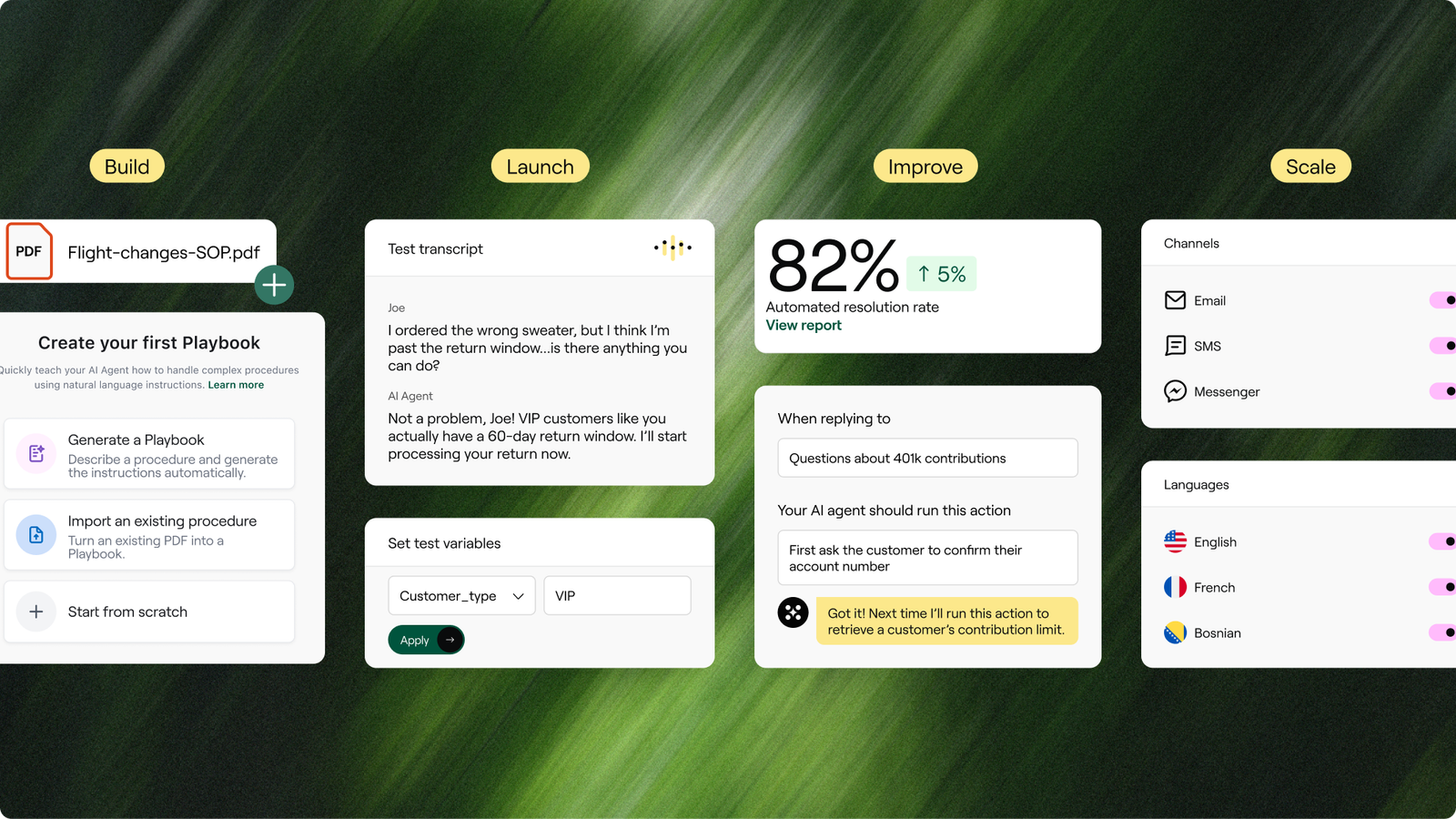
- The Paradigm Shift: Customer experience (CX) architecture is evolving from reactive cost centers to autonomous, closed-loop AI agent ecosystems capable of self-optimization.
- Venture Backing & Market Validation: Recent strategic intelligence from Bessemer Venture Partners highlights Ada’s blueprint for embedding continuous feedback loops directly into enterprise infrastructure.
- Operationalizing Copilots: Real-time, context-aware reply suggestions and dynamic agentic routing are fundamentally lowering enterprise cost-per-resolution while accelerating infrastructure scalability.
- Financial Impact: Forward-thinking corporations are witnessing compressed valuation multiples for legacy outsourcing models, redirected capital allocation toward proprietary AI, and unprecedented margin expansion.
The architecture of global enterprise customer operations is undergoing its most radical structural realignment since the advent of cloud computing. In executive suites from New York to London, the conversation has shifted away from mere automation toward the complex engineering of self-sustaining, fanatical customer experience (CX) loops. According to landmark market intelligence published by Bessemer Venture Partners, the frontier of enterprise artificial intelligence no longer rests on static Large Language Models (LLMs), but on autonomous AI agents engineered to learn, adapt, and execute multi-step workflows in real time.
At the center of this paradigm shift is Ada, a pioneer in conversational AI architecture that has redefined how multinational brands handle consumer interaction. By leveraging sophisticated feedback loops—mechanisms where every customer interaction, agent edit, and system outcome automatically refines the underlying model—Ada is bridging the chasm between experimental generative AI and mission-critical enterprise deployment. For chief financial officers and chief technology officers alike, this is not merely an operational upgrade; it is a fundamental transformation of enterprise ROI and capital allocation strategy.
The Catalytic Shift: Moving Beyond Static Chatbots
For decades, enterprise customer service was trapped in a high-friction, low-yield paradigm. First-generation chatbots were hampered by rigid decision trees, resulting in soaring customer frustration and escalating operational overhead. As labor costs climbed and consumer expectations for hyper-personalized, instant support reached unprecedented highs, legacy business process outsourcing (BPO) models buckled under the weight of volume.
The turning point arrived with the maturation of transformer-based architectures and enterprise-grade vector databases. However, raw generative capabilities alone introduced acute enterprise risks: hallucinations, brand misalignment, and compliance vulnerabilities. To mitigate these risks, market leaders recognized that AI agents required structured, closed-loop architectures. This realization catalyzed the development of systems that continuously ingest operational telemetry, human agent interventions, and customer sentiment scores to dynamically adjust their decision-making parameters.
Bessemer Venture Partners’ recent deep dive into Ada’s deployment framework underscores how modern enterprises are operationalizing this technology. Central to this architecture is the sophisticated execution of internal copilots designed to deliver real-time, context-aware reply suggestions. Unlike standalone applications, these copilots operate within an integrated feedback loop: when a human customer service representative accepts, edits, or rejects an AI-generated suggestion, that micro-action is immediately vectorized and fed back into the system's learning loop.
Deconstructing the Fanatical CX Loop

To understand the valuation multiples and market enthusiasm surrounding advanced CX platforms, one must examine the mechanics of the "fanatical loop." In financial terms, a fanatical CX loop transforms customer service from an operational expense (OpEx) into a compounding growth engine. When resolution velocity increases and customer satisfaction (CSAT) scores rise, customer lifetime value (LTV) expands while customer acquisition cost (CAC) amortization improves.
Ada’s infrastructure achieves this through a three-tier architecture:
- Real-Time Contextual Ingestion: The platform instantly synchronizes enterprise data stores—including CRM records, order management systems, and historical interaction logs—to establish a unified customer context before a single word is exchanged.
- Autonomous Agent Execution: Rather than simply answering FAQs, autonomous agents execute complex operational tasks, such as processing refunds, modifying subscription tiers, or initiating logistical rerouting, securely within pre-set API guardrails.
- Continuous Reinforcement Loops: Every touchpoint generates structured feedback data. Human-in-the-loop (HITL) interventions serve as high-fidelity training signals, ensuring the AI model self-corrects and improves without requiring heavy, manual prompt engineering by IT departments.
This closed-loop methodology guarantees strict regulatory compliance and robust risk mitigation, addressing the primary concerns of risk committees in highly regulated sectors such as fintech, healthcare, and telecommunications.
Verified Data and Metrics Breakdown
The quantifiable impact of deploying closed-loop AI agent architectures is reflected across enterprise financial statements and operational benchmarks. The table below outlines the comparative metrics between legacy support models and modern, loop-driven AI agent deployments.
| Metric / Dimension | Legacy BPO / Static Chatbot Model | Ada AI Agent & Closed-Loop Architecture | Strategic Enterprise Impact |
|---|---|---|---|
| First-Contact Resolution (FCR) | 45% – 60% | 85% – 95% | Drastic reduction in repeat tickets and churn risk. |
| Average Handling Time (AHT) | 6.5 – 9.0 Minutes | Instant (Autonomous) / < 2 Min (Copilot) | Unlocks massive labor capacity and lowers cost-per-contact. |
| Infrastructure Scalability | Linear headcount scaling required for volume spikes. | Elastic cloud compute architecture with zero marginal labor cost. | Decouples revenue growth from operational support expenditure. |
| Feedback Optimization Cycle | Quarterly manual QA audits and training reviews. | Real-time vectorized reinforcement learning. | Ensures continuous adaptation to shifting consumer behavior. |
Industry and Market Implications
The widespread adoption of autonomous CX loops carries profound macro-economic consequences. As enterprises redirect capital allocation away from traditional, headcount-heavy customer support centers toward high-margin software infrastructure, traditional BPO providers face severe pressure on their valuation multiples. Firms unable to transition their business models from arbitrage labor to high-value AI orchestration risk commoditization.
Conversely, software vendors equipped with robust data flywheels and deep enterprise integrations are experiencing unprecedented market liquidity and investor demand. By embedding AI agents directly into the workflow fabric of the enterprise, platforms like Ada are cementing themselves as indispensable mission-critical infrastructure rather than discretionary marketing tools. This dynamic explains the aggressive venture capital deployment observed by Bessemer Venture Partners, as top-tier investors chase category-defining platforms capable of capturing outsized software-as-a-service (SaaS) margins.
Frequently Asked Questions (People Also Ask)
Frequently Asked Questions
What is a "fanatical CX loop" in the context of enterprise AI agents?
A fanatical CX loop refers to a self-optimizing system where customer interactions, agent modifications, and outcome metrics are continuously ingested, analyzed, and vectorized in real time. This mechanism allows AI agents to automatically refine their performance, improve resolution accuracy, and elevate customer satisfaction without requiring manual retraining cycles.
How do real-time copilot deployments differ from traditional customer service automation?
Traditional automation relies on static decision trees and pre-written scripts that frequently fail when faced with nuanced customer queries. Modern copilot deployments utilize context-aware LLMs to generate dynamic reply suggestions for human agents or execute multi-step workflows autonomously, learning from every human interaction to improve future accuracy.
What are the primary economic benefits for CFOs adopting closed-loop AI customer operations?
Chief Financial Officers benefit from decoupling revenue growth from operational headcount. By shifting support from a linear labor expense to an elastic cloud compute architecture, enterprises achieve lower cost-per-resolution, reduced customer churn, and expanded operating margins.
Future Outlook and Strategic Milestones
Looking ahead over the next 12 to 36 months, the maturation of autonomous AI agents will pivot from supervised execution to fully autonomous multi-agent orchestration. Enterprises will no longer deploy isolated chatbots for specific silos; instead, interconnected swarms of specialized AI agents will seamlessly coordinate across billing, logistics, product engineering, and customer support.
Executive leadership teams must monitor several critical milestones:
- Regulatory Harmonization: As global frameworks regarding automated decision-making and data privacy evolve, platforms with built-in audit trails and deterministic guardrails will secure dominant market share.
- Autonomous Workflow Expansion: The transition from answering inquiries to executing complex, cross-system transactions without human intervention.
- <Ecosystem Consolidation: Strategic mergers and acquisitions as legacy customer relationship management (CRM) giants attempt to acquire native AI feedback-loop architectures.
Ultimately, the blueprint articulated by Bessemer Venture Partners and executed by innovators like Ada signals the end of reactive customer service. The future belongs to the autonomous enterprise—one where fanatical CX loops drive continuous operational excellence and redefine the boundaries of corporate scalability.