Executive Takeaways
- The Hardware Bottleneck: Accelerated parallel computing architectures have transitioned from niche data-center components to the primary determinant of enterprise ROI, infrastructure scalability, and sovereign technological capability.
- NVIDIA’s Moat: Beyond raw silicon compute power, NVIDIA's long-term market dominance is anchored by CUDA software lock-in, high-bandwidth memory (HBM) supply chain dominance, and entrenched cloud compute architecture.
- The Challenger Landscape: Over 30 specialized chip makers—spanning hyper-scaler custom ASICs, venture-backed neuromorphic startups, and legacy silicon giants—are aggressively targeting market share through specialized risk mitigation and custom inference efficiency.
For decades, the global semiconductor industry operated on predictable cyclicality, driven by consumer electronics, personal computing, and automotive demand. The arrival of large-scale generative artificial intelligence shattered that paradigm. Today, silicon is the new crude oil, and the race to design, manufacture, and deploy next-generation artificial intelligence accelerators has triggered the largest capital expenditure cycle in corporate history. At the center of this maelstrom sits NVIDIA Corporation, a company that executed one of the most lucrative strategic pivots in business history, transforming itself from a graphics card designer into the absolute gatekeeper of global intelligence.
Yet, a monopoly breeds urgent competition. As venture capitalists, sovereign wealth funds, and hyperscale cloud providers pour hundreds of billions of dollars into infrastructure scalability, more than 30 dedicated AI chip makers are racing to break NVIDIA's stranglehold. From custom Application-Specific Integrated Circuits (ASICs) engineered by Big Tech to venture-backed neuromorphic architectures, the semiconductor battlefield is expanding. For institutional investors, chief technology officers, and policy-makers, understanding this fragmented, high-stakes ecosystem is essential for navigating market liquidity, supply chain risk mitigation, and the future of enterprise software valuation multiples.
The Genesis of the Parallel Computing Revolution
The structural shift toward AI accelerators began when traditional Central Processing Units (CPUs) hit physical and architectural limits. While CPUs are designed for sequential processing—handling complex, multi-step instructions one after another—artificial intelligence workloads require massive parallel processing. Training deep neural networks involves trillions of matrix multiplications executed simultaneously. Graphics Processing Units (GPUs), originally engineered to render pixel data for video games, proved uniquely suited for these concurrent mathematical operations.
NVIDIA recognized this paradigm shift early. In 2006, the company launched CUDA (Compute Unified Device Architecture), a software platform that allowed developers to program GPUs for general-purpose parallel computing. At the time, Wall Street questioned the capital allocation, viewing CUDA as an expensive, speculative R&D exercise with limited immediate enterprise ROI. That early bet created an insurmountable economic moat. Today, millions of developers are trained on CUDA, making enterprise migration to competing hardware frameworks practically prohibitive.
However, as foundational models scale into hundreds of billions of parameters, the constraints of power consumption, memory bandwidth, and thermal dissipation have become acute. This technical bottleneck has opened the door for a diverse array of competitors, each attempting to capture segments of the training and inference value chain.
Mapping the Competitive Landscape: NVIDIA vs. The 30+ Challenger Ecosystem
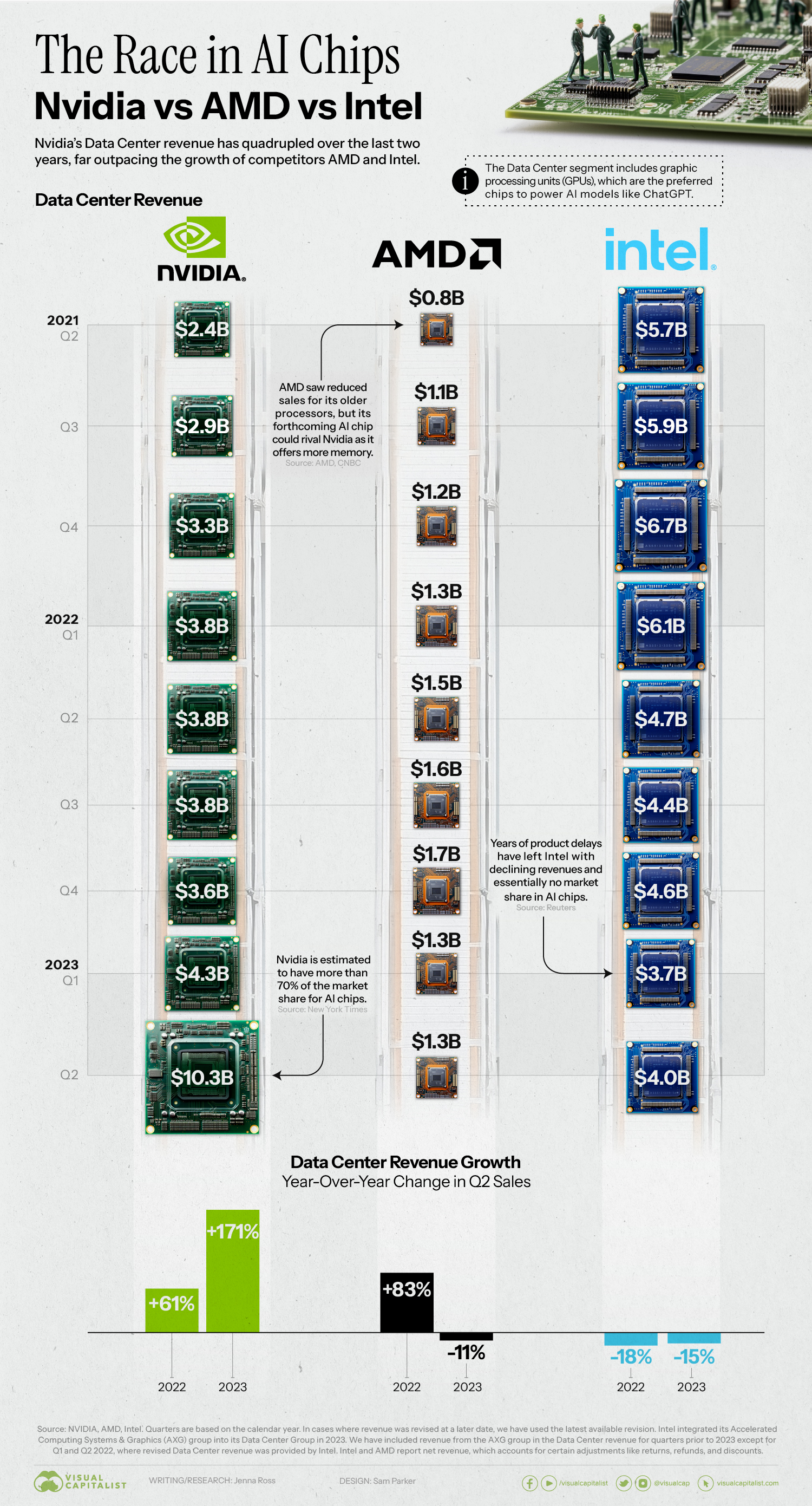
The modern AI chip market is no longer a binary choice between NVIDIA and legacy CPU manufacturers. It is a deeply stratified ecosystem divided into three distinct tiers: hyper-scaler custom silicon initiatives, legacy semiconductor giants, and pure-play AI silicon startups.
1. The Hyperscaler In-House Threat (ASICs)
The world's largest technology conglomerates—Alphabet (Google), Amazon (AWS), Microsoft, and Meta Platforms—are collectively spending hundreds of billions annually on data center infrastructure. To mitigate margin compression caused by heavy reliance on NVIDIA's high-margin GPUs, these enterprises have accelerated internal capital expenditure on custom ASICs tailored to their specific proprietary workloads.
- Google TPU (Tensor Processing Unit): A pioneer in custom AI silicon, Google’s TPUs power internal workloads like Gemini and are increasingly rented out via Google Cloud Platform to external enterprise clients seeking cost-effective inference solutions.
- Amazon Trainium and Inferentia: Designed specifically to optimize training and inference costs for AWS-hosted machine learning models, offering direct pricing pressure on traditional GPU deployments.
- Meta Training and Inference Accelerator (MTIA): Tailored specifically to handle Meta's massive recommendation systems and generative AI content delivery algorithms.
2. Legacy Silicon Giants
Traditional semiconductor heavyweights watched NVIDIA capture the generative AI boom but are aggressively utilizing their massive manufacturing partnerships and balance sheets to claw back market share.
- Advanced Micro Devices (AMD): AMD has positioned its MI300 series as the primary merchant-silicon alternative to NVIDIA's H100 and Blackwell architectures. Backed by expanding software ecosystems like ROCm, AMD is winning significant enterprise validation among cloud providers seeking dual-vendor risk mitigation strategies.
- Intel Corporation: Despite historic execution missteps, Intel is leveraging its Gaudi accelerator line and foundry services (Intel Foundry) to position itself as a trusted domestic and enterprise hardware alternative, emphasizing open-standard software ecosystems.
3. Venture-Backed Pure-Play Innovators
A new wave of well-funded startups is challenging the very physics of computing architecture, targeting extreme efficiency in inference and specialized neuromorphic processing.
- Cerebras Systems: Famous for engineering the Wafer-Scale Engine, a chip the size of an entire silicon wafer, designed to eliminate inter-chip communication bottlenecks for massive model training.
- Groq: Pioneering the Language Processing Unit (LPU), focusing entirely on deterministic, ultra-low-latency inference execution for large language models.
- SambaNova Systems and Graphcore: Developing dataflow architectures and intelligence processing units (IPUs) designed to keep entire models within on-chip memory.
Verified Market Metrics and Architectural Breakdown
To evaluate the operational realities of these competing silicon strategies, institutional stakeholders must analyze the core metrics governing enterprise deployment, capital expenditure, and performance scalability.
| Vendor / Architecture | Primary Focus | Key Competitive Advantage | Primary Enterprise Bottleneck |
|---|---|---|---|
| NVIDIA (Blackwell / H-Series) | Training & High-End Inference | CUDA ecosystem, unmatched interconnect bandwidth, HBM dominance. | High valuation multiples, supply chain lead times, cooling requirements. |
| AMD (Instinct MI300 Series) | Training & Enterprise Inference | Competitive memory capacity, multi-vendor risk mitigation pricing. | Software maturity (ROCm adoption curve vs. CUDA). |
| Hyperscale ASICs (Google, AWS, Meta) | Dedicated Workload Inference | Optimized total cost of ownership (TCO) for proprietary applications. | Lack of general-purpose flexibility; locked to specific cloud platforms. |
| Specialized Startups (Groq, Cerebras) | Ultra-Low-Latency Inference / Wafer-Scale | Extreme speed for specific inference tasks; eliminated memory walls. | Manufacturing yield risks, enterprise trust, lack of robust software tooling. |
Industry & Market Implications: Winners, Losers, and Macroeconomics
The macroeconomic ramifications of the AI chip race extend far beyond the technology sector, directly impacting global trade, national security, and corporate financial health.
Who Wins
Foundry operators—most notably Taiwan Semiconductor Manufacturing Company (TSMC)—sit at the apex of the value chain. Regardless of which fabless chip designer wins enterprise market share, nearly all high-end AI accelerators require TSMC’s advanced node packaging and lithography. Furthermore, enterprise software providers that successfully integrate multi-chip support layers will capture significant enterprise ROI by avoiding vendor lock-in and negotiating lower cloud compute architectures.
Who Loses
Legacy enterprise hardware vendors slow to transition their server portfolios face severe margin compression. Additionally, smaller cloud service providers (CSPs) that lack the balance sheet to secure high-allocation quotas of top-tier AI chips risk structural irrelevance in an enterprise market demanding immediate generative AI deployment capabilities. Regulatory compliance pressures and export controls further complicate market liquidity for firms overly reliant on geopolitical flashpoints.
Frequently Asked Questions (People Also Ask)
Why is NVIDIA considered the dominant force in AI chips if there are 30+ competitors?
NVIDIA’s dominance is not merely a function of hardware raw performance; it is anchored by its proprietary CUDA software ecosystem developed over nearly two decades. Millions of machine learning engineers, researchers, and enterprise software stacks are built natively on CUDA. Replicating this comprehensive developer ecosystem presents an immense barrier to entry for hardware-only competitors.
What is the difference between AI training and AI inference chips?
AI training chips are engineered to process massive datasets to teach neural networks complex patterns, requiring colossal parallel compute capacity and high-bandwidth memory (e.g., NVIDIA H100 or Blackwell). AI inference chips are optimized to execute trained models in real-world applications (e.g., responding to a user prompt in ChatGPT), where metrics like latency, power efficiency, and cost per query are paramount.
Are hyperscale custom ASICs replacing merchant GPUs entirely?
No. While tech giants like Google, Amazon, and Meta deploy custom ASICs to optimize specific, predictable internal workloads and reduce infrastructure costs, merchant GPUs (like those from NVIDIA and AMD) remain the gold standard for general-purpose research, dynamic model development, and enterprises requiring maximum architectural flexibility.
How do geopolitical tensions and export controls impact the AI chip market?
Geopolitical friction—particularly concerning semiconductor supply chains in East Asia and trade restrictions on advanced chip exports to emerging markets—has forced a massive restructuring of capital allocation. Chip makers are aggressively diversifying manufacturing locations, while enterprise buyers build geographic risk mitigation strategies directly into their infrastructure scalability plans.
Future Outlook: Milestones to Watch
As the AI chip market matures over the next 24 to 36 months, several critical inflection points will dictate corporate valuations and industry leadership:
- Software Ecosystem Convergence: Watch for enterprise adoption rates of open-source compilation frameworks (such as MLIR and Triton) that aim to break NVIDIA's CUDA software lock-in and simplify multi-vendor hardware deployment.
- Advanced Packaging and HBM Supply Constraints: The transition to 3D chip stacking and the availability of High Bandwidth Memory will remain the ultimate bottleneck for production volume across all manufacturers.
- Return on Investment (ROI) Realities: As enterprises scrutinize the capital expenditure poured into data center infrastructure, demand will increasingly pivot toward specialized, highly cost-effective inference chips over expensive training monoliths.
Ultimately, while NVIDIA currently commands the silicon high ground, the sheer scale of the global AI transformation ensures a fiercely competitive, multi-polar semiconductor ecosystem for the foreseeable future.
![ChatGPT, Claude, Grok Down 90 Min as Azure Fails [2026]](https://shattered.io/wp-content/uploads/2026/09/chatgpt-claude-grok-outage-azure-2026-1.webp)