The Ultimate AI Model Showdown: Inside the Battle for Enterprise Dominance, Infrastructure Scalability, and ROI
Executive Takeaways
- Frontier Model Divergence: OpenAI’s GPT-5.2, Anthropic’s Claude Opus 4.6, and Google’s Gemini 3 Pro have transitioned from general conversational chat interfaces to specialized enterprise autonomous reasoning engines.
- Cost vs. Inference Efficiency: The emergence of ultra-low-cost reasoning models like DeepSeek-R1 has compressed profit margins for legacy API providers, triggering a valuation and pricing war across cloud compute architecture.
- The Open-Weights Disruptor: Meta’s aggressive open-weights strategy is capturing substantial market share among Fortune 500 CISOs prioritizing data sovereignty and risk mitigation over proprietary cloud lock-in.
- Capital Allocation Shifts: Enterprise procurement committees are increasingly deploying multi-model routing systems—such as FastRouter architecture—to optimize cost-per-token ratios and guarantee high availability.
Introduction: The New Frontier of Generative AI Economics
The global artificial intelligence market has entered a volatile phase of commercial maturation. As corporations transition past exploratory proof-of-concept deployments, executive boards face a high-stakes capital allocation puzzle: selecting the optimal foundational large language model (LLM) to drive enterprise ROI without exposing the firm to unsustainable cloud compute bills or systemic security vulnerabilities. According to recent market intelligence data compiled in March 2026, the competitive landscape is no longer defined by raw parameter counts or generic benchmarks. Instead, enterprise adoption hinges on nuanced trade-offs involving autonomous reasoning depth, token generation speed, regulatory compliance, and granular infrastructure scalability.
At the center of this paradigm shift are industry flagships including OpenAI’s GPT-5.2, Anthropic’s Claude Opus 4.6, Google’s Gemini 3 Pro, and the disruptive reasoning-focused DeepSeek-R1. Simultaneously, Meta’s latest open-weights models are rewriting the rules of infrastructure ownership, enabling enterprises to host powerful models on-premise or within private sovereign clouds. For Wall Street analysts and enterprise Chief Information Officers (CIOs), understanding these distinctions is paramount to forecasting technology budgets and assessing market liquidity across the semiconductor and cloud hosting sectors.
Deconstructing the Titans: Capabilities, Latency, and Reasoning

To evaluate the true economic and operational impact of today’s leading AI models, analysts must dissect how they perform across distinct enterprise use cases—ranging from automated software engineering and complex financial auditing to real-time customer support orchestration.
OpenAI’s GPT-5.2: The Enterprise Heavyweight
OpenAI’s flagship GPT-5.2 represents an evolutionary leap in multi-modal synthesis and agentic workflow execution. Designed to operate with minimal human intervention, GPT-5.2 excels in complex software development pipelines and multi-step financial modeling. However, its sophisticated neural architecture demands substantial computational overhead, translating into higher API costs. For Wall Street financial institutions and tier-1 management consultancies, the model's unparalleled accuracy and deep integration ecosystems justify the premium, provided the deployment generates measurable productivity gains that offset the capital expenditure.
Anthropic’s Claude Opus 4.6: Nuance, Context, and Governance
Anthropic has solidified its position as the darling of enterprise legal, compliance, and risk mitigation departments with Claude Opus 4.6. Renowned for its massive context window and adherence to constitutional AI guardrails, Opus 4.6 minimizes hallucinations when parsing dense regulatory filings, M&A due diligence documents, and proprietary codebase repositories. Its editorial tone and nuanced reasoning make it the preferred model for tasks requiring rigorous fact-checking and precise data extraction.
Google’s Gemini 3 Pro: Native Multimodality and Cloud Synergy
Google’s Gemini 3 Pro leverages the tech giant's vertically integrated Tensor Processing Unit (TPU) infrastructure to deliver lightning-fast token generation speeds alongside natively multi-modal capabilities. Gemini 3 Pro processes hours of high-definition video, complex audio streams, and massive datasets concurrently. For enterprises deeply embedded within the Google Cloud Platform (GCP) ecosystem, Gemini offers seamless data governance, low latency, and competitive enterprise volume discounting.
DeepSeek-R1 & Meta’s Open-Weights: The Cost-Compression Disrupters
The emergence of DeepSeek-R1 fundamentally destabilized the pricing models of Western proprietary AI labs by demonstrating that state-of-the-art reasoning capabilities could be achieved at a fraction of traditional training and inference costs. Concurrently, Meta’s open-weights models continue to dominate open-source deployments. By offering unencumbered access to model weights, Meta empowers enterprises to build custom fine-tuned variations on private infrastructure, effectively eliminating recurring API subscription fees and mitigating strict data residency concerns.
Verified Data & Specifications Breakdown
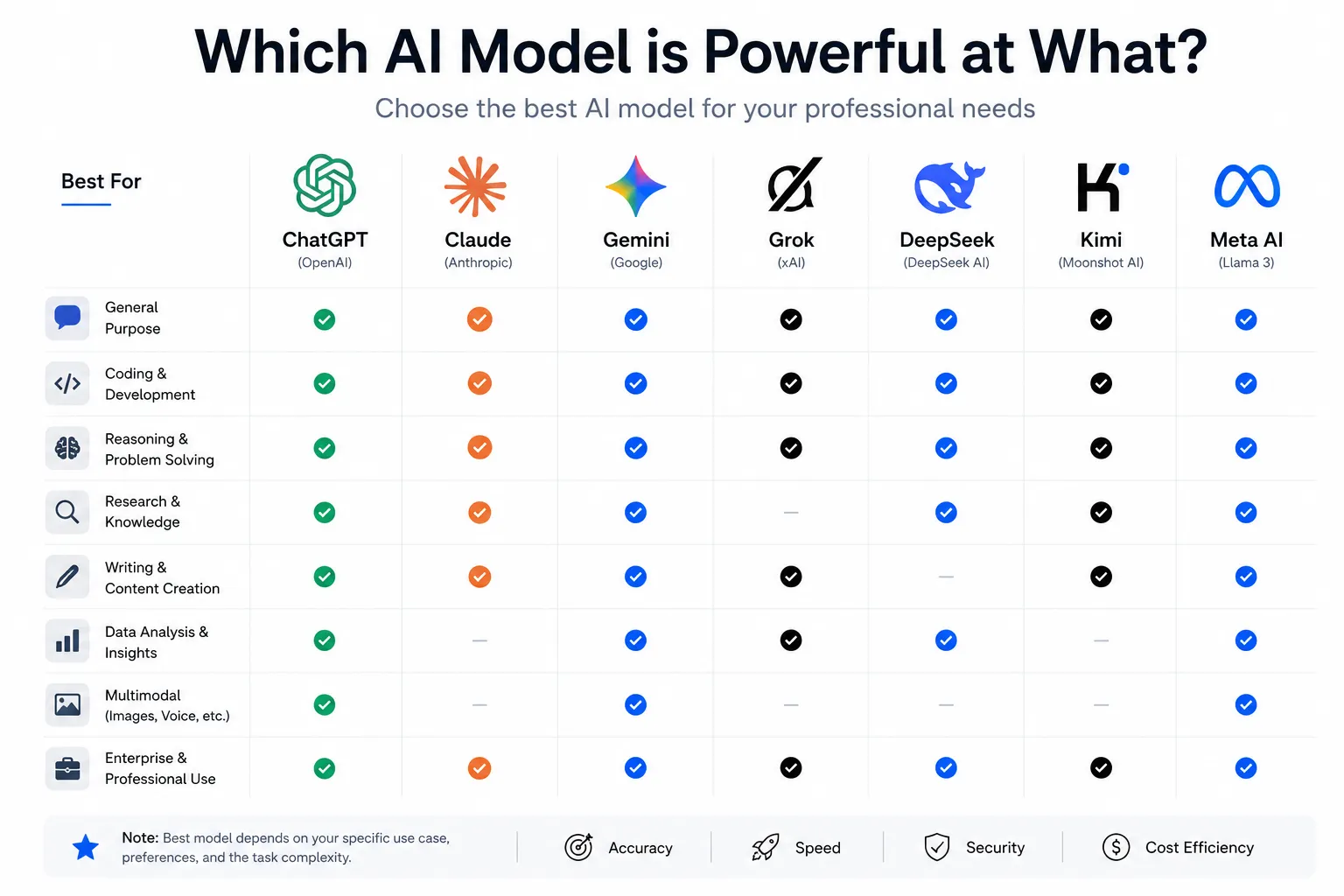
The following comparative matrix synthesizes core operational metrics across the dominant AI models currently driving enterprise IT procurement decisions in 2026:
| Model Name | Primary Developer | Architecture Type | Context Window | Inference Cost Profile | Primary Enterprise Strengths |
|---|---|---|---|---|---|
| GPT-5.2 | OpenAI / Microsoft | Proprietary / Hybrid | Ultra-Wide (512k+ tokens) | Premium / High-Tier | Autonomous agentic workflows, complex coding, ecosystem integration. |
| Claude Opus 4.6 | Anthropic | Proprietary Frontier | Massive Context (1M+ tokens) | Mid-to-High Tier | Legal analysis, risk compliance, nuanced technical document review. |
| Gemini 3 Pro | Proprietary / TPU Optimized | Native Multimodal (2M+ tokens) | Competitive Volume Pricing | Video/audio ingestion, GCP integration, low-latency processing. | |
| DeepSeek-R1 | DeepSeek | Reasoning-Optimized / Mixture of Experts | Standard Enterprise Scale | Disruptively Low (Cost-Compressed) | Advanced mathematical reasoning, budget-constrained API pipelines. |
| Meta Open-Weights Lineup | Meta AI | Open-Weights / Transformer | Varies by Model Scale | Infrastructure Cost Only (Self-Hosted) | Data sovereignty, custom fine-tuning, zero vendor lock-in. |
Industry & Market Implications: Winners, Losers, and Financial Restructuring
The rapid commoditization of foundational intelligence is triggering profound economic realignments across the technology sector. As inference costs plummet due to architectural efficiencies pioneered by models like DeepSeek-R1 and optimized hardware deployment, legacy software-as-a-service (SaaS) business models face an existential reckoning. Enterprises are increasingly questioning why they should pay exorbitant per-seat SaaS licensing fees when they can orchestrate custom workflows using open-weights models hosted on proprietary cloud infrastructure.
Furthermore, cloud compute architecture providers are shifting their capital allocation strategies toward specialized multi-model routing infrastructure—often referred to in enterprise tech circles as FastRouter systems. These intelligent routers dynamically direct user queries to the most cost-effective and capable model in real-time, optimizing enterprise IT expenditure.
- The Winners: Cloud providers with flexible multi-model orchestration tools, enterprises adopting hybrid open-weights/proprietary strategies, and semiconductor manufacturers powering high-efficiency inference silicon.
- The Vulnerable: Single-vendor proprietary AI startups lacking unique proprietary datasets or specialized workflow moats, as well as legacy SaaS incumbents slow to integrate native generative capabilities.
Frequently Asked Questions (People Also Ask)
How do proprietary models like GPT-5.2 and Claude Opus 4.6 compare to open-weights models?
Proprietary models generally offer turnkey deployment, cutting-edge multi-modal reasoning out-of-the-box, and managed security updates backed by major tech firms. Open-weights models, conversely, provide absolute data sovereignty, custom fine-tuning capabilities, and lower long-term variable costs for high-volume enterprise users willing to manage their own cloud compute infrastructure.
What is a FastRouter architecture and why is it critical for enterprise AI spending?
A FastRouter is an intelligent orchestration layer that analyzes incoming user prompts and automatically directs them to the most efficient and cost-effective AI model available. For example, simple summarization tasks are routed to low-cost models like DeepSeek-R1 or smaller open-weights variants, while complex strategic reasoning tasks are directed to flagship models like GPT-5.2 or Claude Opus 4.6, dramatically optimizing overall enterprise ROI.
How are regulatory compliance and data privacy influencing enterprise model selection?
Data privacy regulations (such as GDPR in Europe and evolving domestic AI frameworks) require strict governance over how corporate data is ingested and retained. Financial institutions and healthcare providers often favor self-hosted open-weights models or enterprise-grade cloud agreements that guarantee zero data retention for training purposes, heavily favoring platforms like Claude Opus 4.6 and private Meta deployments.
Future Outlook: Strategic Milestones to Watch
As we look toward the remainder of 2026 and into 2027, the battleground for AI supremacy will shift decisively from raw model scaling to agentic autonomy, edge computing efficiency, and hardware-software co-design. Key milestones for institutional investors and technology leaders to monitor include:
- Autonomous Agent Standardization: The widespread adoption of standardized protocols allowing multi-vendor AI models to securely collaborate on complex, multi-day enterprise projects.
- Edge Inference Breakthroughs: The scaling of highly compressed reasoning models capable of running locally on enterprise edge hardware, drastically reducing cloud dependency.
- Regulatory Consolidation: Legislative developments regarding liability in autonomous AI decision-making, which will dictate enterprise risk mitigation frameworks across global markets.
Reporting contributed by the Technology & Financial Markets investigative desk from New York, London, and San Francisco.