Executive Takeaways
- The Intel Read-Through: Intel Corporation’s latest operational updates and margin compression highlight aggressive price-discounting strategies in x86 data center servers and ongoing weakness in traditional enterprise non-AI server hardware spend.
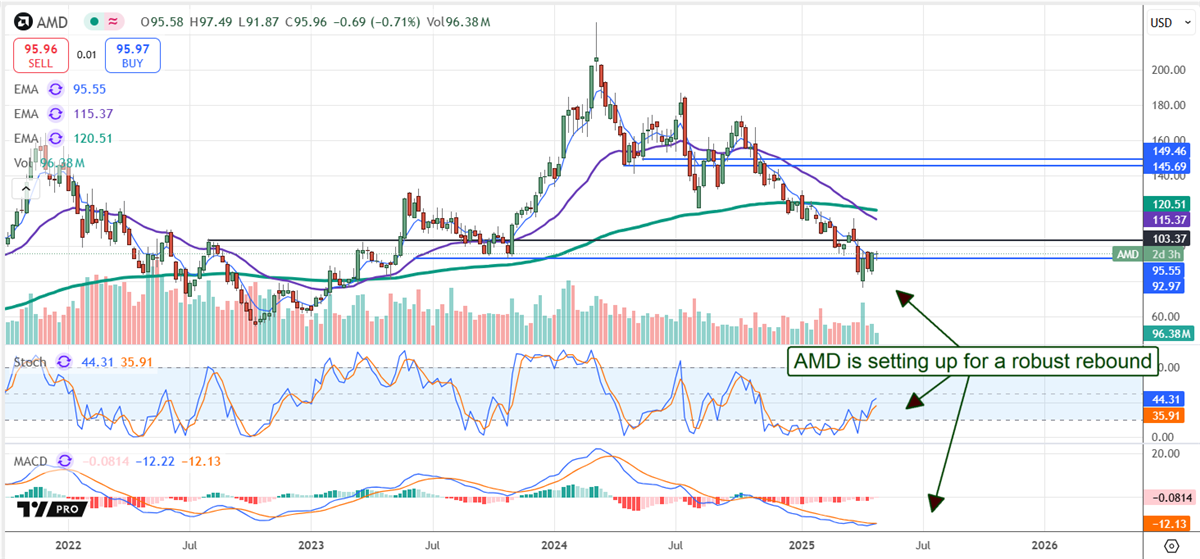
- Valuation Compression Risks: Advanced Micro Devices, Inc. (NASDAQ: AMD) enters the early November earnings window trading at elevated valuation multiples, leaving little margin for error if data center gross margins or chiplet yield ramps fall short of street estimates.
- Architectural Clash: While AMD’s EPYC "Turin" (Zen 5) architecture maintains structural Total Cost of Ownership (TCO) advantages, Intel’s launch of Xeon "Granite Rapids" represents its most competitive enterprise compute platform in five years, threatening AMD's market-share expansion momentum.
- Tactical Capital Allocation: Wall Street institutional desks are increasingly recommending risk-mitigation strategies—including partial profit booking or collateralized hedging—prior to Nov. 3 as option-implied volatility spikes across semiconductor equities.
The Intel Warning Shot: Why Gelsinger’s Margin Squeeze Threatens Lisa Su’s Momentum
Test Our Free AI & Tech Utilities Suite
Calculate LLM API token costs, analyze article dwell-time, or simulate tech DCA returns.
For the past three years, the narrative governing semiconductor capital allocation has been exceptionally straightforward: AMD, helmed by Chief Executive Officer Dr. Lisa Su, was systematically eroding Intel Corporation’s structural dominance in enterprise server rooms and cloud infrastructure. Driven by Taiwan Semiconductor Manufacturing Co.’s (TSMC) superior process nodes and AMD’s modular chiplet architecture, AMD’s EPYC product family captured significant x86 data center server market share from Intel’s legacy Xeon line.
However, recent market signals and Intel’s earnings disclosures have sent a clear distress flare across institutional trading desks. Intel Chief Executive Officer Pat Gelsinger’s strategic pivot—marked by aggressive pricing write-downs, inventory restructurings, and heavy capital expenditures under its IDM 2.0 blueprint—serves as a structural warning shot for AMD equity holders ahead of the critical early November earnings window.
The primary concern is not merely competitive parity, but the broader health of traditional enterprise server budgets. While cloud service providers (CSPs) like Microsoft Azure, Amazon Web Services (AWS), and Google Cloud Platform (GCP) continue to deploy tens of billions of dollars toward artificial intelligence accelerators, legacy non-AI enterprise server spend is experiencing a prolonged digestion period. Intel’s margin headwinds underscore a harsh reality: to defend its remaining market footprint, Intel is sacrificing gross margins by heavily discounting its Xeon processors, creating severe pricing pressure that could constrain AMD’s data center revenue expansion.
The x86 Enterprise Battleground: Granite Rapids Meets Zen 5 Turin

To fully grasp the financial risks facing AMD investors, one must analyze the shifting technological equilibrium within cloud compute architecture. AMD’s structural earnings engine has relied on its EPYC platform, which consistently delivered superior core density, power efficiency, and lower Total Cost of Ownership (TCO) compared to Intel’s delayed Sapphire Rapids and Emerald Rapids architectures.
That dynamic is shifting. Intel’s deployment of its Xeon 6 processor family—specifically the performance-core (P-core) "Granite Rapids" architecture built on the Intel 3 process node—represents the chipmaker’s first competitive threat to AMD’s dominance in half a decade. Granite Rapids dramatically closes the memory bandwidth gap by supporting ultra-fast MRDIMMs and offers high core counts designed to directly challenge AMD’s flagship EPYC 9005 series ("Turin").
If Intel aggressively undercuts AMD on price per core to regain lost enterprise share, AMD’s historical ability to expand consolidated gross margins above 50% faces direct headwinds. When an industry incumbent with massive global fab capacity decides to prioritize market share preservation over short-term operating margins, the entire ecosystem experiences margin compression.
Hyperscale CapEx vs. Enterprise Hardware Digestion
A critical divergence in capital allocation is taking place across global enterprise IT landscape:
- Hyperscaler AI Infrastructure: Capital allocation remains concentrated in massively scalable graphics processing units (GPUs) and specialized AI accelerators, such as Nvidia’s Blackwell architecture and AMD’s Instinct MI300X series.
- Traditional Server Enterprise Compute: Fortune 500 Chief Information Officers (CIOs) are extending refresh cycles for standard x86 servers to free up capital for high-eCPM enterprise AI pilot projects.
- The Read-Through for AMD: While AMD’s MI300X is generating billions in new revenue, its high valuation multiplier assumes simultaneous market share gains in both AI training/inference hardware *and* high-margin standard x86 server sockets. If non-AI enterprise server growth stalls, AMD’s core revenue driver could decelerate faster than consensus models anticipate.
Verified Data & Metrics Breakdown: Financial & Operating Comparison
The following comparative matrix outlines key operational, financial, and valuation metrics for AMD and Intel heading into the Q3/Q4 earnings cycle:
| Metric / Performance Indicator | AMD (Advanced Micro Devices) | Intel Corporation | Market & Investment Implication |
|---|---|---|---|
| Forward Price-to-Earnings (P/E) | ~30.0x - 42.0x (Elevated) | ~85.0x - N/A (Restructuring) | AMD carries a significant premium; any top-line missed expectation invites immediate multiple contraction. |
| Consolidated Gross Margin (Q2/Q3 Trailing) | ~49% - 53% (Non-GAAP) | ~35% - 38% (GAAP Compressed) | Intel's margin collapse reflects aggressive pricing strategies to retain server socket share. |
| Server Compute Architecture Flagship | EPYC 9005 Series ("Turin" Zen 5) | Xeon 6 ("Granite Rapids" / Intel 3) | Intel has closed the performance-per-watt gap, creating pricing friction for AMD. |
| AI Accelerator Revenue Guidance | ~$4.5B - $5.0B+ (Instinct MI300X) | ~$500M+ (Gaudi 3 Pipeline) | AMD leads in alternative AI silicon, but market expectations leave zero room for delivery delays. |
| Enterprise Budget Sensitivity | High (Depends on x86 Market Share Gains) | Very High (Exposed to Traditional IT Drag) | Enterprise server digestion impacts both firms, but AMD's elevated enterprise valuation exposes it to greater downside volatility. |
Macro Capital Allocation & Enterprise Compute Dynamics
Institutional portfolio managers assessing market liquidity ahead of Nov. 3 are looking closely at the semiconductor supply chain. AMD's operational model relies heavily on TSMC's sub-4nm leading-edge wafer allocation. While this fabless model shields AMD from the billions in ongoing capital expenditures required to build front-end semiconductor foundries, it also subjects AMD to high wafer costs and constrained advanced packaging capacity (CoWoS).
Conversely, Intel's heavy investment in its internal foundry services (IFS) has severely penalized its near-term cash flow and return on invested capital (ROIC). Yet, Gelsinger’s willingness to operate at near-zero operating margins in certain client and server divisions to burn off inventory has created a volatile pricing environment. For AMD, maintaining high gross margins while contending with Intel's aggressive pricing tactics requires flawless execution in high-margin enterprise data center wins.
Furthermore, cloud compute architecture is shifting toward custom, arm-based silicon designed by hyperscalers themselves—such as AWS Graviton, Google Axion, and Microsoft Cobalt. This internal silicon substitution poses a long-term structural threat to the entire x86 addressable market, impacting both AMD and Intel.
Tactical Strategy for Nov. 3: Profit Booking vs. Long-Term Thesis
Why is the early November timeframe so crucial for AMD investors? The convergence of third-quarter corporate earnings releases, macroeconomic data, corporate debt refinancings, and shifting option implied volatility creates a high-beta trading environment around Nov. 3.
Trading desks note that AMD stock has developed a high implied volatility skew leading into earnings releases. Historically, when high-growth semiconductor equities trade at elevated Price-to-Sales (P/S) and Forward P/E multiples during periods of mixed macro enterprise spending, even a minor guidance adjustment trigger swift, institutional-led selling.
Risk Mitigation Strategies for Portfolios
- Trimming Overhead Exposure: Investors holding positions accumulated at lower cost bases may consider taking partial profits to lock in capital gains, reallocating proceeds into lower-beta enterprise software or short-term liquidity instruments.
- Options Collar Construction: Institutional desks frequently utilize collar strategies—purchasing out-of-the-money protective puts financed by writing out-of-the-money covered calls—to hedge downside tail risks while maintaining upside exposure up to targeted price ceilings.
- Rebalancing into High-ROI Enterprise Infrastructure: Portfolios heavily overweighted in fabless semiconductor design may benefit from diversifying into infrastructure vendors that capture hyperscale CapEx regardless of which chip manufacturer wins specific socket allocations.
Frequently Asked Questions (People Also Ask)
Is Intel’s margin warning a direct threat to AMD’s revenue growth?
Yes. Intel's compressed gross margins signal that the company is utilizing aggressive price discounting to protect its legacy server socket share. Because AMD's valuation multi-expansion is built on high-margin x86 data center share gains, pricing pressure from Intel can constrain AMD’s average selling prices (ASPs) and dilute consolidated gross margins.
Should long-term investors sell AMD stock before early November?
While long-term investors with multi-year investment horizons may remain confident in AMD's product roadmap and execution under Dr. Lisa Su, short-to-medium-term investors face elevated volatility. Booking partial profits or implementing downside hedging strategies before Nov. 3 allows investors to mitigate earnings event risk and potentially re-enter at lower valuation multiples if a post-earnings pullback occurs.
How does AMD’s MI300X compare to Nvidia and Intel’s AI chips?
AMD’s Instinct MI300X offers competitive memory bandwidth and capacity, making it a viable alternative for high-throughput AI inference workloads compared to Nvidia’s H100/H200 series. While Intel’s Gaudi 3 targets cost-conscious enterprise AI deployments, AMD has established itself as the primary secondary supplier to major cloud hyperscalers seeking an alternative to Nvidia’s dominant ecosystem.
What key metrics should investors watch in AMD’s upcoming earnings report?
Investors should focus on three primary metrics: Data Center Segment Revenue growth, Consolidated Non-GAAP Gross Margin, and updated full-year guidance for Instinct MI300X AI accelerator sales. Any weakness in core server CPU margins or flat sequential AI chip guidance could trigger institutional profit-taking.
Future Outlook: What Comes Next for the Semiconductor Sector
As the market approaches the early November catalyst window, the semiconductor sector stands at a critical juncture. The enterprise compute narrative is shifting from pure revenue expansion to disciplined return on invested capital (ROIC) and enterprise margin sustainability.
While AMD’s technological execution over the past decade has been exceptional, Intel’s aggressive tactical maneuvering and structural pricing headwinds mean AMD shareholders must navigate a far more complex competitive environment. The coming earnings updates will reveal whether AMD can maintain its premium valuation multiple by continuing to gain enterprise server share, or if Intel’s warning marks the beginning of a broader margin contraction phase across the x86 semiconductor landscape.
For prudent investors, managing risk, assessing valuation metrics, and reviewing capital allocation strategies prior to Nov. 3 remains a sound tactical strategy in an increasingly volatile market environment.