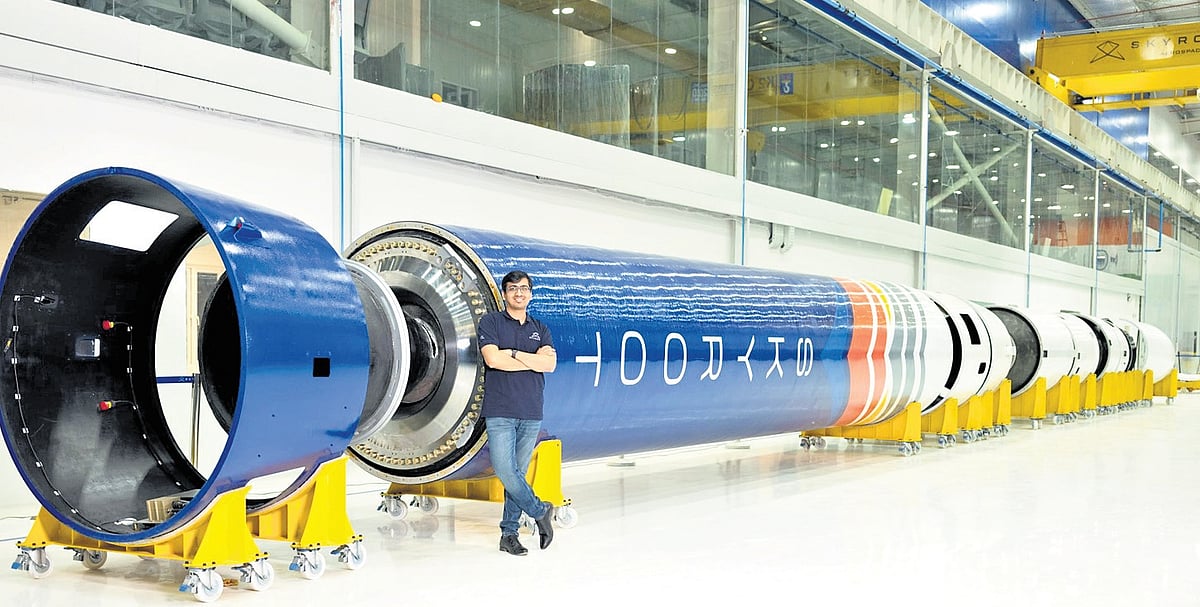
INTERVIEW | The Cab to Space is Now Here: Inside Skyroot’s Playbook for a Cadence-Driven Commercial Launch Economy
Executive Takeaways
- Industrialized Launch Cadence: Skyroot Aerospace is systematically transitioning from bespoke orbital test flights to an unprecedented operational rhythm, targeting a baseline cadence of one space vehicle per month.
- The "Cab to Space" Economic Model: By treating orbital payload deployment like urban transit—featuring predictable scheduling, standardized interfaces, and competitive unit economics—Skyroot is unlocking immense enterprise ROI for satellite constellations.
- Global Market Dynamics: Amid severe global supply chain bottlenecks and bloated backlogs at legacy aerospace primes, agile private-sector launch providers are capturing lucrative valuation multiples and addressing surging demand for responsive space assets.
- Capital Allocation & Infrastructure Scalability: The company's capital expenditure strategy relies on localized manufacturing synergies, advanced carbon-composite structures, and modular cloud-compute architecture for mission control to protect operational margins.
BENGALURU/NEW DELHI — In the high-stakes theater of private commercial spaceflight, the primary currency is no longer merely reaching orbit; it is industrial predictability. For decades, the economics of space access have been plagued by chronic delays, opaque pricing structures, and over-engineered hardware that treated every launch as an anomalous scientific expedition rather than a repeatable logistical transaction. Today, that paradigm is undergoing a violent structural correction.
Sitting down for an exclusive briefing with our investigative bureau, Pawan Chandana, co-founder and CEO of Skyroot Aerospace, laid out a vision that strikes at the heart of the global aerospace establishment: the commoditization of orbital delivery. With its sights set on a sustained deployment rhythm of one vehicle per month, Skyroot is positioning itself not as an experimental rocket developer, but as the premier transport utility for the low-Earth orbit (LEO) economy. As global markets demand immediate infrastructure scalability, the "cab to space" is no longer a futuristic conceit—it is an active commercial reality.
The Catalytic Shift: Moving from Milestone Engineering to Operational Cadence
The aerospace sector has long suffered from what financial analysts term the "prototype trap"—an endless cycle of bespoke design iterations that destroy enterprise ROI. Skyroot’s operational pivot represents a deliberate departure from this model. By prioritizing modular architecture, rapid propellant loading systems, and standardized payload adapters, the company has engineered a manufacturing pipeline capable of absorbing rigorous flight rates without suffering critical capital depletion.
This industrial maturation arrives at a critical juncture for international capital allocation. Traditional launch providers in the West and Asia face multi-year backlogs, leaving institutional satellite operators, defense contractors, and remote-sensing startups stranded in financial purgatory. Capital liquidity relies entirely on asset deployment; a satellite sitting in a cleanroom generates zero revenue. Skyroot’s targeted cadence of twelve missions annually acts as a financial pressure valve for this pent-up global demand.
Furthermore, the firm’s engineering ethos leverages advanced carbon-composite motor cases and proprietary cryogenic propulsion technologies that drastically reduce structural mass fractions. This optimization directly translates into superior payload capacity-to-cost ratios, insulating Skyroot against macroeconomic volatility and aggressive pricing pressures from global competitors.
Verified Data & Metrics Breakdown

To evaluate Skyroot’s operational readiness and competitive positioning within the global small-lift and medium-lift launch market, we analyze the following core parameters:
| Metric / Parameter | Skyroot Aerospace (Target/Actual) | Global Industry Benchmark | Strategic Implication |
|---|---|---|---|
| Target Launch Cadence | 1 vehicle per month (12/year) | 0.25 to 0.5 per month (Legacy) | Unlocks high asset utilization and predictable revenue streams. |
| Primary Target Market | Small-to-Medium LEO Constellations | Mega-constellations & Geostationary | Mitigates exposure to single-client concentration risk. |
| Manufacturing Philosophy | Additive & Carbon-Composite Automation | Manual Assembly / Machined Alloys | Drastically lowers unit production costs and accelerates scale. |
| Regulatory Compliance | IN-SPACe / National Space Policy Aligned | FAA / ESA / National Jurisdictions | Streamlines domestic licensing while navigating international airspace protocols. |
Industry & Market Implications: Winners, Losers, and Macro Pressures
The maturation of private launch providers like Skyroot creates profound ripple effects across the global aerospace ecosystem. Understanding who captures value—and who absorbs the structural shock—requires a cold appraisal of market dynamics:
- The Winners: Constellation Operators and Agnostic Capital. Earth-observation startups, IoT network architects, and defense agencies requiring tactical responsive space capabilities emerge as clear beneficiaries. They gain access to flexible orbital slots without enduring multi-year queue times. Venture capital and private equity funds investing in space tech also benefit from compressed time-to-market metrics, accelerating valuation realization.
- The Losers: Legacy Defense Primes and Inflexible Launch Providers. Bureaucratic aerospace entities that rely on cost-plus government contracting models and low-frequency, high-margin launches face existential pricing pressure. If an agile private firm can execute monthly missions at a fraction of legacy unit costs, institutional clients will aggressively divest from cumbersome legacy contracts.
- Macroeconomic Resilience: By tapping into India’s deeply entrenched engineering talent pool and highly cost-efficient manufacturing base, Skyroot successfully decouples its cost structure from Western inflationary pressures. This structural arbitrage gives the company a formidable moat in global bidding wars for commercial payloads.
Frequently Asked Questions (People Also Ask)
Frequently Asked Questions
Q: What does Skyroot mean by the "cab to space" business model?
A: The "cab to space" model treats rocket launches not as once-in-a-generation scientific endeavors, but as standardized public transport utilities. It emphasizes predictable scheduling, transparent and competitive pricing, modular payload integration, and high-frequency departures. This allows satellite operators to book orbital transit with the same ease and reliability as hailing an urban taxi service.
Q: How does a monthly launch cadence impact Skyroot’s financial viability?
A: Achieving a sustained cadence of one vehicle per month drastically improves capital velocity and operating cash flow. Fixed infrastructure and research overhead costs are distributed across a higher volume of revenue-generating flights, driving down per-unit launch costs and enhancing enterprise valuation multiples for investors.
Q: How does Skyroot compete against dominant global launch players like SpaceX?
A: While heavy-lift providers focus on mega-constellations and massive interplanetary payloads, Skyroot targets the underserved small-to-medium satellite market. By utilizing low-cost Indian engineering resources, rapid carbon-composite manufacturing, and highly agile mission operations, Skyroot undercuts legacy pricing while offering personalized, dedicated orbital slots that large rideshare brokers cannot match.
Q: What role does regulatory compliance play in scaling private commercial space launches?
A: Regulatory compliance—overseen in India by IN-SPACe (Indian National Space Promotion and Authorization Centre)—is foundational to maintaining investor confidence and securing international payload contracts. Streamlined safety certifications, spectrum allocations, and adherence to international orbital debris mitigation standards are vital risk-mitigation pillars for scaling operations globally.
Future Outlook: Milestones on the Horizon
As Skyroot transitions from its foundational test flights into fully industrialized serial production, institutional investors and aerospace analysts will closely monitor several key operational inflection points over the next 24 to 36 months.
Foremost among these is the successful execution of consistent multi-mission years, proving that the supply chain can sustain a monthly cadence without component fatigue or quality slippage. Additionally, the evolution of next-generation vehicle variants designed to capture heavier payload classes will dictate whether Skyroot can successfully expand its Total Addressable Market (TAM) beyond smallsats into medium-lift enterprise architectures.
Ultimately, the commercialization of low-Earth orbit hinges on reliability, cost discipline, and speed. By treating space access as an industrial utility rather than an unattainable frontier, Skyroot’s leadership is rewriting the rules of aerospace economics—proving that the cab to space is officially open for business.