The Orbital Power Shift: How ISRO’s LVM3-M6 Shattered India’s Payload Ceiling to Challenge the Global Space Oligopoly
Executive Takeaways
- Historic Payload Threshold: ISRO’s Launch Vehicle Mark 3 (LVM3-M6) mission has successfully deployed the heaviest payload ever launched from Indian soil, systematically decoupling New Delhi from expensive foreign launch manifests.
- Commercial Sovereignty via NSIL: Executed under the commercial mandate of NewSpace India Limited (NSIL), the launch signals an aggressive pivot toward capturing high-margin commercial satellite launch contracts amid a crippling global launch capacity crunch.
- Propulsion Optimization: Structural refinements in the twin S200 solid rocket boosters and uprated thrust parameters on the indigenous CE-20 cryogenic upper stage yielded a decisive boost in mass-to-orbit efficiency without inflating marginal launch cap-ex.
- Geopolitical Arbitrage: With Russian Soyuz systems commercially cordoned off and Europe’s Ariane 6 scaling slowly, LVM3-M6 positions India as a low-cost, enterprise-grade alternative to SpaceX’s Falcon 9 for broadband constellation and heavy telecom operators.
The Break from Kourou: India’s Quest for Heavy-Lift Autonomy
For more than three decades, a glaring fiscal vulnerability haunted the Indian space program. While the Polar Satellite Launch Vehicle (PSLV) built an untouchable global reputation as the low-cost "workhorse" for sun-synchronous, sub-two-tonne satellites, India remained critically dependent on French Guiana’s Kourou spaceport and Arianespace for its heaviest telecommunications assets. Whenever the Indian Space Research Organisation (ISRO) required a four-tonne or heavier satellite placed into Geostationary Transfer Orbit (GTO), hundreds of millions of dollars in sovereign foreign exchange flowed to Western launch service providers.
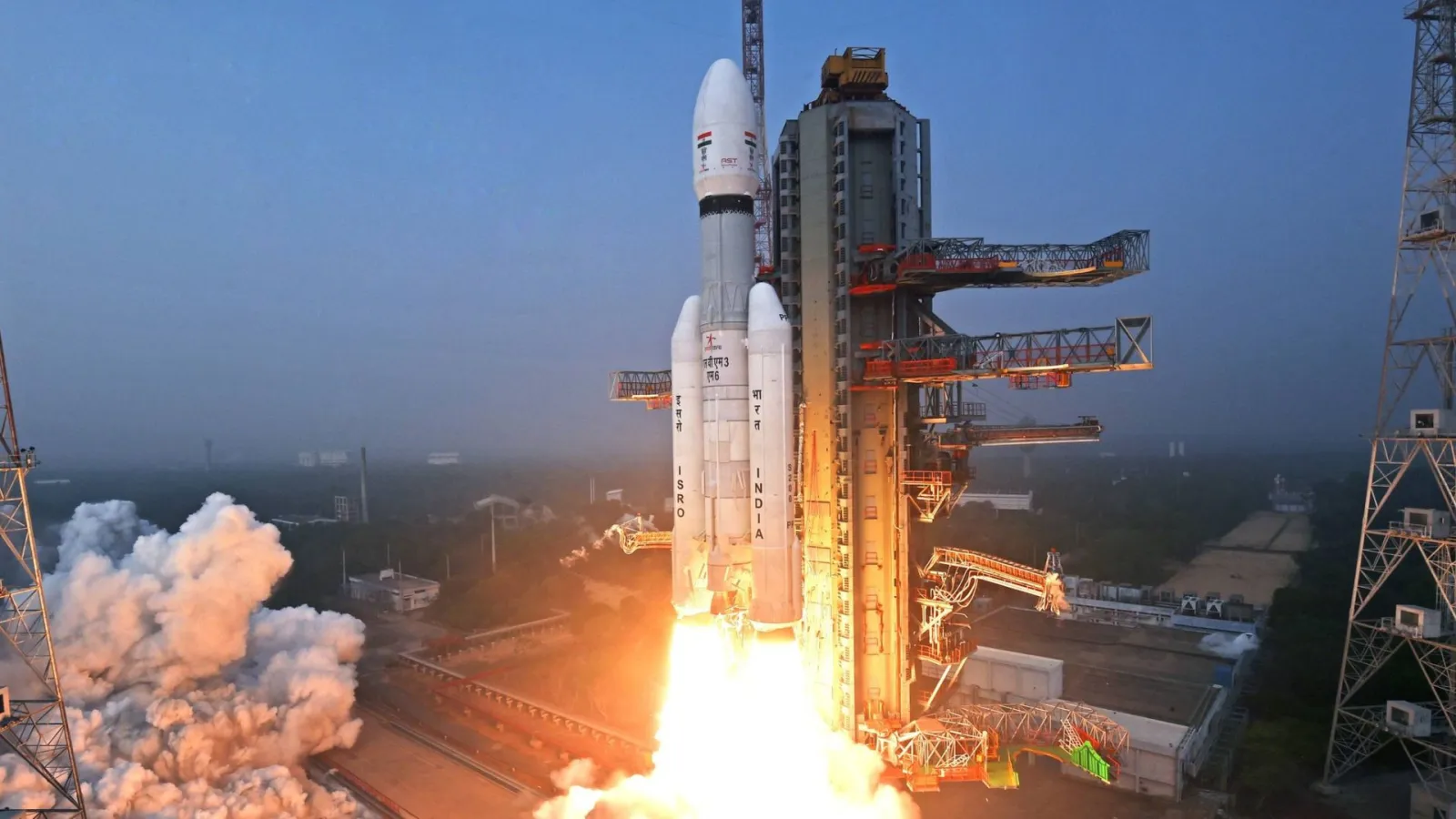
The thunderous liftoff of the LVM3-M6 mission from the Satish Dhawan Space Centre (SDSC-SHAR) in Sriharikota has permanently rewritten that balance sheet. By carrying the single heaviest satellite assembly ever launched from domestic territory into its targeted trajectory, the LVM3-M6 mission represents the culmination of a decade-long engineering campaign to achieve heavy-lift self-reliance. This is not merely an engineering milestone; it is a calculated geopolitical intervention in the $630 billion global space economy.
The mission crystallizes India's transition from an exploratory, state-subsidized enterprise into an assertive, commercially disciplined launch operator. With satellite operators worldwide facing severe backlog delays and soaring insurance premiums, LVM3-M6 validates India’s domestic infrastructure as ready to handle top-tier payloads at industry-beating capital efficiency.
Engineering the Monster: Anatomy of the LVM3-M6 Uprating
To cross the critical payload threshold, ISRO engineers executed key structural and propulsive enhancements on the LVM3 architecture—a three-stage heavy-lift vehicle designed to generate immense sea-level thrust before handing off to high-efficiency liquid and cryogenic engines.
The baseline LVM3 configuration relies on two S200 solid rocket boosters—among the largest solid motors manufactured worldwide—strapped to an L110 core stage powered by twin Vikas liquid engines burning unsymmetrical dimethylhydrazine (UDMH) and nitrogen tetroxide (N2O4). For the M6 campaign, ISRO leveraged proprietary advances in propellant grain design and lightened motor case architectures, maximizing early-stage thrust-to-weight margins while managing aerodynamic stresses during the transonic transition.
However, the real operational alpha of the LVM3-M6 resides in its C25 cryogenic upper stage, powered by the indigenously developed CE-20 engine. Burning liquid hydrogen (LH2) and liquid oxygen (LOX), the CE-20 operated during M6 under uprated chamber pressures, delivering higher Specific Impulse (Isp) across an extended burn profile. This uprated cryogenic envelope allows ISRO to expand its orbital payload injection limits, directly attacking the weight threshold that historically forced domestic operators to seek out SpaceX's Falcon 9 or European Ariane rockets.
The Financial Engine: NewSpace India Limited and Market Realities
The technical success of LVM3-M6 is inseparable from the structural monetization directives imposed by NewSpace India Limited (NSIL), the central public sector enterprise tasked with commercially scaling India's space assets. The global launch market is navigating a supply shock: the Ukrainian conflict rendered Russia's Soyuz fleet persona non grata for Western-backed commercial constellations, United Launch Alliance’s (ULA) Vulcan Centaur is tied to domestic defense manifests, and Ariane 6 faces a multi-year production backlog.
This dynamic has left Elon Musk’s SpaceX with near-monopoly pricing power in the commercial heavy-lift sector. Enterprise satellite operators—from broadband mega-constellations to defense communications consortia—are desperately seeking secondary source diversification to mitigate counterparty risk. NSIL’s operationalization of the LVM3-M6 directly satisfies this institutional demand.
By leveraging domestic manufacturing ecosystems—including strategic industrial partnerships with Larsen & Toubro, Godrej Aerospace, and Hindustan Aeronautics Limited (HAL)—ISRO and NSIL have engineered a cost per kilogram that challenges the prevailing market. While the Falcon 9’s reuse paradigm dominates headline economics, the disposable LVM3-M6 structure offers highly competitive spot pricing for dedicated, high-mass missions where customers require sovereign data protections and precision orbital injections without the orbital slot compromises inherent in rideshare clusters.
Comparative Architecture: LVM3-M6 vs. Global Heavy-Lift Competitors
The operational landscape for heavy commercial and sovereign launches reveals how the uprated LVM3-M6 stacks up against Western counterparts across critical operational and economic vectors:
| Launch Vehicle | Operator | Payload to LEO (kg) | Payload to GTO (kg) | Cryogenic Stage Architecture | Primary Commercial Status |
|---|---|---|---|---|---|
| LVM3-M6 (Uprated) | ISRO / NSIL (India) | ~8,200–8,500 | ~4,200–4,500 | CE-20 (LOX / LH2 - Gas Generator) | Operational; Expanding Commercial Manifest |
| Falcon 9 (Block 5) | SpaceX (USA) | 22,800 (Expendable) | 8,300 (Expendable) | Merlin 1D Vacuum (LOX / RP-1) | Dominant Global Market Leader |
| Ariane 6 (A62 Variant) | Arianespace (Europe) | 10,350 | 4,500 | Vinci (LOX / LH2 - Expander Cycle) | Operational Ramp-Up; Constrained Capacity |
| Vulcan Centaur | ULA (USA) | 19,000 | 8,400 | Centaur V / RL10 (LOX / LH2) | National Security Manifest Dominant |
Market Implications: Winners, Losers, and Capital Allocation
The downstream ramifications of the LVM3-M6 mission echo far beyond Sriharikota's launch pads:
- Winners: Tier-1 Indian Aerospace Suppliers. Industrial conglomerates like Larsen & Toubro, Godrej Aerospace, and private precision fabricators are the primary beneficiaries of this milestone. With ISRO offloading complete vehicle assembly to industry consortia, corporate operating margins in India's private aerospace supply chain are set to expand through consistent, recurring production batches.
- Winners: Sovereign Telecommunications Infrastructure. India’s Department of Telecommunications and regional broadband initiatives gain direct, rapid-deployment capability for high-throughput geostationary assets (such as the GSAT series), preserving sovereign data integrity while saving millions in foreign currency outlays.
- Losers: Legacy European Launch Brokers. European brokering platforms that historically banked on Indian payloads to fill manifest margins now face a double blow: India has ended its reliance on third-party heavy launchers and is directly bidding on international satellite launches.
- The SpaceX Factor: SpaceX is unlikely to lose its baseline rideshare dominance, but LVM3-M6 breaks its uninhibited pricing power for dedicated mid-to-heavy institutional missions. Sovereign nations seeking non-ITAR-restricted, geopolitically neutral launch opportunities now possess a verified, unaligned partner in NewSpace India.
Frequently Asked Questions (People Also Ask)
What was the strategic objective of the ISRO LVM3-M6 mission?
The LVM3-M6 mission was engineered to deliver the heaviest satellite payload to date from Indian soil into designated orbit. The mission validates structural, thermal, and propulsion upgrades—most notably within the CE-20 cryogenic upper stage—proving that India can deploy high-mass communications and institutional payloads domestically without purchasing orbital slots from foreign operators.
How does LVM3 differ from ISRO's legacy PSLV rocket?
While the PSLV is an optimized medium-lift system primarily tailored for Sun-Synchronous Polar Orbits (carrying 1.5 to 1.75 tonnes to LEO), the LVM3 is a dedicated heavy-lift launch vehicle designed with a liquid-core, twin solid-strap-on, and cryogenic upper-stage configuration. LVM3 can deliver up to 8+ tonnes to Low Earth Orbit and over 4 tonnes to Geostationary Transfer Orbit, making it the vehicle of choice for deep-space missions (Chandrayaan), crewed spaceflight (Gaganyaan), and heavy telecommunications satellites.
What role does NewSpace India Limited (NSIL) play in LVM3 commercialization?
NSIL is the commercial branch of India’s Department of Space, functioning as the primary interface between ISRO and enterprise customers. NSIL procures rockets directly from industrial consortia, markets launch capacity globally, and executes commercial contracts—such as previous OneWeb constellation deployments and multi-national telecom missions—allowing ISRO to transition into pure-play research, scientific exploration, and platform innovation.
Can the LVM3 vehicle support human spaceflight?
Yes. The LVM3 architecture serves as the foundation for ISRO’s Gaganyaan human spaceflight programme. Designated as the "Human-Rated LVM3" (HLVM3), the vehicle integrates comprehensive safety margins, an Emergency Escape System (crew escape tower), redundant avionics, and structural modifications designed to safeguard astronauts during every stage of the launch profile.
The Horizon: Gaganyaan Integration and Next-Gen Launchers (NGLV)
The flight validation of LVM3-M6 marks an operational inflection point. Over the next 24 months, data collected from the M6 telemetry envelope will be fed directly into the human-rating protocols for the Gaganyaan orbital test flights, verifying that the uprated CE-20 engine and S200 dynamics operate well within human-survivability margins.
Simultaneously, ISRO is leveraging this milestone to build momentum for its ambitious Next-Generation Launch Vehicle (NGLV), codenamed "Soorya." Envisioned as a partially reusable heavy-lifter utilizing methane-fueled (Methalox) propulsion stages, the NGLV aims to slash payload deployment costs to below $1,000 per kilogram. While NGLV remains on the mid-term horizon, the LVM3-M6 has established that India is no longer an aspiring participant in heavy-lift rocketry—it is an established power capable of meeting its own sovereign needs and reshaping the economics of the global space race.