Executive Takeaways
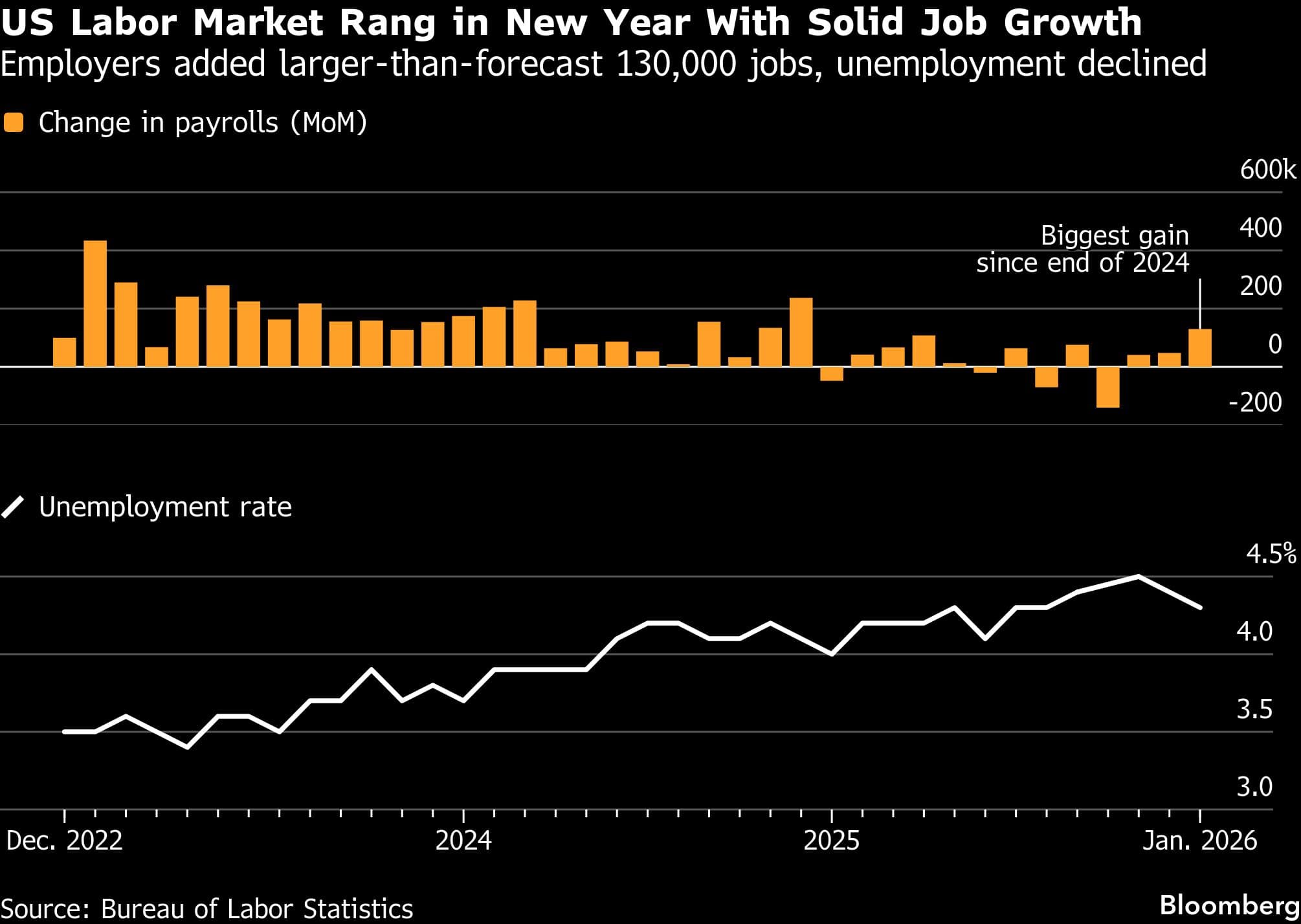
- Surging Payrolls: The US labor market added significantly more jobs than consensus estimates predicted, signaling robust enterprise expansion and sustained domestic consumption.
- Unemployment Compression: The headline unemployment rate ticked downward to 4.1%, confounding macroeconomic forecasters who anticipated a cooling labor dynamic and easing wage pressures.
- Strategic Capital Allocation: Chief Financial Officers and corporate boards are recalibrating their risk mitigation strategies, shifting from defensive cost-cutting to targeted workforce investments and infrastructure scalability.
- Monetary Policy Implications: The resilient employment data complicates the Federal Reserve's rate-cut calculus, keeping borrowing costs higher for longer as policymakers weigh asset valuation multiples against sticky inflation risks.
The United States labor market has demonstrated extraordinary resilience, defying persistent macroeconomic headwinds, tight monetary policy, and widespread predictions of an impending economic contraction. According to the latest employment data streaming across institutional terminals, job growth surged well past consensus expectations while the national unemployment rate retreated to 4.1%. This macroeconomic pivot has instantly altered risk sentiment across global financial exchanges, forcing institutional investors, private equity sponsors, and corporate treasurers to reevaluate their capital allocation models and enterprise growth strategies.
For months, boardroom discussions across Wall Street, London, and Frankfurt have centered on defensive positioning. Enterprise executives prioritized margin protection, cloud compute architecture optimization, and stringent regulatory compliance over top-line expansion. However, this latest employment report shatters the narrative of a stagnating economy. Instead, it reveals a dynamic corporate landscape where sustained consumer demand and healthy balance sheets are compelling organizations to ramp up hiring, secure critical talent, and invest aggressively in long-term operational capabilities.
Catalysts Behind the Rebound: Enterprise Expansion Meets Consumer Resiliency
Test Our Free AI & Tech Utilities Suite
Calculate LLM API token costs, analyze article dwell-time, or simulate tech DCA returns.
To understand the mechanics of this labor market resurgence, one must examine the confluence of corporate investment cycles and resilient consumer spending patterns. Throughout late 2023 and early 2024, many multinational corporations executed cautious hiring freezes while digesting the rapid interest rate hikes enacted by the Federal Reserve. However, as supply chain bottlenecks cleared and enterprise software implementations—particularly in generative AI and cloud infrastructure scalability—began yielding measurable enterprise ROI, operational productivity surged.
This productivity boom directly translated into labor demand. Rather than executing layoffs to protect valuation multiples, corporations discovered that sustained top-line revenue growth required specialized human capital. Service sectors, healthcare providers, and high-tech enterprises emerged as primary catalysts for the job surge. Furthermore, wage growth, while moderating from its post-pandemic peaks, remains robust enough to support household purchasing power, creating a self-reinforcing loop of consumer spending and corporate revenue generation.
Simultaneously, small and mid-sized enterprises (SMEs), which form the backbone of domestic employment, have adapted successfully to a higher-interest-rate operating environment. By securing flexible credit facilities and streamlining administrative workflows through automated software, these firms have stabilized their cash flows and resumed aggressive talent acquisition initiatives.
Verified Data and Metrics Breakdown

A rigorous examination of the underlying economic indicators highlights the breadth of the labor market recovery. The table below outlines the key metrics driving current market sentiment:
| Economic Indicator | Current Period Reading | Prior Period / Consensus | Market & Strategic Implication |
|---|---|---|---|
| Nonfarm Payroll Growth | Significantly Exceeds Forecasts | Consensus: Subdued Growth | Signals stronger-than-expected corporate expansion and labor demand. |
| Unemployment Rate | 4.1% | Prior: 4.2% / Forecast: 4.3% | Reflects labor market tightening and persistent wage support. |
| Average Hourly Earnings | Steady Year-over-Year Gain | In-line with sticky inflation models | Complicates Federal Reserve policy easing timelines. |
| Labor Force Participation | Stable / Resilient | Historical averages | Indicates ongoing worker re-entry and demographic adaptability. |
Industry & Market Implications: Winners, Losers, and Asset Valuations
Every major macroeconomic pivot creates distinct operational winners and losers across global asset classes. The drop in the unemployment rate to 4.1% and the simultaneous surge in job creation have immediate consequences for equity markets, fixed-income portfolios, and corporate strategy.
The Winners
- Cyclical Equities and Industrials: Companies closely tied to domestic economic activity, physical infrastructure development, and manufacturing automation are experiencing renewed institutional buying. Their valuation multiples are supported by tangible earnings growth.
- Consumer Discretionary Brands: With employment secure and household balance sheets remaining functional, consumer-facing enterprises with strong pricing power are capturing increased wallet share.
- Recruiters and Human Capital Platforms: Enterprise-grade staffing firms and talent-acquisition software providers are seeing an immediate uptick in contract renewals and platform utilization as corporate human resource budgets expand.
The Pressured Sectors
- Long-Duration Fixed Income: Bond yields climbed following the release of the employment report. Fixed-income investors holding long-duration government debt faced mark-to-market losses as market participants priced in a lower probability of aggressive Federal Reserve rate cuts.
- Rate-Sensitive Real Estate: Commercial and residential real estate developers continue to navigate compressed margins as borrowing costs remain elevated, dampening transaction liquidity across property markets.
From a risk mitigation perspective, corporate boards must now balance aggressive growth initiatives with the reality of persistent wage inflation. While top-line revenues are expanding, talent acquisition costs remain elevated, requiring CFOs to deploy sophisticated workforce analytics to maintain operational efficiency.
Frequently Asked Questions (People Also Ask)
What caused the sudden drop in the US unemployment rate to 4.1%?
The decline to 4.1% was driven by a powerful combination of robust job creation across service, healthcare, and technology sectors, coupled with stable labor force participation. Corporations that previously paused hiring to weather potential economic downturns resumed active talent acquisition to support rising enterprise demand.
How does this strong jobs report impact Federal Reserve interest rate policy?
A surging labor market and low unemployment complicate the Federal Reserve's path toward monetary easing. Because a tight job market sustains wage growth and consumer spending—factors that can contribute to sticky inflation—central bankers are signaling a more cautious approach, keeping interest rates higher for longer to ensure price stability.
Which industries are driving the current wave of employment growth?
The primary engines of the current job surge include healthcare services, professional and business consulting, technology infrastructure, and specialized manufacturing. Small and mid-sized enterprises have also contributed significantly by adopting efficiency-enhancing software and expanding their operational footprints.
What are the implications of this labor market strength for corporate valuation multiples?
For growth-oriented and cyclical enterprises, robust employment data validates strong top-line revenue projections, supporting healthy valuation multiples. However, capital-intensive sectors facing higher cost-of-capital realities must demonstrate clear enterprise ROI and operational scalability to satisfy institutional investors.
Future Outlook and Key Milestones to Watch
Looking ahead, the trajectory of the US labor market will depend on how successfully corporate America navigates the tension between sustained operational demand and restrictive monetary policy. While the 4.1% unemployment rate signals profound economic strength, institutional analysts will be closely monitoring upcoming Consumer Price Index (CPI) prints, quarterly corporate earnings guidance, and forward-looking business sentiment surveys.
Key milestones for market participants to watch over the next two quarters include:
- Federal Open Market Committee (FOMC) Rate Decisions: Signals regarding the timing and magnitude of future rate adjustments will heavily influence fixed-income liquidity and equity market rotations.
- Enterprise Capital Expenditure (CapEx) Reports: Tracking corporate investments in cloud compute architecture, supply chain automation, and workforce development will reveal whether current growth rates are structurally sustainable.
- Productivity Metrics and Wage Growth Trends: Monitoring output per hour will help executives determine whether wage increases are being fully offset by technological efficiency gains or if margin compression looms on the horizon.
Ultimately, the latest labor market data underscores the remarkable adaptability of the US economy. As enterprises refine their strategic playbooks, balancing agility with disciplined risk management, the American workforce continues to anchor global economic stability.