Executive Takeaways
- Unprecedented Mass Milestone: The LVM3-M6 mission successfully injected the BlueBird Block-2 satellite into low Earth orbit, marking the heaviest payload ever launched from domestic Indian soil.
- Commercial Validation: Executed via NewSpace India Limited (NSIL) and AST SpaceMobile, the launch solidifies LVM3’s competitive positioning in the global commercial launch services market against SpaceX and ArianeSpace.
- shift in Capital Allocation: Global telecom enterprises and institutional investors are re-evaluating infrastructure scalability metrics as direct-to-device cellular broadband moves closer to commercial viability.
- Defensible Unit Economics: India’s cost-optimized engineering paradigm continues to compress per-kilogram launch costs, posing structural valuation challenges for legacy aerospace manufacturers.
BENGALURU/NEW YORK — In an era where commercial spaceflight dictates global geopolitical leverage and enterprise connectivity valuations, the Indian Space Research Organisation (ISRO) has delivered a masterclass in engineering execution and market positioning. The successful execution of the LVM3-M6 mission, carrying the colossal BlueBird Block-2 satellite, represents far more than a routine technological triumph for New Delhi’s space agency. It is a watershed moment that recalibrates the global launch services marketplace, providing institutional investors and enterprise executives with a formidable alternative to Western-dominated payload delivery networks.
Operating through its commercial arm, NewSpace India Limited (NSIL), ISRO executed a flawless lift-off from the Satish Dhawan Space Centre in Sriharikota. By successfully placing the heaviest commercial satellite ever integrated and launched from Indian soil into its designated low Earth orbit (LEO), the mission validates LVM3’s (Launch Vehicle Mark-3) readiness for high-cadence, high-stakes international commercial deployment. For enterprise strategists and telecommunications conglomerates, this mission serves as tangible proof that India’s aerospace infrastructure scalability has matured into a reliable engine for global connectivity, risk mitigation, and digital infrastructure expansion.
The Genesis of LVM3-M6: Catalytic Events and Technical Architecture
The journey toward the LVM3-M6 milestone was shaped by years of iterative propulsion development, rigorous structural testing, and strategic international partnerships. Originally conceived as India’s heavy-lift launch vehicle—colloquially dubbed the "Fat Boy"—the LVM3 has undergone a series of systematic upgrades designed to enhance payload capacity, vibration damping, and orbital insertion precision. The integration of the C25 cryogenic upper stage, powered by the CE-20 engine, has proven to be a vital architectural differentiator, delivering high specific impulse and reliable combustion stability under extreme thermal loads.
The payload at the center of this mission, the BlueBird Block-2 satellite developed by AST SpaceMobile, introduced unprecedented engineering hurdles. Unlike traditional deep-space or geostationary payloads, massive direct-to-cellular constellation satellites require sprawling, highly delicate antenna arrays and robust power generation subsystems. Transporting a spacecraft of this physical magnitude and mass footprint demanded meticulous thermal-structural analysis, custom payload fairing adaptations, and advanced trajectory optimization to minimize atmospheric drag during the critical maximum dynamic pressure (Max-Q) phase.
From a capital allocation perspective, the mission underscores a broader structural shift in how satellite operators procure launch services. With traditional Western launch providers facing extensive backlog delays and escalating per-kilogram pricing, NSIL’s ability to deliver schedule certainty, regulatory compliance, and predictable unit economics has transformed LVM3 into a preferred vehicle for international blue-chip clients seeking risk diversification and optimized deployment schedules.
Verified Data and Metrics Breakdown
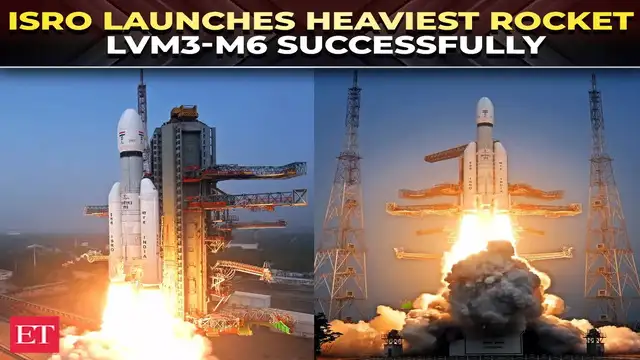
A rigorous examination of the mission parameters highlights the technical superiority and operational efficiency achieved during the LVM3-M6 campaign. The following comparative data matrix details the operational specifications, payload thresholds, and market implications of India's premier heavy-lift vehicle.
| Mission Parameter | LVM3-M6 Specifications | Industry Benchmark / Context |
|---|---|---|
| Primary Payload | BlueBird Block-2 (AST SpaceMobile) | Next-generation direct-to-device cellular broadband satellite |
| Launch Site | Second Launch Pad, SDSC SHAR, Sriharikota | Equatorial advantage optimizing orbital inclination efficiency |
| Mass Capacity (LEO) | Up to 8,000 kg (Optimized for heavy LEO insertion) | Significant upgrade over previous Indian medium-lift vehicles |
| Propulsion Architecture | S200 solid boosters, L110 core, CE-20 cryogenic upper stage | High-reliability staged combustion with indigenous cryogenic tech |
| Commercial Broker | NewSpace India Limited (NSIL) | Commercial arm facilitating global enterprise contracts |
Industry & Market Implications: Re-Pricing Global Aerospace Assets
The successful execution of LVM3-M6 ripples across global financial markets, directly influencing valuation multiples for commercial satellite operators, aerospace components manufacturers, and telecommunications enterprises. As global enterprises pivot toward ubiquitous cloud compute architecture, Internet of Things (IoT) integration, and seamless 5G/6G cellular connectivity from space, the bottleneck has invariably shifted from satellite manufacturing capacity to reliable, cost-effective launch availability.
Who Wins:
- NSIL and the Indian Aerospace Ecosystem: Cementing a reputation for reliability allows NSIL to command higher contract volumes, driving domestic job creation, technology transfer, and private-sector participation via the Indian Space Policy framework.
- Global Constellation Operators: Companies requiring heavy LEO insertions now have access to a diversified, competitively priced launch provider, mitigating supply chain bottlenecks and protecting enterprise ROI.
- Telecommunications Giants: Partnerships with direct-to-device pioneers like AST SpaceMobile accelerate deployment timelines, eliminating terrestrial dead zones and unlocking massive new addressable markets in emerging economies.
Who Faces Headwinds:
- Legacy Western Launch Providers: High operational overheads and rigid cost structures leave established players vulnerable to NSIL’s aggressive, value-driven pricing models.
- Single-Source Procurement Strategists: Aerospace firms relying exclusively on Western commercial launch networks must now justify their capital allocation strategies to institutional investors who demand supply chain risk diversification.
Frequently Asked Questions (People Also Ask)
Frequently Asked Questions
A: LVM3-M6 successfully deployed the BlueBird Block-2 satellite, establishing a new record for the heaviest commercial payload ever launched from domestic Indian soil. This demonstrates the heavy-lift capability of India's launch infrastructure and validates its readiness for massive LEO satellite constellations.
A: By offering a reliable, cost-optimized alternative to Western launch providers, NSIL introduces healthy pricing competition into the global market. This helps satellite operators optimize capital allocation, compress time-to-market, and mitigate single-source supply chain risks.
A: Built by AST SpaceMobile, BlueBird Block-2 is designed to provide direct-to-cellular broadband and telecommunications services globally, enabling standard mobile phones to connect directly to space-based assets without requiring specialized ground hardware.
A: NSIL acts as the commercial arm of ISRO, spearheading technology commercialization, managing international launch contracts, and bridging domestic aerospace engineering capabilities with global enterprise demand.
Future Outlook: Strategic Milestones and Roadmap Ahead
As the dust settles over the Satish Dhawan Space Centre, institutional analysts and aerospace engineers are already looking toward the next phase of India’s space evolution. The immediate horizon will test ISRO’s ability to scale launch cadences while advancing next-generation propulsion technologies, including semi-cryogenic engines and reusable launch vehicle (RLV) demonstrators. These innovations are critical for maintaining structural cost advantages as global competitors experiment with fully reusable architectures.
For enterprise leaders, the takeaway is unequivocal: India’s space program has transitioned from an exploratory national endeavor into a formidable, profit-driven commercial enterprise. As regulatory compliance frameworks modernize and private Indian space-tech startups mature, international capital allocation toward the subcontinent's aerospace sector is projected to accelerate exponentially. Stakeholders monitoring long-term enterprise valuation, telecommunications infrastructure scalability, and supply chain resilience must factor ISRO and NSIL into their core strategic planning for the decade ahead.