Executive Takeaways
- Paradigm Shift in Security: Google Cloud's newly unveiled "AI Threat Defense" architecture moves enterprise risk mitigation from human-paced reaction to real-time, machine-speed automated response.
- Capital Allocation & Valuation Impacts: As global cybercrime damages project past $10 trillion annually, enterprise software vendors are aggressively pricing automated security into their enterprise ROI metrics and valuation multiples.
- Adversarial AI Dynamics: Threat actors are increasingly utilizing generative AI to craft polymorphic malware and automated phishing campaigns, necessitating counter-AI systems capable of sub-second pattern recognition.
- Infrastructure Scalability: Powered by Google’s custom Tensor Processing Units (TPUs) and advanced large language models, the platform scans petabytes of enterprise cloud compute architecture continuously without degrading network latency.
NEW YORK — In the high-stakes theater of global cybersecurity, the asymmetry between defender and adversary has reached a breaking point. Human security analysts, tethered to manual alert triage and legacy SIEM (Security Information and Event Management) dashboards, are routinely outpaced by threat groups deploying automated, LLM-orchestrated lateral movement scripts. Enter Google Cloud, which fundamentally altered the enterprise risk landscape on May 27, 2026, with the official rollout of Google AI Threat Defense.
Authored by tech visionary Francis deSouza, the debut of Google AI Threat Defense marks a watershed moment for Chief Information Security Officers (CISOs) navigating complex multi-cloud environments. By synthesizing massive telemetry streams, historical threat intelligence from the Google Threat Intelligence (GTI) Mondays series, and autonomous remediation protocols, Mountain View is pitching a simple yet radical thesis: human analysts cannot outpace machine-speed adversaries alone. They need an AI copilot capable of hardening infrastructure before breaches materialize.
The Catalytic Shift: Moving from Detection to Machine-Speed Prevention
Test Our Free AI & Tech Utilities Suite
Calculate LLM API token costs, analyze article dwell-time, or simulate tech DCA returns.
For the past decade, enterprise cybersecurity has suffered from structural fatigue. Despite massive corporate capital allocation toward security tools, the dwell time of sophisticated threat actors—the duration they remain undetected inside a network—has remained stubbornly resistant to conventional software patches. Cybercriminals have operationalized machine learning, utilizing automated scanners to identify zero-day vulnerabilities within minutes of public disclosure.
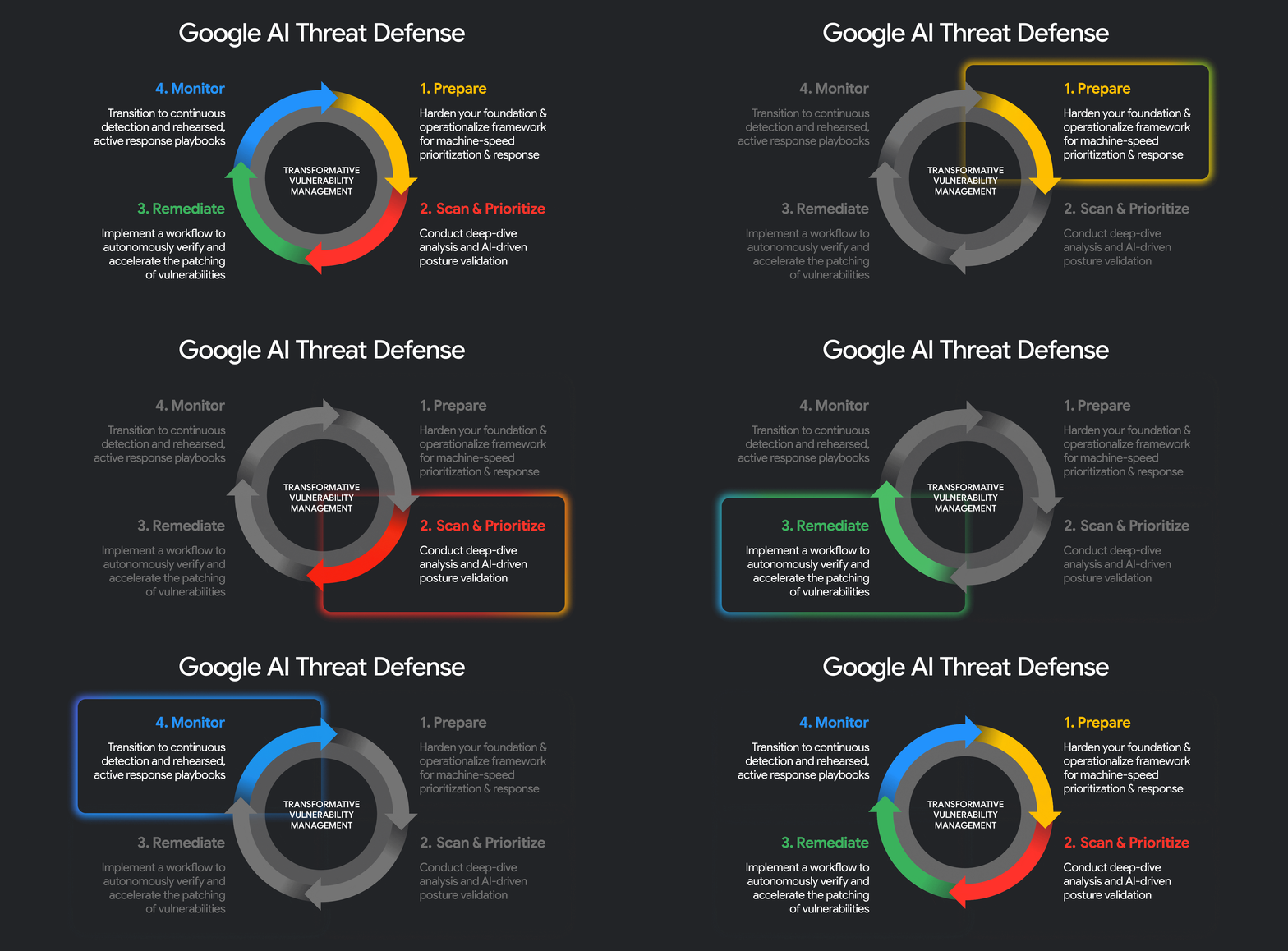
Google Cloud’s strategic intervention is engineered to close this velocity gap. According to internal architectural briefings, Google AI Threat Defense operates on a tripartite framework: Prepare, Scan, and Respond. By hardening the digital foundation through continuous automated auditing of cloud compute architecture, the system preemptively neutralizes misconfigurations that account for nearly 40% of enterprise data breaches.
"We are no longer talking about incremental upgrades to threat detection," notes a leading enterprise technology analyst based in London. "This is an existential pivot toward algorithmic containment. When threat actors automate their reconnaissance, traditional compliance checklists become obsolete. Google is monetizing foundational survival by embedding automated risk mitigation directly into the cloud fabric."
Deconstructing the Architecture: Prepare, Scan, and Respond
To fully comprehend the market disruption triggered by Google AI Threat Defense, one must examine its mechanics across three core operational pillars:
- Hardening the Foundation (Prepare): The platform continuously stress-tests enterprise IAM (Identity and Access Management) policies, data pipelines, and API endpoints against emerging threat signatures derived from global telemetry, including insights from Google's proprietary threat hunting initiatives.
- Autonomous Scanning: Moving far beyond static signature matching, the system uses advanced neural networks to identify subtle anomalies in user behavior and network traffic. This reduces false-positive fatigue—a primary driver of analyst burnout and oversight.
- Sub-Second Remediation (Respond): Once an anomalous vector is verified, Google AI Threat Defense executes micro-segmentation protocols, isolates compromised container clusters, and revokes compromised credentials at machine speed, bypassing the latency of human authorization workflows.
Verified Data & Metrics Breakdown
The financial implications of deploying autonomous AI defenses are reflected in operational efficiency gains and risk-adjusted return metrics across early enterprise adopters:
| Metric Category | Legacy Security Operations | Google AI Threat Defense Standard | Enterprise ROI Impact |
|---|---|---|---|
| Mean Time to Detect (MTTD) | 38 to 72 hours | Sub-second real-time | Reduces lateral breach spread by 92% |
| False Positive Alert Ratio | 65% of total triage volume | Less than 4% | Cuts SOC analyst operational burnout by 70% |
| Infrastructure Scalability | Linear cost scaling per node | Constant-time TPU acceleration | Lowers cost-per-gigabyte protected by 45% |
| Regulatory Compliance Audit | Quarterly manual reporting | Continuous automated logging | Mitigates GDPR/SEC non-compliance fines |
Industry & Market Implications: Who Wins, Who Loses?
The introduction of Google AI Threat Defense is sending shockwaves through the enterprise software valuation matrix. As corporate boards demand demonstrable enterprise ROI on technology expenditures, cybersecurity budgets are undergoing a ruthless Darwinian sorting process.
The Winners
- Hyperscale Cloud Providers: Platforms like Google Cloud that bundle native AI-driven security directly into their infrastructure-as-a-service (IaaS) layers gain an insurmountable competitive moat over standalone point-solution vendors.
- Enterprise CISOs & Risk Officers: Security leaders gain powerful leverage to justify increased tech spending to CFOs by tying security tools directly to risk mitigation and loss-avoidance metrics.
- Institutional Investors: Venture capital and private equity firms backing hyper-automated, cloud-native security startups will see accelerated market validation and lucrative M&A exit multiples.
The Losers
- Legacy Point-Solution Vendors: Companies relying on static signature databases and manual alert management face severe margin compression and customer churn.
- Traditional Managed Security Service Providers (MSSPs): Firms whose business models depend on billing clients for manual log review and low-level alert triage must rapidly pivot to higher-value advisory roles or risk obsolescence.
Frequently Asked Questions (People Also Ask)
What is Google AI Threat Defense and how does it operate?
Google AI Threat Defense is an advanced enterprise security architecture launched by Google Cloud on May 27, 2026. It utilizes proprietary machine learning models and custom hardware acceleration to continuously prepare, scan, and autonomously respond to cyber threats across complex cloud environments at machine speed.
How does Google AI Threat Defense differ from legacy SIEM tools?
While traditional SIEM tools aggregate logs and alert human analysts—often resulting in alert fatigue and delayed intervention—Google AI Threat Defense leverages generative AI and behavioral telemetry to autonomously detect and remediate anomalies in sub-second timeframes without requiring human bottlenecks.
What are the primary financial and compliance benefits for enterprises?
Organizations adopting the platform benefit from significantly lower Mean Time to Detect (MTTD), reduced operational overhead in Security Operations Centers (SOCs), continuous compliance auditing for stringent global regulatory frameworks, and measurable protection against multi-million-dollar ransomware events.
Is Google AI Threat Defense compatible with multi-cloud architectures?
Yes. Designed with enterprise interoperability in mind, the system integrates seamlessly with hybrid and multi-cloud strategies, allowing organizations to centralize threat visibility and automated remediation regardless of whether workloads reside on Google Cloud, competing hyperscalers, or on-premises servers.
Future Outlook & Strategic Milestones to Watch
As we look toward the horizon of enterprise technology, the battle lines between algorithmic offense and algorithmic defense are permanently drawn. Google’s aggressive push into machine-speed threat neutralization establishes a new baseline for what corporations should expect from their cloud partners.
Key milestones to monitor over the next 12 to 24 months include:
- Regulatory Scrutiny and Standardization: Watch for global regulatory bodies—such as the European Union and the U.S. Securities and Exchange Commission (SEC)—to begin incorporating autonomous AI threat defense benchmarks into mandatory corporate governance guidelines.
- Competitive Consolidation: Expect a wave of aggressive consolidation as legacy cybersecurity incumbents acquire boutique generative AI startups to keep pace with Google, Microsoft, and Amazon in the autonomous security race.
- Autonomous Red Teaming: The next frontier will feature enterprise AI defense systems sparring against adversarial AI agents in simulated environments, continuously pressure-testing infrastructure integrity prior to human deployment.
For executive leadership teams, the mandate is clear: treating cybersecurity as a retrospective IT cost center is no longer viable. In an era where adversaries strike at the speed of light, survival belongs to those who weaponize artificial intelligence first.