Executive Takeaways
- Monetization Validation: Hyperscalers like Microsoft Azure, Amazon AWS, and Google Cloud are finally proving that artificial intelligence can generate tangible, multi-billion-dollar enterprise revenue streams.
- The Capex Super-Cycle: Capital expenditure dedicated to AI infrastructure is projected to breach the historic $1 trillion threshold, driven by unrelenting enterprise demand for advanced cloud compute architecture.
- The Supplier Advantage: Despite Big Tech's surging top-line growth, hardware, semiconductor, and specialized infrastructure suppliers retain superior operating leverage, insulating them from downstream application margin compression.
- Strategic Risk Mitigation: Institutional asset allocation is shifting toward high-margin upstream enablers as portfolio managers seek durable moats against intensifying competition in generative AI software layers.
For more than three years, Wall Street’s primary existential debate centered on a single, high-stakes question: When would the staggering billions poured into artificial intelligence materialize on corporate balance sheets? As we cross into the second half of 2026, that fog of uncertainty has decisively lifted. Hyperscale cloud providers are officially validating their immense capital allocation strategies, posting robust, accelerated top-line growth fueled directly by generative AI workloads, enterprise integrations, and specialized cloud compute architecture.
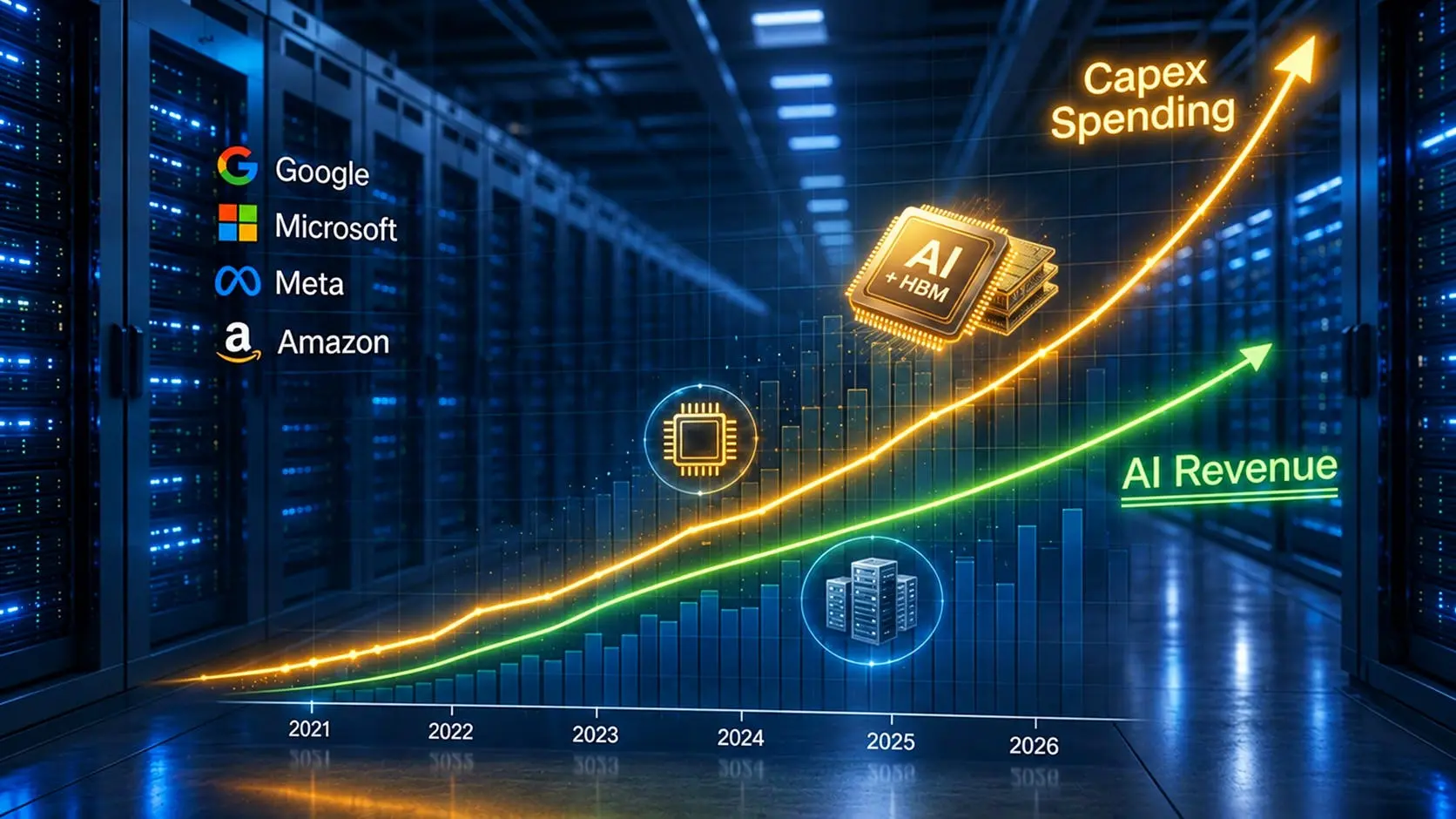
Yet, beneath the celebratory earnings reports and record-shattering market valuations lies a compelling structural paradox unearthed by deep institutional analysis from firms like the I/O Fund. While Big Tech is generating unprecedented AI revenue, the true structural winners—the entities capturing the highest operating margins with the lowest direct exposure to software pricing wars—remain the hardware and infrastructure suppliers. As AI capital expenditure (Capex) races toward an astonishing $1 trillion milestone, the underlying mechanics of this boom reveal that selling the picks and shovels in a digital gold rush remains vastly more lucrative than panning for gold.
The Catalyst: From Experimental Pilots to Enterprise Monopolies
Test Our Free AI & Tech Utilities Suite
Calculate LLM API token costs, analyze article dwell-time, or simulate tech DCA returns.
The transformation of artificial intelligence from a speculative research project into a core economic driver did not happen by accident. Throughout 2024 and 2025, enterprise CIOs experimented cautiously with foundational large language models. By early 2026, those pilots matured into mission-critical deployments across financial services, healthcare, logistics, and software-as-a-service (SaaS) ecosystems.
Microsoft Azure, Amazon Web Services (AWS), and Google Cloud have become the indispensable toll roads of this new technological era. According to recent market intelligence, Azure’s accelerated cloud consumption metrics are directly traceable to enterprise adoption of advanced cognitive services and custom model training pipelines. This surge in enterprise ROI has emboldened executive leadership teams to greenlight multi-year infrastructure commitments.
However, running hyper-scale AI inferencing and training requires a staggering amount of physical resources. The sheer electrical, thermal, and silicon demands have forced hyperscalers into a continuous cycle of aggressive reinvestment. This is precisely where the financial asymmetry becomes clear. For every dollar of new software or cloud service revenue Big Tech captures, a substantial portion flows immediately upstream to semiconductor foundries, advanced packaging specialists, networking gear manufacturers, and alternative energy providers.
Deconstructing the $1 Trillion Capex Super-Cycle

To understand why suppliers maintain the structural advantage, one must examine the forward-looking capital expenditure estimates compiled by leading technology analysts. Industry projections indicate that aggregate AI-related Capex is barreling toward $1 trillion. This level of infrastructure spending is historically unprecedented, rivaling the post-WWII industrial buildouts or the dot-com era fiber-optic cable deployment—with one critical distinction: it is backed by immediate, cash-flowing enterprise demand.
Big Tech firms are locked in a relentless prisoner’s dilemma. To maintain market share and cloud dominance, no single player can afford to under-spend on data center capacity. If Microsoft halts its cluster expansions, enterprise clients migrate to Google or AWS. This structural necessity guarantees a continuous, inelastic demand curve for upstream suppliers.
Consequently, semiconductor designers, foundry operators, and optical networking equipment makers enjoy exceptional pricing power. While downstream application layers face fierce margin compression due to open-source model proliferation and intense SaaS competition, hardware suppliers operate within high-barrier oligopolies. Their valuation multiples are supported by tangible supply constraints, giving them superior risk mitigation characteristics during macroeconomic shifts.
Verified Data & Metrics Breakdown
The following comparative analysis illustrates the shifting financial dynamics between Big Tech hyperscalers and their critical supply chain enablers, reflecting current 2026 market realities:
| Metric / Indicator | Big Tech Hyperscalers (Azure, AWS, GCP) | Upstream AI Suppliers (Hardware & Infrastructure) |
|---|---|---|
| Projected Annual AI Capex | Approaching aggregate $1 Trillion run-rate | Primary beneficiary of total capital inflow |
| Operating Margin Profile | Subject to heavy depreciation and R&D headwinds | High gross margins driven by proprietary IP & scarcity |
| Pricing Power Vulnerability | Moderate-to-High (Cloud commoditization pressures) | Low (Constrained supply meets insatiable demand) |
| Core Revenue Driver | Enterprise SaaS integration, API calls, cloud compute | Advanced accelerators, networking, power infrastructure |
Industry & Market Implications: Winners, Losers, and Economic Shifts
The realization that suppliers hold the structural high ground triggers profound portfolio repositioning across institutional asset management firms. Navigating this landscape requires a sophisticated grasp of market liquidity and valuation multiples.
The Winners: Semiconductor Titans and Infrastructure Enablers
Upstream suppliers—spanning specialized semiconductor manufacturers, high-speed networking innovators, advanced liquid cooling providers, and energy infrastructure developers—are capturing the most pristine cash flows of the AI era. Because their products are mission-critical prerequisites for any enterprise or hyperscaler attempting to train or deploy frontier models, these firms bypass the margin erosion seen in downstream consumer and business software applications.
The Complex Reality for Hyperscalers
While Big Tech firms are unquestionably succeeding in scaling their top-line AI revenues, their bottom lines are tethered to immense capital depreciation cycles. Massive investments in server farms, custom silicon, and real estate mean that free cash flow growth does not always match revenue velocity. Nevertheless, companies like Microsoft, Amazon, and Alphabet possess the balance sheet strength to absorb these costs, securing long-term enterprise lock-in.
Broader Economic and Regulatory Ripple Effects
The sheer magnitude of the $1 trillion infrastructure buildout is reshaping global energy markets and geopolitical supply chains. Power generation, grid modernization, and nuclear energy integration have become inextricable components of tech investing. Simultaneously, regulatory compliance regarding data sovereignty and export controls continues to concentrate advanced manufacturing among a select group of trusted global suppliers.
Frequently Asked Questions (People Also Ask)
Expert Q&A on the AI Infrastructure Economy
Why are suppliers considered better positioned than Big Tech in the AI boom?
Suppliers operate with high gross margins, distinct pricing power, and zero exposure to downstream software price competition. While hyperscalers must constantly spend hundreds of billions on depreciation-heavy infrastructure and R&D, suppliers collect guaranteed upstream revenue across the entire industry's capital expenditure cycle.
How is Big Tech proving that AI can generate meaningful revenue?
Hyperscalers are demonstrating tangible monetization through accelerated cloud consumption metrics on platforms like Microsoft Azure, AWS, and Google Cloud, driven by enterprise-grade API integrations, cognitive services, and large-scale model deployment.
What role does infrastructure scalability play in future AI capital allocation?
Infrastructure scalability dictates which cloud providers can capture surging enterprise demand. Because compute, cooling, and electrical power are finite, capital allocation is heavily skewed toward securing reliable hardware supply chains and robust data center architecture.
What are the primary risk mitigation strategies for institutional investors in tech?
Institutional portfolio managers are diversifying risk by overweighting upstream hardware enablers and diversified semiconductor leaders, shielding their holdings from potential margin contraction or price wars within the generative AI application layer.
Future Outlook: Milestones and Strategic Watchpoints
As the artificial intelligence super-cycle pushes deeper into its next phase, market observers must monitor several definitive inflection points. First, tracking the exact conversion rate of enterprise AI pilots into recurring, non-discretionary software budgets will determine the long-term sustainability of hyperscale revenue growth.
Second, supply chain bottlenecks—particularly in advanced packaging, high-bandwidth memory, and grid-level electrical power—will serve as the ultimate governor of sector-wide expansion. Companies that successfully navigate these physical constraints while preserving operating margins will command premium valuation multiples.
Ultimately, while Big Tech has successfully proven that artificial intelligence is a legitimate, revenue-generating engine, the underlying economics confirm an old market maxim: during a technological gold rush, the entities selling the industrial machinery capture the most durable, risk-adjusted rewards.