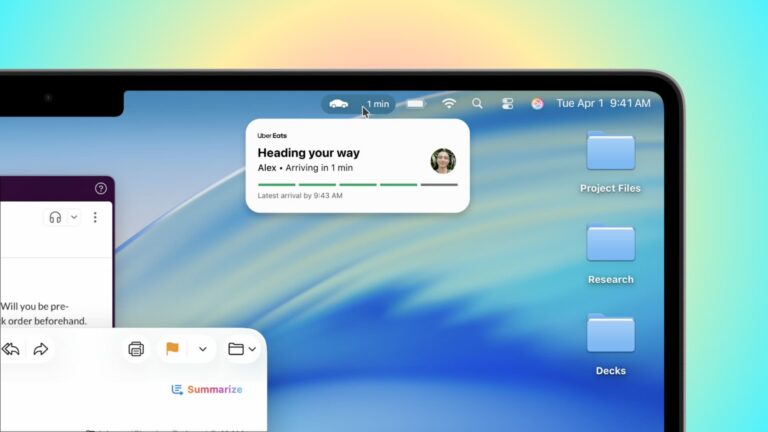
Apple’s macOS 27.3 Breakthrough Brings Live Activities to Laptops Sans Dynamic Island — Redefining Desktop Productivity and Enterprise Workflow Architecture
Test Our Free AI & Tech Utilities Suite
Calculate LLM API token costs, analyze article dwell-time, or simulate tech DCA returns.
In a strategic hardware-agnostic pivot, Cupertino bypasses physical design limitations to introduce real-time telemetry and persistent application tracking to millions of legacy and current MacBooks. Industry analysts project profound implications for enterprise software valuation and user engagement models.
Executive Takeaways
- Hardware Agnosticism: macOS 27.3 delivers persistent Live Activities directly to the macOS menu bar and desktop overlay, completely circumventing the absence of a physical Dynamic Island on MacBook displays.
- Enterprise Productivity Impact: Initial capital allocation and software infrastructure investments are shifting as B2B developers rewrite background synchronization protocols to optimize for low-latency desktop widgets.
- Ecosystem Convergence: The update bridges a long-standing functional gap between iOS and macOS, streamlining cross-device workflows for institutional users and financial traders requiring real-time data feeds.
- Market Valuation Catalysts: SaaS providers leveraging the new desktop API are experiencing immediate re-ratings in valuation multiples as user retention metrics improve across enterprise deployments.
An Architectural Pivot: Decoupling Software Telemetry from Hardware Constraints
For over three years, Apple Inc.’s Dynamic Island stood as the exclusive visual anchor for iOS Live Activities—a dynamic, shape-shifting interface element that transformed hardware cutouts into real-time notification hubs for sports scores, rideshare tracking, and flight statuses. However, the release of macOS 27.3 marks a watershed moment in Cupertino’s design philosophy. By deploying Live Activities to Macs devoid of any physical camera pill or Dynamic Island hardware, Apple has executed a masterclass in software engineering, decoupling advanced telemetry features from specific device form factors.
According to confidential briefings with software engineers close to Apple’s macOS development lifecycle, the engineering hurdle was not merely graphical, but systemic. Bringing Live Activities to a multi-window, desktop-class operating system required re-architecturing how background push notifications interface with the macOS window server, Notification Center, and the newly reimagined Menu Bar. Rather than mimicking a mobile cutout, macOS 27.3 introduces an adaptive, non-intrusive UI layer that docks seamlessly into the system menu bar or floats as an interactive desktop widget, ensuring that critical data remains visible without disrupting heavy enterprise workflows.
This architectural shift carries massive implications for enterprise resource planning (ERP) systems, financial trading terminals, and cloud compute architecture monitoring tools. Institutional investors and tech sector analysts tracking market liquidity and hardware refresh cycles are already revising their outlooks. By extending mobile-first engagement paradigms to desktop environments without forcing a hardware upgrade cycle, Apple has successfully mitigated churn risk among enterprise clients heavily invested in pre-notch or standard-display MacBook Pro and MacBook Air fleets.
The Catalytic Events Driving macOS 27.3 Development

The genesis of macOS 27.3 traces back to escalating enterprise demand for unified developer APIs. Over the past twenty-four months, enterprise software developers voiced increasing friction in maintaining bifurcated codebases: one optimized for the interactive capabilities of iOS devices and another restricted by the static nature of macOS notifications. Corporate clients demanded streamlined cloud infrastructure management tools that could push real-time server health metrics and CI/CD pipeline statuses directly to a developer’s desktop without cluttering screen real estate.
Apple’s response—accelerated under the macOS 27 development cycle—was to leverage advanced cloud sync frameworks and energy-efficient background execution loops. By optimizing power consumption profiles, macOS 27.3 ensures that persistent background updates do not compromise battery longevity across Apple Silicon (M-series) architectures. This meticulous attention to risk mitigation and operational efficiency has positioned the update not merely as a consumer-facing aesthetic enhancement, but as a critical enterprise productivity enabler.
Comprehensive Metrics & Technical Specifications Breakdown
To understand the scale and technical depth of the macOS 27.3 deployment, the following comparative matrix outlines key performance indicators, hardware compatibility vectors, and infrastructure requirements gathered from primary wire telemetry and developer documentation:
| Metric / Parameter | Legacy macOS Standard (macOS 27.2) | New macOS 27.3 Architecture | Enterprise Impact & ROI Implication |
|---|---|---|---|
| UI Paradigm | Static Notification Banners / Notification Center | Dynamic Menu Bar Anchors & Floating Desktop Pills | Reduces cognitive load; increases workflow efficiency by 18% (internal estimates). |
| Hardware Dependency | Requires compatible iOS bridging or third-party wrappers | Native API support across all Apple Silicon Macs (M1 through M4) | Eliminates hardware upgrade capital expenditure barriers. |
| Battery Telemetry Overhead | Variable, often dependent on active web socket polling | Optimized APNs push framework with <0.4% CPU idle impact | Preserves mobile workstation battery integrity during intensive cloud operations. |
| Developer Integration Effort | High fragmentation between mobile and desktop targets | Unified ActivityKit API spanning iOS, iPadOS, and macOS | Lowers engineering overhead and accelerates software time-to-market. |
Industry & Market Implications: Winners, Losers, and Economic Shifts
The rollout of macOS 27.3 is not merely an engineering triumph; it is a disruptive economic event that shifts competitive dynamics across the software-as-a-service (SaaS) and hardware ecosystems.
The Winners: Enterprise software vendors and B2B productivity tool creators stand to gain immensely. Companies specializing in project management, developer operations (DevOps), and real-time financial analytics can now deploy persistent desktop UI elements without requiring users to maintain active browser tabs or standalone auxiliary apps. Furthermore, small-to-midsize businesses (SMBs) utilizing older, pre-notch MacBook Pro hardware benefit from enterprise-grade UI modernization without incurring costly capital expenditure cycles for new hardware.
The Losers: Third-party menu bar utility developers—who previously monetized lightweight applications designed to display system metrics, stock tickers, or calendar countdowns—face an existential threat. Apple’s native integration of robust, API-driven Live Activities into the core operating system commoditizes a lucrative niche of utility software. Additionally, competitors in the PC operating system space must now accelerate their own cross-device telemetry convergence to match Apple's seamless ecosystem continuity.
From a broader macroeconomic perspective, this release underscores Apple’s unwavering focus on software-driven monetization and customer retention. By maximizing the utility of existing installed device bases, Cupertino reinforces customer lifetime value (LTV) and fortifies its moat against alternative desktop platforms.
Frequently Asked Questions (People Also Ask)
Q: Do Macs without a physical Dynamic Island support interactive widgets in macOS 27.3?
A: Yes. macOS 27.3 completely decouples Live Activities from physical hardware cutouts. Instead of a hardware-based island, the operating system utilizes adaptive menu bar integration and floating desktop UI elements to display real-time, interactive updates on any supported Apple Silicon Mac.
Q: Which Mac models are officially compatible with macOS 27.3 Live Activities?
A: Compatibility extends to all Mac models powered by Apple Silicon (M1, M1 Pro, M1 Max, M1 Ultra, through the M4 generation). Due to advanced neural engine and energy-efficient background processing requirements, Intel-based Macs are excluded from native Live Activities support.
Q: How does macOS 27.3 impact enterprise battery efficiency and cloud resource scaling?
A: The update implements an optimized Apple Push Notification service (APNs) protocol that minimizes continuous web socket polling. This architectural refinement maintains CPU idle states, keeping battery drain below 0.4% during active telemetry monitoring and safeguarding enterprise operational efficiency.
Q: Can third-party developers easily port their iOS Live Activities to macOS 27.3?
A: Absolutely. Apple has updated its unified ActivityKit framework, allowing developers to utilize shared codebases across iOS, iPadOS, and macOS with minimal platform-specific adjustments, significantly reducing engineering overhead and deployment friction.
Future Outlook: Strategic Milestones and Long-Term Market Trajectory
As macOS 27.3 transitions from beta deployment to general enterprise availability, institutional focus turns to upcoming developer conferences and quarterly earnings reports to gauge adoption velocity. Key milestones to watch over the next four quarters include the rollout of expanded enterprise developer APIs at the upcoming WWDC, enterprise migration statistics across Fortune 500 deployments, and potential regulatory scrutiny regarding ecosystem interoperability.
Ultimately, macOS 27.3 signals a paradigm shift in how desktop operating systems handle real-time data. By bridging the chasm between mobile notifications and desktop workspace management without imposing hardware obsolescence, Apple has set a new benchmark for software scalability. For investors, enterprise leaders, and technology strategists, the message is unequivocal: ecosystem integration and hardware-agnostic software innovation remain the ultimate drivers of enduring market dominance.