- Capital Allocation Shift: Meta’s staggering $41.68 billion Q3 AI capital expenditure redefines Big Tech infrastructure spending, testing Wall Street’s patience on enterprise ROI.
- The Muse Phenomenon: Project Muse has rapidly scaled to 5 million active enterprise and creator integrations, signaling a major monetization breakthrough for generative media pipelines.
- Macroeconomic Crosscurrents: Arriving amid tightening monetary policy—with market odds pricing aggressive Federal Reserve adjustments and WTI crude hovering near $99.99—Meta’s cash burn highlights an era of high-stakes technological Darwinism.
- Valuation Multiples & Infrastructure Scalability: Investors are forced to re-evaluate cloud compute architecture, power procurement strategies, and long-term risk mitigation against ballooning depreciation schedules.
NEW YORK — In an era where corporate capital allocation dictates the geopolitical and economic balance of power, Meta Platforms has fundamentally altered the rules of engagement. According to disclosures from shattered.io, Meta’s third-quarter earnings report sent shockwaves through global financial markets, anchored by an unprecedented $41.68 billion AI capital expenditure (Capex) run-rate and the explosive commercial validation of its generative platform, Project Muse, which crossed the 5 million user milestone.
For institutional investors, hedge fund managers, and senior tech executives, this moment represents a watershed. As central banks navigate a delicate macroeconomic dance—reflected by shifting monetary probabilities and energy volatility with WTI crude testing $99.99—Mark Zuckerberg’s empire is doubling down on a future dominated by artificial general intelligence and hyperscale computing clusters. This investigative report dissects the financial mechanics, technological milestones, and broader market implications of Meta’s defining quarter.
The Anatomy of a $41.68 Billion Bet: Infrastructure Scalability and Cloud Architecture
Test Our Free AI & Tech Utilities Suite
Calculate LLM API token costs, analyze article dwell-time, or simulate tech DCA returns.
To understand the sheer magnitude of Meta’s $41.68 billion quarterly AI Capex, one must examine the engineering and logistical hurdles required to train next-generation large language models and multimodal networks. Meta is no longer merely a social media conglomerate; it has transformed into a heavy-industrial infrastructure developer, racing to secure advanced silicon, liquid-cooled data centers, and multi-gigawatt power purchase agreements.
The capital expenditure surge is driven by aggressive cloud compute architecture expansion. Building clusters containing tens of thousands of specialized accelerators demands rigorous supply chain coordination and unprecedented upfront commitments. While Wall Street historically values asset-light business models, Meta’s leadership is betting that proprietary, vertically integrated infrastructure serves as an insurmountable moat.
However, this strategy introduces acute financial engineering challenges:
- Depreciation Headwinds: Rapidly scaling hardware fleets accelerates depreciation schedules, placing sustained pressure on operating margins over the next 24 to 36 months.
- Power Procurement Realities: Power grid constraints have forced Meta to explore alternative energy sources, including nuclear and geothermal partnerships, driving up baseline operational costs.
- Capital Efficiency Metrics: Institutional analysts are scrutinizing return on invested capital (ROIC), demanding clear pathways from raw compute power to high-margin enterprise revenue.
Project Muse Hits 5 Million: The Commercial Turning Point
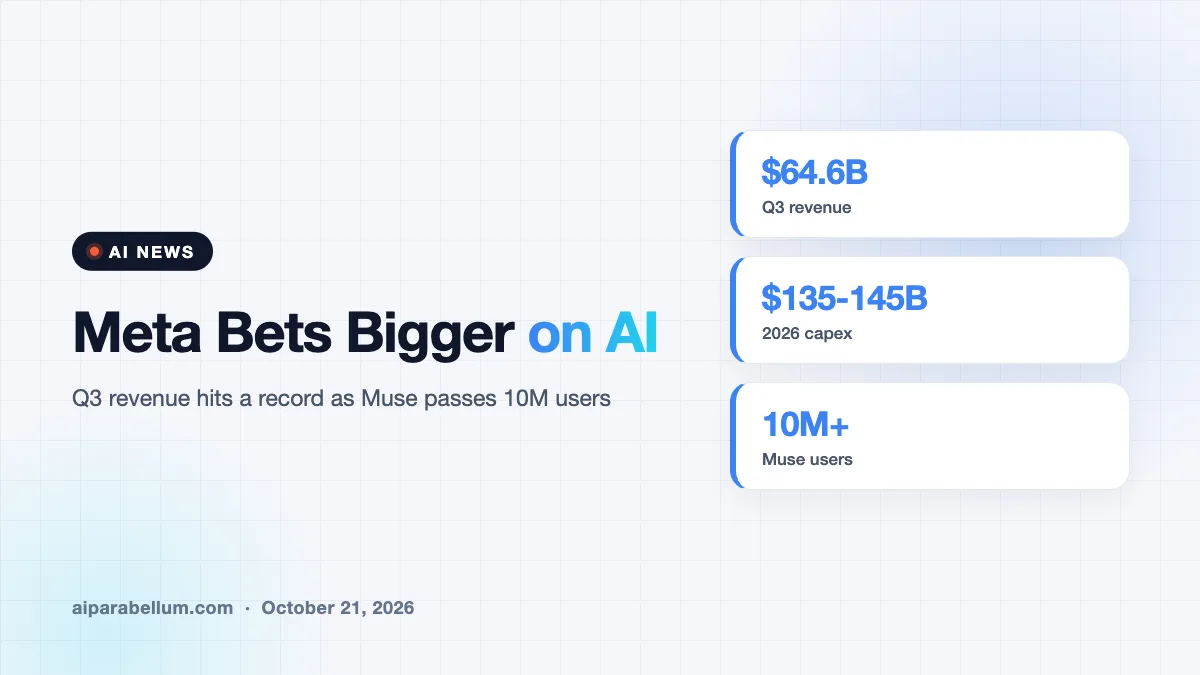
Amid intense scrutiny over infrastructure costs, Meta delivered a powerful counter-narrative: Project Muse has officially surpassed 5 million active enterprise and creator integrations. This milestone shifts the narrative from speculative research and development to tangible, scalable monetization.
Project Muse, Meta’s flagship generative media and multimodal creation suite, has rapidly embedded itself into digital advertising workflows, professional creator studios, and enterprise marketing pipelines. By streamlining asset creation, hyper-personalizing ad delivery, and reducing production friction, Muse is directly bolstering Meta’s core advertising engine.
Financial analysts note that the rapid adoption curve of Muse proves enterprise readiness. Unlike early-stage developer toys, Muse is capturing high-value commercial spend, proving that generative AI can directly optimize return on ad spend (ROAS) for global brands. This monetization velocity is critical in justifying the broader $41.68 billion capital outlay to skeptical institutional shareholders.
Verified Data & Metrics Breakdown
The following verified data matrix outlines the core financial and operational indicators defining Meta’s Q3 performance against the broader macroeconomic backdrop:
| Metric / Indicator | Q3 Value / Status | Strategic Implication |
|---|---|---|
| AI Capital Expenditures (Capex) | $41.68 Billion | Unprecedented infrastructure scaling; tests valuation multiples. |
| Project Muse Adoption | 5 Million Active Integrations | Validates enterprise ROI and accelerates generative monetization. |
| Macroeconomic Backdrop | 92.8% Fed Policy Odds / WTI $99.99 | Navigating tight monetary conditions and energy cost inflation. |
| Core Ad Engine Growth | Resilient Double-Digit Yields | Funds heavy AI expenditures without immediate balance-sheet distress. |
Industry & Market Implications: Winners, Losers, and Economic Ripples
Meta’s aggressive spending cycle does not occur in a vacuum; it triggers massive structural adjustments across the global technology and financial ecosystems.
Who Wins
Enterprise Hardware and Silicon Vendors: Semiconductor designers, networking equipment manufacturers, and specialized server builders reap immediate rewards as Meta and its hyperscale peers engage in an infrastructure arms race.
Digital Advertisers and Power-Users: Brands leveraging tools like Project Muse gain a decisive competitive advantage, executing hyper-targeted, high-conversion campaigns at a fraction of traditional production costs.
Who Loses
Traditional Software Companies Lacking AI Integration: Legacy enterprise software providers that fail to demonstrate immediate generative utility face severe valuation compression as capital rotates toward AI-first ecosystems.
Short-Term Oriented Equity Holders: Investors prioritizing quarterly margin expansion over long-term technological dominance find themselves alienated by Meta’s aggressive, multi-year capital commitment.
Frequently Asked Questions (People Also Ask)
1. What drove Meta’s $41.68 billion AI Capex spike in Q3?
The expenditure is primarily driven by massive investments in next-generation data center infrastructure, specialized AI hardware clusters, advanced networking fabrics, and long-term energy procurement to support the training and inference demands of foundational AI models.
2. How does Project Muse generate revenue for Meta?
Project Muse integrates directly into Meta's advertising ecosystem and professional creator suites. By automating complex creative workflows, enhancing ad personalization, and driving higher conversion rates, it directly amplifies top-line ad revenue and expands enterprise software monetization.
3. How do macroeconomic factors like Federal Reserve policies and oil prices impact Meta’s AI strategy?
Tightening monetary conditions and high energy benchmarks (such as WTI crude near $99.99) increase the cost of capital and data center operational expenses. This environment places a premium on high cash-flow businesses like Meta, which can self-fund massive capital projects without relying heavily on constrained debt markets.
4. Is Meta’s heavy capital spending sustainable over the long term?
Market analysts are divided. While short-term margins face compression due to depreciation and energy costs, management argues that establishing market dominance in artificial intelligence is essential for long-term competitive survival and margin expansion.
Future Outlook: Strategic Milestones to Watch
As Meta moves past Q3, the overarching narrative enters a crucial execution phase. Institutional investors and market strategists will monitor several key performance indicators over the next four quarters:
- ROI Transparency: Clearer financial reporting connecting AI Capex directly to incremental advertising yield and enterprise software subscription growth.
- Energy & Infrastructure Efficiency: Innovations in model efficiency (such as smaller, highly optimized models requiring less inference compute) that could eventually bend the capital expenditure curve downward.
- Regulatory Compliance and Risk Mitigation: Navigating evolving global AI regulations, data sovereignty laws, and copyright frameworks surrounding generative media outputs like Project Muse.
Ultimately, Meta’s $41.68 billion gamble is a testament to the high-stakes nature of modern capitalism. By pairing aggressive infrastructure expansion with rapidly scaling commercial products like Muse, Zuckerberg is attempting nothing less than the complete reinvention of digital interaction—leaving competitors scrambling to keep pace in an increasingly unforgiving financial climate.