

The AI Trade Resurrects Wall Street: Inside the Rebound Driven by Big Tech Infrastructure and Q3 Earnings
Test Our Free AI & Tech Utilities Suite
Calculate LLM API token costs, analyze article dwell-time, or simulate tech DCA returns.
Executive Takeaways
- AI-Driven Resurgence: A renewed wave of buying in semiconductor and cloud infrastructure giants propelled major US benchmarks upward, offsetting severe individual equities losses.
- Divergent Market Health: While the S&P 500 gained 0.6% and the Dow Jones Industrial Average scraped out a marginal 0.03% gain, severe underperformance in industrial and aerospace heavyweights underscored underlying macroeconomic volatility.
- Earnings Reality Check: As third-quarter reporting season accelerates, institutional capital allocation is shifting toward firms demonstrating immediate enterprise ROI on AI capital expenditures.
- Bubble Warnings vs. Balance Sheets: Persistent debate surrounds valuation multiples, yet institutional liquidity continues to favor high-growth tech over traditional defensive postures.
Introduction: The AI Trade Refuses to Die
Wall Street’s persistent fascination—and financial reliance—on artificial intelligence infrastructure experienced another violent repricing upward on Tuesday. As trading desks across Lower Manhattan digested a torrent of third-quarter corporate earnings, the overarching narrative remained resolutely anchored to the structural buildout of generative AI. Far from running out of momentum, the market demonstrated that any macroeconomic anxiety is swiftly neutralized whenever a major technology bellwether reaffirms its commitment to capital expenditure in advanced compute architecture.
The session closed with the S&P 500 advancing 0.6%, while the Dow Jones Industrial Average barely crossed into positive territory with a 0.03% uptick. Beneath these headline indices, however, lay a volatile ecosystem of stark divergence. While mega-cap technology and select logistics plays surged, heavy industrials and aerospace contractors suffered sharp liquidations. This deep-dive investigative report explores the structural mechanics behind Tuesday’s rally, examines the underlying data, analyzes the winners and losers of the current reporting cycle, and assesses the sustainability of the ongoing AI momentum trade.
The Catalytic Forces: Q3 Earnings Meet Infrastructure Scalability
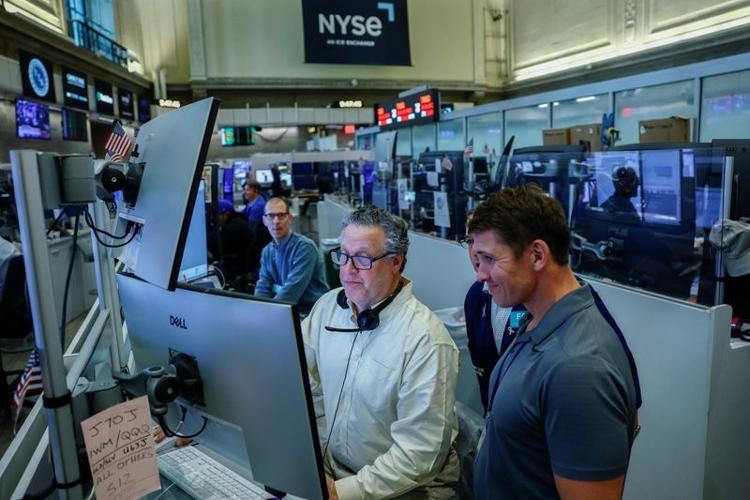
The primary catalyst for Tuesday's market action was not a macro data release from the Federal Reserve, nor a shift in interest rate expectations. Instead, it was the intersection of third-quarter corporate disclosures and institutional reallocation into high-beta technology assets. Portfolio managers navigating the final quarter of the fiscal year are under intense pressure to justify their annual alpha generation, leading to aggressive buying in names perceived as non-negotiable holdings in the digital economy.
For months, Wall Street strategists have debated whether the massive capital allocation toward data centers, power generation, and advanced semiconductors would yield acceptable enterprise ROI. Tuesday's session provided reassurance to bulls. Corporations reporting during this cycle are increasingly detailing how AI integration is driving operational efficiencies, reducing labor costs, and expanding cloud compute architecture margins. Consequently, fears of a near-term valuation collapse were temporarily shelved as institutional liquidity rushed back into the sector.
Yet, this enthusiasm exists alongside vocal skepticism. Prominent market bears continue to warn that the market is exhibiting classic bubble characteristics. Warnings that "Big Tech could drop 25%" under the weight of stretched valuation multiples and potential regulatory compliance hurdles remain a persistent dark cloud. Nonetheless, short-term momentum decisively overpowered long-term caution during Tuesday’s session, fueled by algorithmic rebalancing and active portfolio window-dressing.
Market Performance Breakdown
The day's tape revealed profound bifurcation across sectors. While the broad market celebrated the tech revival, idiosyncratic corporate disasters reminded investors of the risks inherent in holding single-stock concentration.
| Index / Ticker | Daily Change | Classification | Primary Driver |
|---|---|---|---|
| S&P 500 (US500) | +0.6% | Broad Market Index | Tech sector outperformance and AI momentum revival. |
| Dow Jones (DJI) | +0.03% | Price-Weighted Index | Weighed down by industrial and manufacturing laggards. |
| Boeing (BA) | -10.69% | Aerospace & Defense | Ongoing operational challenges, labor disputes, and cash burn concerns. |
| Sherwin-Williams (SHW) | -2.73% | Specialty Chemicals | Softer housing market data and margin pressures. |
| United Parcel Service (UPS) | +5.75% | Logistics & Transport | Better-than-expected operational efficiency and volume stabilization. |
Industry and Market Implications: Winners, Losers, and Macro Fallout
The sharp contrast between the performance of tech-heavy assets and legacy industrial names highlights a broader structural transition in the global economy. Capital is increasingly concentrating in sectors capable of generating exponential scale with minimal physical friction, while capital-intensive, labor-reliant industries face severe margin compression.
The Winners: Cloud Infrastructure and Logistics Optimization
Semiconductor designers, hyperscale cloud providers, and logistics firms that successfully integrate automation emerged victorious. United Parcel Service’s 5.75% surge illustrates that traditional blue-chip enterprises can still command investor confidence if they demonstrate rigorous cost containment and operational agility. Meanwhile, the broader technology complex continues to act as a magnet for global liquidity, proving immune to traditional valuation metrics in the short term.
The Losers: Industrial Stagnation and Single-Stock Risk
Conversely, Boeing’s staggering 10.69% drop serves as a stark warning regarding systemic risk in legacy manufacturing. Persistent regulatory scrutiny, supply chain bottlenecks, and severe cash burn continue to plague the aerospace giant, dragging down sentiment across traditional industrial portfolios. Specialty chemicals provider Sherwin-Williams also faltered (-2.73%), reflecting persistent weakness in end-markets like residential construction and commercial real estate.
Frequently Asked Questions (People Also Ask)
1. What caused the Wall Street rally on Tuesday?
The market rally was primarily driven by revived momentum in artificial intelligence and technology stocks during the third-quarter earnings reporting cycle. Strong investor appetite for cloud infrastructure and semiconductor firms overshadowed weakness in industrial and manufacturing equities, pushing major indices like the S&P 500 up by 0.6%.
2. Are we currently in an artificial intelligence stock bubble?
Market analysts are deeply divided. While bulls argue that massive enterprise capital expenditures in AI infrastructure are justified by long-term productivity gains and enterprise ROI, bears warn that stretched valuation multiples and overly optimistic growth projections could lead to significant corrections, with some citing the potential for a 25% pullback in Big Tech if earnings fail to meet lofty expectations.
3. Why did Boeing (BA) shares drop so significantly?
Boeing shares plunged 10.69% due to compounding operational challenges, including ongoing manufacturing quality controls, regulatory hurdles, labor negotiations, and substantial negative free cash flow that continues to alarm institutional investors.
4. How are Q3 corporate earnings impacting institutional capital allocation?
Institutional portfolio managers are aggressively reallocating capital away from stagnant or capital-intensive sectors and into companies demonstrating immediate technological leverage, cost efficiencies, and robust balance sheets capable of weathering macroeconomic uncertainty.
Future Outlook: What Comes Next for Wall Street
As the third-quarter earnings season progresses, Wall Street’s near-term trajectory will depend heavily on forward-looking guidance from mega-cap technology executives. Key milestones to watch include upcoming announcements regarding data center power consumption, semiconductor supply chain constraints, and potential shifts in Federal Reserve monetary policy regarding interest rates and liquidity management.
While the AI trade has proven remarkably resilient, investors must remain vigilant regarding risk mitigation. Valuation discipline, rigorous balance sheet analysis, and sensitivity to regulatory shifts will dictate which portfolios successfully navigate the remainder of the fiscal year. For now, the bulls remain firmly in control, betting that the structural transformation of the global economy through artificial intelligence is still in its early innings.


