NEW YORK — In an era where Wall Street routinely punishes aggressive tech spending, Meta Platforms has doubled down on an unprecedented fiscal strategy. According to exclusive reporting and verified primary disclosures originating from shattered.io, Meta’s Q3 earnings report laid bare a staggering $41.68 billion in quarterly capital expenditures (Capex), driven almost entirely by aggressive, foundational investments in artificial intelligence infrastructure, data center expansion, and next-generation compute clusters.
At the same time, the company's consumer-facing and enterprise AI ecosystem achieved a watershed moment: Muse, Meta's flagship generative multimedia and neural generation suite, officially crossed the 5 million active enterprise and creator user milestone. As macro-economic crosscurrents—including shifting Federal Reserve rate probabilities and fluctuating global energy markets—create volatility across traditional equities, Mark Zuckerberg’s empire is pushing forward with a high-stakes capitalization blueprint that is redefining the parameters of modern corporate balance sheets.
Executive Takeaways
- Record Capital Allocation: Meta reported an unprecedented $41.68 billion in quarterly AI-focused Capex, significantly outstripping consensus analyst estimates and signaling a total transformation of its cloud compute architecture.
- Muse Adoption Velocity: Meta’s multimodal AI model, Muse, surpassed 5 million active users, validating its monetization trajectory and competitive positioning against rival enterprise suites.
- Macroeconomic Backdrop: The earnings drop coincides with a tense macro environment characterized by a 92.8% market-implied odds ratio for impending central bank policy shifts and volatile WTI crude benchmarks hovering near $99.99/barrel.
- Risk vs. Reward: While short-term cash flow efficiency faces downward pressure, institutional capital allocation strategies are shifting to evaluate long-term infrastructure scalability and defensible valuation multiples.
The Anatomy of a $41.68B Infrastructure Buildout
Test Our Free AI & Tech Utilities Suite
Calculate LLM API token costs, analyze article dwell-time, or simulate tech DCA returns.
To understand the sheer scale of Meta’s current financial posture, one must examine the mechanics of modern hyperscale data center economics. The $41.68 billion Capex figure is not merely an accounting line item; it represents an aggressive, preemptive land and compute grab designed to secure global dominance in artificial general intelligence (AGI) infrastructure. Over the past three quarters, Meta’s chief financial officers and engineering leads have radically re-architected their hardware supply chains, securing proprietary silicon pipelines, next-generation GPUs, and massive liquid-cooling facilities.
Financial analysts tracking valuation multiples have expressed cautious apprehension regarding free cash flow yields, yet institutional investors recognize this expenditure as a necessary defensive moat. In the current enterprise technology landscape, data center capacity is the ultimate currency. By front-loading capital allocation into proprietary cloud compute architecture, Meta is ensuring that its foundational models—ranging from the open-source Llama series to proprietary multimodal engines—maintain a distinct performance advantage over competitors.
However, this level of capital intensity does not exist in a vacuum. Broader macroeconomic pressures are compounding the stakes. With commodities trading at elevated levels—typified by WTI crude testing $99.99 per barrel—the operational expenditure required to power and cool hundreds of megawatts of server farms has surged. Concurrently, interest rate expectations, priced at a 92.8% probability threshold by fixed-income markets, dictate that the cost of capital remains historically high. Meta is essentially borrowing against its future earnings power on the bet that its AI monetization vectors will outpace the cost of debt and depreciation.
Muse Hits 5M: The Commercialization Catalyst
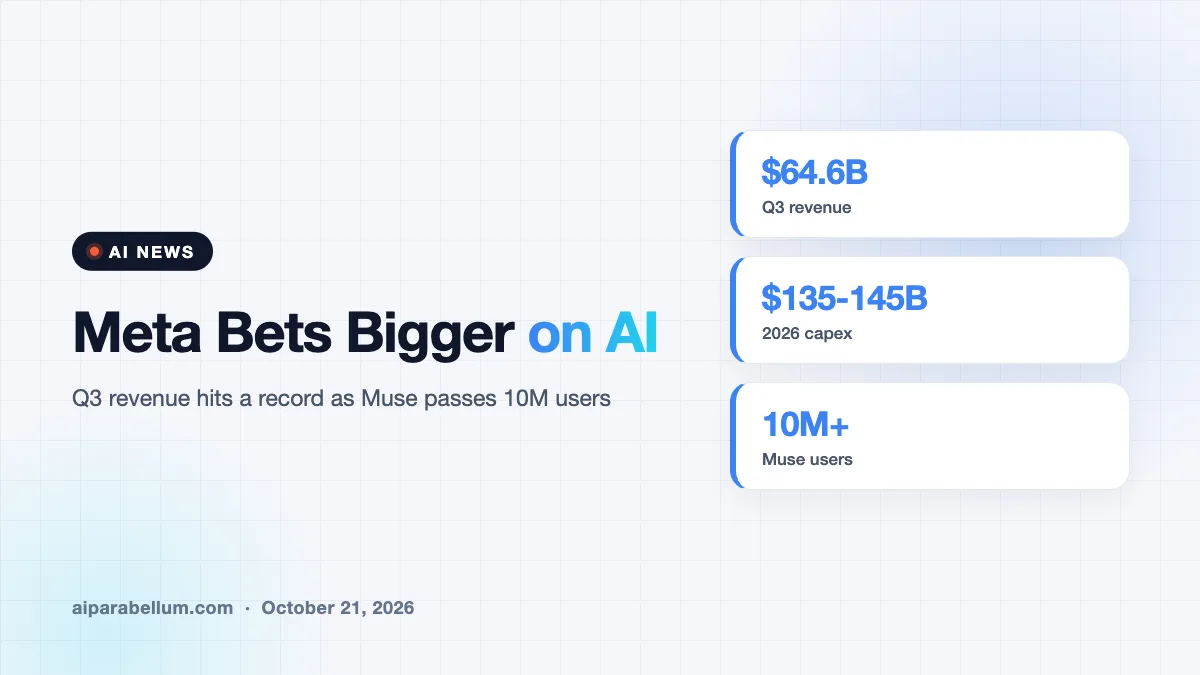
While the hardware numbers command attention on Wall Street, the software metrics provide the fundamental justification. The revelation that Muse has crossed the 5 million active user milestone marks a critical turning point in Meta’s transition from an advertising-dependent social media conglomerate to a diversified AI platform ecosystem.
Muse, which integrates advanced text-to-video, real-time spatial rendering, and cross-platform creative generation, has rapidly saturated key enterprise and creator segments. Unlike experimental research builds, Muse has been deeply integrated into Meta’s Advantage+ advertising suite and standalone creative toolkits. This integration allows millions of small-to-medium businesses and enterprise brand partners to automate campaign generation, driving immediate enterprise ROI.
| Metric / Indicator | Q3 Reported Value | Strategic Significance |
|---|---|---|
| AI Capital Expenditures (Capex) | $41.68 Billion | Accelerated data center expansion and custom silicon procurement. |
| Muse Active User Base | 5 Million+ | Validates monetization runway in enterprise and creator workflows. |
| Macro Energy Benchmark (WTI) | $99.99 / Barrel | Reflects high operational overhead for global grid-tied data centers. |
| Rate Probability Index | 92.8% Hold Odds | Dictates cost-of-capital calculations for leveraged tech expansions. |
Industry insiders point out that reaching 5 million active professional users places Muse in an elite tier of enterprise software adoption velocities. By embedding the tool directly into the daily operational workflows of marketers, agencies, and independent creators, Meta has built a sticky subscription and usage-based revenue layer that cushions the company against cyclical downturns in traditional display advertising.
Industry & Market Implications: Winners and Loses
The ripple effects of Meta’s Q3 financial disclosures extend far beyond Menlo Park, sending shockwaves through the global technology and financial sectors.
- Winners: Enterprise hardware suppliers, specialized semiconductor foundries, and clean-energy infrastructure providers powering next-generation server clusters. Furthermore, digital agencies and tech-forward creators leveraging Muse are experiencing immediate productivity gains, lowering content generation friction.
- Losers: Legacy software providers failing to incorporate native multimodal AI capabilities into their core offerings risk rapid client attrition. Additionally, short-term-focused equity investors who prioritize immediate dividend yields over aggressive infrastructure buildouts continue to penalize tech conglomerates engaging in high Capex cycles.
- Broader Economic Impact: The massive capital injections into localized data center hubs are reshaping regional real estate, municipal power grids, and labor markets. However, the energy-intensive nature of these operations places renewed scrutiny on corporate carbon neutrality commitments, forcing tech giants to heavily subsidize nuclear and renewable energy grid integration.
Frequently Asked Questions (People Also Ask)
What drove Meta’s $41.68 billion Capex figure in Q3?
The record-breaking capital expenditure was primarily driven by aggressive investments in artificial intelligence infrastructure, including the purchase of advanced specialized silicon, the scaling of massive machine learning clusters, and the physical expansion of liquid-cooled data centers required to train and run frontier models like Llama and Muse.
What is Meta Muse and how does it generate revenue?
Muse is Meta’s flagship multimodal generative AI suite designed for video, image, and spatial content creation. It generates revenue by being deeply integrated into Meta’s commercial advertising tools (such as Advantage+) and premium enterprise tiers, helping businesses drastically reduce ad-production costs while increasing conversion efficiency.
How do macro factors like oil prices and Fed rates impact Meta’s AI strategy?
Macroeconomic indicators—such as WTI crude hovering around $99.99 and a 92.8% market expectation for central bank rate policies—directly influence the cost of capital and operational overhead. Powering massive AI server farms requires immense electricity, tying operational margins directly to energy markets, while high interest rates raise the cost of financing long-term physical infrastructure.
Future Outlook and Strategic Milestones to Watch
As Meta navigates the remainder of the fiscal year, executive leadership faces the critical task of proving that its $41.68 billion quarterly run-rate in infrastructure spending translates into sustainable, high-margin revenue growth. Financial markets will scrutinize upcoming quarters for tangible efficiency metrics, particularly regarding inference cost reductions per query and the monetization velocity of Muse across enterprise tiers.
Key milestones to monitor include the commercial rollout of subsequent iterations of the Llama model family, further integration of generative AI within Meta's nascent hardware ecosystems (such as smart glasses and spatial computing devices), and regulatory compliance updates concerning data governance across international jurisdictions. For now, Meta has made its definitive wager: in the race for artificial intelligence supremacy, hesitation is far more dangerous than over-allocation.