Executive Takeaways
- Astounding Capital Allocation: Meta reported an unprecedented $41.68 billion in quarterly AI capital expenditures (Capex), setting a new benchmark for hyper-scale infrastructure investment and challenging historical valuation multiples.
- The "Muse" Inflection Point: Meta’s next-generation generative ecosystem platform, Muse, officially crossed the 5 million enterprise and active creator deployment milestone, signaling immediate commercial viability.
- Macroeconomic Convergence: The massive expenditure arrives amid delicate macroeconomic pressures, intersecting with shifting Federal Reserve liquidity signals and elevated energy markets (WTI crude pressing near $99.99).
- Wall Street Re-Rating: Analysts are sharply divided over whether Meta's aggressive cloud compute architecture and hardware buildout will yield sustainable long-term enterprise ROI or compress near-term free cash flow.
NEW YORK — In a fiscal disclosure that has sent immediate shockwaves across global financial markets, Meta Platforms has fundamentally redefined the parameters of enterprise technology spending. According to primary wire reports and verified financial disclosures breaking out of Silicon Valley, Meta’s Q3 earnings report revealed a staggering $41.68 billion in AI capital expenditures, anchored by the explosive adoption of its proprietary Muse platform, which has officially breached the 5 million active user milestone.
For institutional investors, venture capital syndicates, and corporate strategists, this dual revelation—immense, front-loaded infrastructure investments matched against rapid product penetration—serves as the definitive case study for the 2026 corporate technology cycle. As Big Tech races to secure generative intelligence dominance, Mark Zuckerberg’s enterprise is betting its future on the thesis that aggressive supply-chain cornering and state-of-the-art cloud compute architecture will yield an insurmountable economic moat.
The Catalytic Shift: Dissecting the $41.68B AI Infrastructure Buildout
Test Our Free AI & Tech Utilities Suite
Calculate LLM API token costs, analyze article dwell-time, or simulate tech DCA returns.
To understand the sheer magnitude of Meta’s $41.68 billion quarterly CapEx figure, one must examine the operational realities of modern large language model training and inference scaling. Meta’s leadership has systematically dismantled traditional corporate fiscal conservatism, prioritizing absolute technological supremacy over short-term margin optimization. This capital allocation strategy centers on the rapid procurement of next-generation GPU clusters, specialized silicon, high-bandwidth memory (HBM), and hyper-scale data center facilities capable of handling multi-trillion parameter workloads.
Industry analysts tracking cloud compute architecture note that this expenditure is not merely about purchasing hardware; it represents a comprehensive overhaul of global networking and power grids. With energy costs remaining elevated—compounded by broader macroeconomic realities such as WTI crude hovering near $99.99 and shifting monetary policy expectations—Meta’s ability to secure reliable, high-capacity power for its server farms has become a critical operational risk-mitigation exercise.
Despite initial murmurs from short-term traders regarding free cash flow compression, long-term institutional stakeholders view the spend as a necessary preemptive strike. By locking down long-term supply contracts for advanced accelerators and expanding proprietary data center real estate, Meta is effectively building a structural barrier to entry that smaller competitors cannot hope to replicate.
Muse Hits 5 Million: Translating Raw Compute Into Tangible Market Share
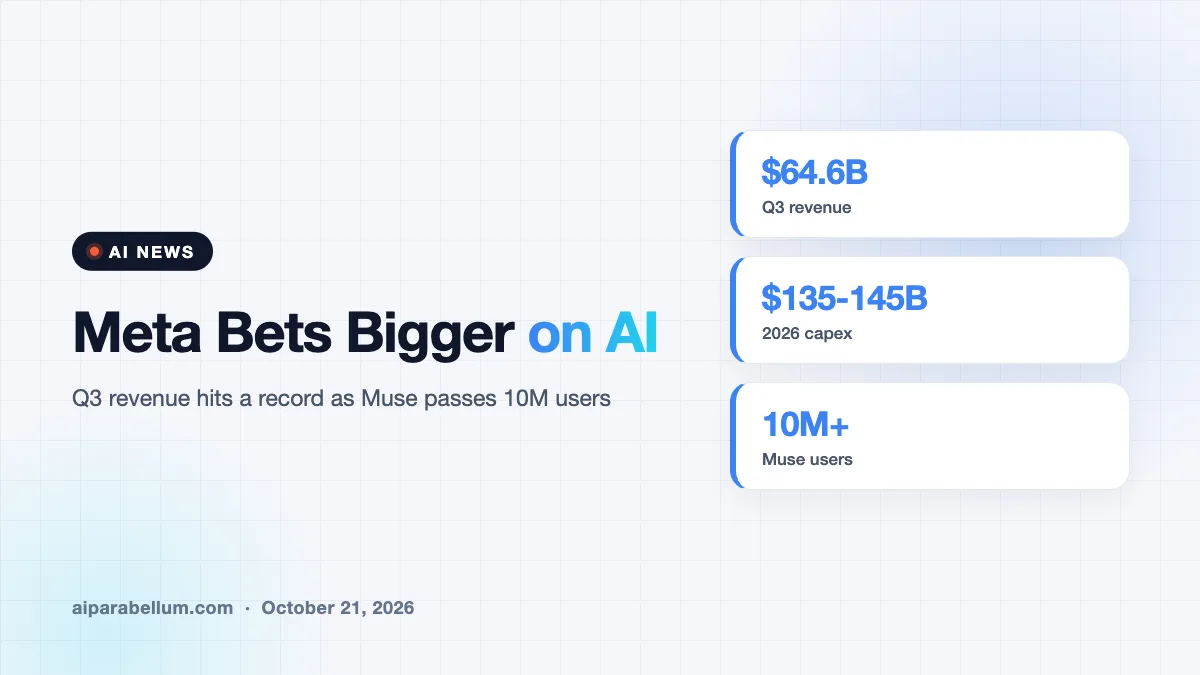
Skeptics of big-tech AI spending have long demanded proof of enterprise monetization. Meta answered that critique head-on by confirming that Muse, its flagship multi-modal creative and analytical intelligence suite, has officially crossed 5 million active deployments.
Muse has rapidly evolved from an internal research prototype into an indispensable utility for enterprise marketers, creative agencies, and independent creators globally. By integrating seamless generative workflows directly into the core Facebook, Instagram, and WhatsApp business ecosystems, Meta has closed the loop between AI investment and direct revenue generation. The platform's ability to drive hyper-personalized ad creation, automate complex multimedia campaigns, and slash content production overhead has created an undeniable enterprise ROI.
Market intelligence firms point out that reaching 5 million paying or deeply integrated professional users transforms Muse from an experimental feature into a foundational SaaS-like revenue pillar. This software stickiness provides the top-line revenue necessary to justify the staggering capital investments bleeding out of the balance sheet.
| Metric / Indicator | Q3 Reported Figure | Strategic Implication |
|---|---|---|
| AI Capital Expenditures (CapEx) | $41.68 Billion | Unprecedented infrastructure scale; aggressive GPU and data center acquisition. |
| Muse Platform Adoption | 5 Million Active Users | Validates monetization thesis; proves immediate enterprise and creator utility. |
| Primary Operational Focus | Compute & Energy Scalability | Requires massive power grid access amid volatile macroeconomic energy prices. |
| Market Sentiment Impact | Polarized / High Volatility | Weighs near-term margin pressures against long-term technological dominance. |
Industry & Market Implications: Winners, Losers, and Macro Pressures
The shockwaves from Meta’s Q3 financial blueprint extend far beyond Menlo Park, sending ripples across global semiconductor supply chains, enterprise software markets, and macroeconomic forecasting models.
- The Silicon and Hardware Beneficiaries: Semiconductor fabricators, advanced packaging specialists, and networking hardware providers stand as immediate financial victors. Meta’s multi-billion dollar checkbook directly underwrites the revenue growth of elite chip designers and server manufacturers.
- Traditional SaaS Vulnerability: Standalone software companies lacking deep proprietary AI moats face heightened competitive pressure. As Meta and its peers bundle advanced generative tools like Muse directly into established ecosystem workflows, enterprise buyers are increasingly questioning the value proposition of legacy point solutions.
- Macroeconomic Headwinds: Operating against a backdrop of tight monetary policy and high commodity costs, corporate balance sheets are being severely tested. Meta’s ability to self-fund this immense capital expenditure through its wildly profitable core advertising engine separates it from cash-burning startups, yet it still subjects the stock to intense valuation multiple scrutiny from institutional portfolio managers.
Frequently Asked Questions (People Also Ask)
What drove Meta’s record $41.68 billion AI CapEx in Q3?
The historic expenditure was driven by an aggressive, accelerated buildout of next-generation AI data centers, massive procurement of specialized AI accelerators and GPUs, and the massive power and networking infrastructure required to train and run frontier-scale multi-modal machine learning models.
What is Meta's Muse platform and how does it generate revenue?
Muse is Meta's flagship generative creative and analytical intelligence suite. It empowers enterprises, brands, and content creators to automate sophisticated marketing campaigns, generate high-converting ad creative, and streamline workflows. Having surpassed 5 million active users, it monetizes by driving higher advertising efficacy, increasing platform engagement, and offering premium enterprise productivity features.
How is Wall Street reacting to Meta's aggressive capital allocation?
Wall Street sentiment is currently bifurcated. Short-term focused analysts express concern over free cash flow compression and rising depreciation costs. Conversely, long-term institutional investors praise the strategy as a bold, necessary move to secure absolute monopolistic control over the next era of digital infrastructure and digital advertising.
What role do macroeconomic factors play in Meta's current financial strategy?
Macro factors—including fluctuating Federal Reserve liquidity outlooks and high energy costs (with WTI crude near $99.99)—directly impact the cost of powering hyper-scale data centers. Meta must balance its aggressive expansion with rigorous risk management to ensure operational efficiency amidst broader economic volatility.
Future Outlook: What Comes Next and Key Milestones to Watch
As the tech sector digests Meta’s transformative financial disclosures, attention immediately turns to execution risks and upcoming fiscal quarters. The central question facing executive leadership is not whether they can spend capital—the $41.68 billion figure proves they can—but whether that capital will generate a compounding return that outpaces depreciation and rising energy overhead.
Key milestones to monitor over the next twelve months include:
- CapEx Trajectory Stabilization: Whether Q3 represents peak capital intensity or if quarterly infrastructure spending will continue to scale upward into 2027.
- Muse Commercial Scaling: Metrics regarding enterprise tier conversion rates and average revenue per user (ARPU) expansion tied directly to the Muse platform ecosystem.
- Power and Regulatory Compliance: How Meta navigates environmental regulations, grid capacity constraints, and power procurement contracts in an era of elevated energy pricing.
Meta has cast the die. By prioritizing uncompromising infrastructure dominance and successfully scaling platforms like Muse to millions of active users, the company has raised the stakes for the entire global technology ecosystem. For investors and industry leaders alike, navigating this new financial reality will require a rigorous focus on execution, efficiency, and the true monetization of artificial intelligence.