As election cycles accelerate across the United States, institutional investors, corporate treasurers, and wealth managers are pivoting their focus from traditional fundamental analysis to macroeconomic risk mitigation. The impending midterm elections represent more than a routine shift in congressional majorities; they are a profound systemic inflection point for capital allocation, valuation multiples, and federal fiscal trajectory. With the national debt eclipsing historic thresholds and monetary policy remaining tightly wound, the legislative stalemate or alignment emerging from the midterms will directly dictate corporate tax regimes, regulatory compliance frameworks, and federal borrowing velocity.
Behind closed doors in major financial hubs from Wall Street to the City of London, risk committees are stress-testing portfolios against varying election outcomes. Will divided government impose fiscal discipline through gridlock, or will partisan brinkmanship trigger renewed showdowns over the debt ceiling? How will shifting committee chairmanships impact defense spending, energy transition subsidies, and antitrust enforcement? This investigative report unpacks the hidden mechanics connecting congressional math to market liquidity, debt yields, and enterprise valuations.
Executive Takeaways
- Fiscal Gridlock vs. Partisan Brinkmanship: A divided Congress historically reduces major legislative volatility, forcing fiscal stasis, but simultaneously heightens the risk of recurring debt-ceiling confrontations that rattle short-term Treasury liquidity.
- Tax Policy & Valuation Multiples: The expiration horizon of key provisions from the 2017 Tax Cuts and Jobs Act (TCJA) places corporate earnings and valuation multiples directly in the crosshairs of upcoming congressional negotiations.
- Capital Allocation Shifts: Sectors heavily reliant on government subsidies—such as clean energy, defense contractors, and healthcare providers—face acute regulatory risk and volatility depending on which party controls key oversight committees.
- Sovereign Debt Realities: Regardless of the electoral split, structural deficits remain entrenched, keeping upward pressure on long-term Treasury yields and crowding out private sector capital access.
The Macroeconomic Nexus: Elections, Deficits, and Market Liquidity
Test Our Free AI & Tech Utilities Suite
Calculate LLM API token costs, analyze article dwell-time, or simulate tech DCA returns.
To understand the market implications of the midterms, one must first examine the deteriorating health of the federal balance sheet. The U.S. national debt has surged past $34 trillion, driven by pandemic-era stimulus, post-pandemic infrastructure spending, and escalating mandatory outlays for entitlement programs and interest payments. When investors evaluate sovereign risk, they look closely at the primary deficit and the political willingness to enact structural reforms.
Historically, divided government—where the White House is controlled by one party and at least one chamber of Congress by the other—has been viewed favorably by equity markets as a guarantor of policy moderation. By preventing sweeping, unhedged fiscal expansions or sudden regulatory overhauls, gridlock preserves a predictable operating environment for multinational enterprises. However, modern hyper-partisanship has inverted this dynamic. Instead of benign stasis, divided government now frequently manifests as fiscal brinkmanship, characterized by government shutdown threats, protracted budget negotiations, and last-minute suspensions of the debt ceiling.
These recurring standoffs inject artificial volatility into short-term funding markets. When the Treasury General Account (TGA) is drained and subsequently refilled around debt limit resolutions, it creates violent fluctuations in market liquidity. For institutional asset managers, this means cash equivalents and ultra-short-duration instruments experience pricing anomalies that complicate liquidity management and enterprise cash optimization strategies.
Tax Policy, Corporate Earnings, and Valuation Multiples
Perhaps the most direct transmission channel from the midterms to corporate bottom lines involves impending tax expirations. Major individual tax cuts and certain business provisions enshrined in the 2017 legislation are scheduled to sunset. The composition of the incoming 119th Congress will determine whether these cuts are extended, modified, or allowed to lapse.
For corporate finance executives, the debate over the corporate tax rate—currently anchored at 21%—is a paramount variable in financial modeling. Proposals from progressive lawmakers to elevate the rate toward 28% would instantly compress net profit margins across the S&P 500, forcing a recalculation of forward-looking valuation multiples. Conversely, a sweeping conservative victory could preserve low tax burdens but would likely leave untouched the mounting structural deficits that drive up the risk-free rate.
| Legislative Variable | Divided Congress Scenario | Single-Party Sweep Scenario | Primary Market Impact |
|---|---|---|---|
| Corporate Tax Rate (21%) | Maintained status quo due to legislative deadlock. | Subject to revision upward or aggressive permanent extension. | Direct EPS sensitivity; valuation multiple repricing. |
| Debt Ceiling Resolution | High friction, late-stage compromises, short-term spikes in repo rates. | Streamlined passage with minimal market disruption. | Sovereign credit default swap (CDS) volatility. |
| Energy & Climate Subsidies | Defense of existing incentives; incremental permitting reform compromise. | Targeted rollbacks or accelerated fossil fuel investment incentives. | Sector-specific capital expenditure reallocations. |
| Antitrust & Tech Regulation | Bipartisan scrutiny on big tech; aggressive regulatory agency funding battles. | Polarized approach depending on party ideology regarding market dominance. | M&A activity velocity and enterprise compliance overhead. |
Sector-Specific Vulnerabilities: Winners, Losers, and Regulatory Exposure
Capital markets never react uniformly; midterms act as a sorting mechanism, penalizing sectors exposed to adverse policy shifts while rewarding those aligned with newly empowered congressional committees.
Defense and Aerospace: Geopolitical tensions remain elevated across multiple theaters, ensuring baseline bipartisan support for national security outlays. However, the composition of defense appropriations committees dictates procurement priorities. A shift toward conservative leadership typically favors traditional defense primes, advanced missile defense, and hardware scalability, whereas progressive oversight frequently emphasizes cybersecurity architecture, cloud compute modernization, and R&D efficiency.
Energy Transition and Infrastructure: The Inflation Reduction Act (IRA) unlocked unprecedented capital deployment into clean energy, electric vehicle infrastructure, and grid modernization. A shift in congressional power introduces significant regulatory compliance risk for renewable developers. While capital allocation into established projects is protected by long-term offtake agreements, new tax credits and regulatory approvals face severe headwinds if conservative lawmakers capture legislative oversight.
Healthcare and Pharmaceuticals: Drug pricing negotiations authorized under recent legislation remain a primary flashpoint. Legislative majorities determine whether federal agencies expand their negotiation authority or face budgetary restrictions designed to protect pharmaceutical R&D incentives and valuation multiples.
People Also Ask (FAQ)
How do midterm elections historically impact the stock market?
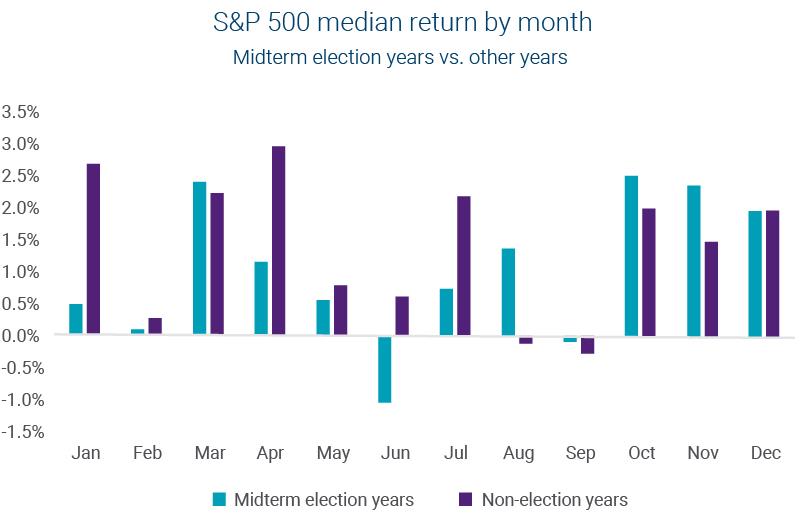
Historically, stock markets exhibit heightened volatility leading up to midterm elections due to policy uncertainty. However, once the election concludes, equities have experienced a strong seasonal tendency to rally over the subsequent 12 months, regardless of which party wins. This pattern stems from the removal of political ambiguity, allowing institutional capital to resume long-term strategic positioning.
What is the direct relationship between congressional gridlock and Treasury yields?
Congressional gridlock prevents large-scale discretionary fiscal expansion, which theoretically limits new sovereign debt issuance relative to unchecked spending. However, structural deficits driven by mandatory spending ensure that debt issuance remains historically high. Consequently, while gridlock reduces legislative fiscal shocks, long-term Treasury yields remain anchored to broader macroeconomic inflation prints and Federal Reserve monetary policy rather than election outcomes alone.
Which market sectors face the highest regulatory risk following a power shift?
Sectors most dependent on government subsidies, federal procurement contracts, or direct regulatory oversight face the highest exposure. This includes clean energy and EV manufacturers, managed care and pharmaceutical corporations, and large-cap technology firms navigating bipartisan antitrust scrutiny and data privacy compliance mandates.
How should institutional investors hedge portfolio risk during election cycles?
Sophisticated risk mitigation strategies include diversifying duration exposure in fixed income, increasing allocations to cash equivalents to capitalize on short-term liquidity dislocations, rotating into defensive sectors with strong cash flow visibility, and utilizing options overlays to protect equity portfolios against sudden legislative or debt-ceiling shocks.
Future Outlook: Milestones and Strategic Portfolio Positioning
As the political calendar marches toward election day and the subsequent convening of the new Congress, portfolio managers must monitor specific macroeconomic and legislative signposts. The primary metric to track is not merely the tally of congressional seats, but the narrowness of majorities in both the House and Senate, which dictates the viability of bipartisan compromises versus partisan deadlock.
Furthermore, corporate treasurers must maintain rigorous risk mitigation protocols surrounding debt-ceiling deadlines and Treasury issuance schedules. As structural deficits persist, the sheer volume of sovereign debt hitting primary dealers will continue to test market liquidity and exert upward pressure on term premiums. Ultimately, while political rhetoric will dominate headlines, disciplined capital allocation, robust balance sheet liquidity, and acute awareness of regulatory compliance will remain the ultimate determinants of investment success in an increasingly complex macroeconomic landscape.