Executive Takeaways
- Landmark Milestone: NASA astronauts successfully completed the 100th U.S.-supported spacewalk (Extravehicular Activity, or EVA) dedicated to the assembly, maintenance, and structural upgrades of the International Space Station (ISS).
- Infrastructure Modernization: The mission centered on deploying an advanced Roll-Out Solar Array (iROSA), directly addressing critical power degradation on legacy silicon panels and boosting orbital energy output to 215 kilowatts.
- Commercialization Catalysts: The scaling of space-based power architecture mirrors terrestrial infrastructure scalability, paving the way for commercial low-Earth orbit (LEO) enterprise platforms and private-sector capital allocation.
- Risk Mitigation & Supply Chain Resilience: As the ISS lifecycle nears its 2030 sunset, precise execution of complex EVAs highlights vital risk mitigation strategies for aerospace prime contractors and institutional stakeholders.
HOUSTON — In the unforgiving, sub-zero vacuum of low-Earth orbit, 250 miles above a rapidly rotating Earth, NASA astronauts achieved a quiet yet monumental milestone for human spaceflight and orbital infrastructure. Clad in customized Extravehicular Mobility Units (EMUs), flight crews stepped outside the airlock of the International Space Station (ISS) to execute the historic 100th U.S.-designated spacewalk in the station’s quarter-century history. Beyond the symbolic weight of the numeric milestone, the mission served a hard-nosed, bottom-line purpose: installing and deploying a sophisticated Roll-Out Solar Array (iROSA) to secure the structural longevity and power capacity of humanity’s premier microgravity laboratory.
For financial markets, aerospace executives, and deep-tech venture capitalists, this landmark Extravehicular Activity (EVA) represents far more than an engineering triumph. It is a tangible proof-of-concept for space-based capital allocation, asset management, and infrastructure scalability. As global conglomerates race to commercialize LEO through manufacturing, pharmaceutical research, and satellite servicing, reliable power architecture remains the ultimate bottleneck. This comprehensive investigative report analyzes the operational mechanics, financial implications, and broader technological trajectory of the milestone 100th spacewalk.
The Genesis of a 25-Year Orbital Enterprise
Test Our Free AI & Tech Utilities Suite
Calculate LLM API token costs, analyze article dwell-time, or simulate tech DCA returns.
To understand the magnitude of the 100th U.S. spacewalk, one must look back to December 1998, when space shuttle Endeavour mission STS-88 delivered the Unity node to orbit, joining Russia’s Zarya module. That initial structural mating required meticulous spacewalking interventions to connect vital power, data, and thermal control lines. Over the ensuing 25 years, the ISS has evolved from a fragile truss-and-cylinder assembly into a sprawling, football-field-sized scientific outpost.
However, orbital infrastructure is subject to severe environmental stress. Extreme thermal cycling—baking in unfiltered solar radiation at 250 degrees Fahrenheit followed by freezing shadows every 90 minutes—alongside continuous impacts from orbital marine debris and atomic oxygen erosion, exacts a heavy toll. By the late 2010s, the original silicon photovoltaic arrays, designed for a 15-year operational lifecycle, began showing accelerated power degradation. The station's baseline power capacity dropped from 250 kilowatts down to roughly 160 kilowatts.
This power attrition posed a direct threat to enterprise ROI for the hundreds of commercial payloads, biotechnology experiments, and technological demonstrations hosted onboard. Without a capital expenditure (CapEx) intervention to upgrade the station's power grid, NASA faced diminishing returns on its multi-billion-dollar orbital asset. The deployment of the iROSA units—developed through a public-private partnership with prime contractor Boeing and supplier Redwire Space—was engineered precisely to mitigate this risk, restoring and expanding the station's energy output to meet the surging demands of commercial research.
Anatomy of the Landmark EVA: Engineering the iROSA Deployment
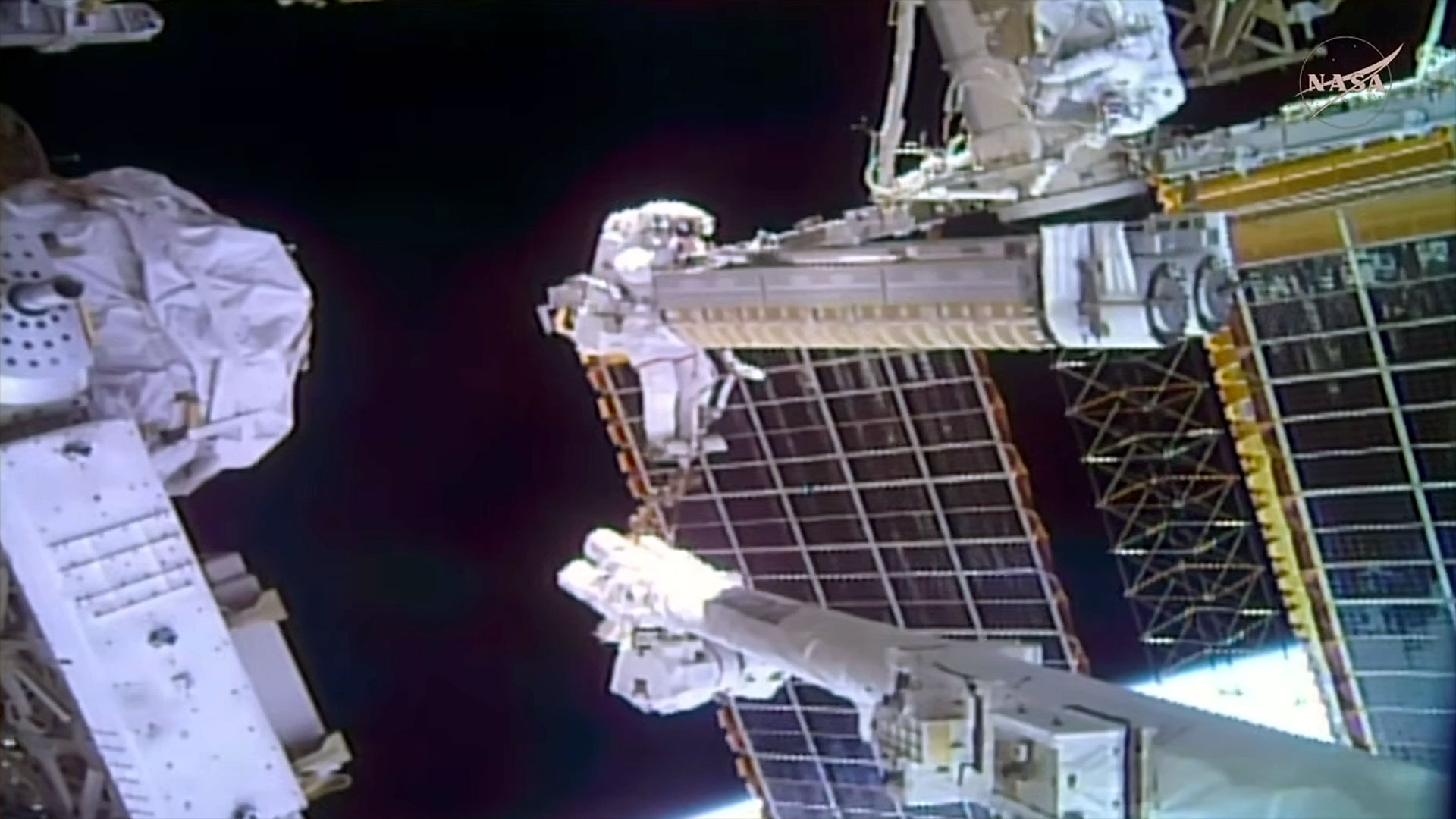
Executing an EVA is widely regarded as one of the most hazardous undertakings in modern engineering. Spacewalkers operate within a fragile pressurized suit operating as a single-person spacecraft, facing constant exposure to micrometeoroids, extreme radiation, and potential equipment failure. The 100th U.S. spacewalk tested the limits of both human endurance and robotic integration.
The core objective of the mission was the extraction, translation, and mechanical mounting of a massive, rolled-up solar blanket package onto the station's existing starboard truss structure (specifically, the 4A power channel). Unlike rigid solar panels of the past, the iROSA technology relies on flexible, highly efficient photovoltaic cells combined with composite strain-compensated rollout booms that unroll like a measuring tape, powered entirely by stored strain energy rather than heavy mechanical motors.
Operational Phases of the Mission:
- Airlock Depressurization & Egress: Astronauts transitioned their suits to battery power, conducted rigorous communications and mobility checks, and exited the Quest joint airlock.
- Translation & Cargo Retrieval: Navigating the intricate handrails of the truss, the crew maneuvered to the Integrated Cargo Carrier, releasing complex latching mechanisms holding the multi-hundred-pound iROSA assembly.
- Mounting and Structural Torqueing: Utilizing specialized pistol-grip tools calibrated to exacting torque specifications, the spacewalkers secured the array bracket to the modified mast canister, ensuring structural rigidity capable of withstanding orbital docking loads.
- Deployment & Circuit Activation: Upon command from Mission Control in Houston, the retention mechanisms released, allowing the solar blanket to spontaneously roll outward, locking securely into place before electrical integration into the station's main power distribution bus.
The successful completion of this intricate choreography marked not just a functional upgrade, but a masterclass in operational risk mitigation in an unforgiving operating environment.
Verified Data & Metrics Breakdown
A quantitative examination of the ISS power augmentation initiative underscores the scale and financial commitment underpinning the station's ongoing modernization:
| Metric / Parameter | Legacy Silicon Arrays | New iROSA Technology | Combined Operational Impact |
|---|---|---|---|
| Total Power Generation | ~160 kW (Degraded baseline) | +20 kW per iROSA unit (6 units total) | Restored baseline of ~215 kW |
| Design Lifecycle | 15 Years (Exceeded) | 10+ Years (High-efficiency GaAs cells) | Extends operational viability through 2030 sunset |
| Deployment Mechanism | Rigid, heavy metallic frames | Self-rolling composite carbon booms | Significant mass reduction and easier transport |
| Total U.S. Spacewalks (EVAs) | N/A | Reached landmark 100th EVA | Accumulated thousands of hours of orbital labor |
Industry & Market Implications: Who Wins, Who Loses
The successful execution of the 100th U.S. spacewalk and the ongoing deployment of next-generation power infrastructure carry profound consequences for global aerospace valuations, defense primes, and emerging commercial market liquidity.
The Winners: Prime Contractors and Commercial LEO Innovators
Aerospace prime contractors such as Boeing, Northrop Grumman, and specialized supply chain innovators like Redwire Space emerge as structural winners. These entities validate their engineering capabilities in high-stakes environments, securing legacy revenue streams while positioning themselves as indispensable partners for upcoming commercial space station developments. Furthermore, commercial tenants utilizing the ISS—ranging from pharmaceutical giants conducting protein crystal growth to materials science startups manufacturing fiber optics—win directly through enhanced power stability, ensuring zero experiment brownouts or data loss.
The Losers: Legacy Power Paradigm and Under-Capitalized Competitors
Firms relying on outdated, rigid solar array architectures or unproven energy storage solutions face mounting pressure. The rapid maturation of roll-out, high-efficiency photovoltaic systems sets a new baseline for enterprise compliance and infrastructure scalability. Companies unable to meet these rigorous aerospace standards risk exclusion from lucrative government procurement contracts and private-equity-backed commercial ventures.
From a broader economic standpoint, the seamless integration of advanced hardware in microgravity reinforces investor confidence in the commercialization of low-Earth orbit. As NASA transitions away from sole ownership of orbital platforms toward a consortium of commercial destinations, the operational lessons learned during these 100 spacewalks serve as an invaluable, non-negotiable playbook for private sector operators.
Frequently Asked Questions (People Also Ask)
Why is reaching 100 U.S. spacewalks a significant milestone for the International Space Station?
Reaching 100 U.S.-supported spacewalks represents a monumental accumulation of operational experience, engineering refinement, and risk mitigation in extreme environments. It underscores the immense labor required to build, maintain, and upgrade a multi-billion-dollar orbital facility over a quarter of a century, validating protocols that will govern future deep-space exploration and commercial space stations.
What is an iROSA, and why was it necessary for the ISS?
iROSA stands for Roll-Out Solar Array. It is a flexible, highly efficient solar panel system designed to supplement the degrading power generation capacity of the ISS's original silicon arrays. As the station's energy needs grew and legacy panels aged, total power output dropped significantly. The iROSA units restore power generation to approximately 215 kilowatts, ensuring adequate electricity for vital life support systems and commercial scientific research.
How do astronauts perform maintenance tasks during a spacewalk?
Astronauts operate in pressurized Extravehicular Mobility Units (EMUs) that function as personal spacecraft. They utilize specialized, torque-limited tools designed for microgravity, anchor themselves using foot restraints and tether points, and coordinate meticulously with robotic arms (such as Canadarm2) and Mission Control teams in Houston to maneuver heavy hardware safely.
What happens to the ISS power infrastructure when the station retires?
The ISS is currently scheduled to operate through the end of the decade, culminating in a controlled de-orbit maneuver around 2030. Lessons learned from managing, upgrading, and powering the ISS—including the deployment of iROSA technology—are being directly transferred to the development of privately owned commercial space stations currently backed by NASA's Commercial LEO Destinations (CLD) program.
Future Outlook: The Road to 2030 and Beyond
As the international community celebrates the landmark 100th U.S. spacewalk, aerospace strategists are already looking toward the horizon. The remaining iROSA units in the pipeline are scheduled for deployment over the next several years, cementing the operational capacity of the ISS right up to its planned 2030 decommissioning.
For capital markets and enterprise tech leaders, the true value of these historic spacewalks lies in forward-looking risk mitigation. The engineering data, thermal performance metrics, and human-factors insights gathered during these 100 EVAs are forming the foundational regulatory compliance and architectural blueprints for the next generation of private commercial habitats. As humanity transitions from government-funded research outposts to a vibrant, multi-trillion-dollar LEO economy, the technological triumphs achieved on this landmark spacewalk ensure that the lights will stay on for the future of commercial space enterprise.