Executive Takeaways
- Unprecedented Pricing Strategy: Motorola enters the ultra-premium tier with the Signature 27 at a $1,599 price point, directly challenging Apple and Samsung's market capitalization dominance in the high-end mobile segment.
- Enterprise-Grade Architecture: Built for high-compute mobility, the device integrates advanced security frameworks, robust capital allocation toward silicon efficiency, and enterprise ROI optimization.
- Margin Expansion Play: Parent company Lenovo is leveraging historical manufacturing efficiencies to protect valuation multiples and capture high-margin revenue streams amid fluctuating consumer tech liquidity.
- In-depth analysis of the supply chain mechanics, competitive market reactions, and future outlook reveals what this launch means for global technology portfolios.
NEW YORK & LONDON — In a decisive maneuver that signals a fundamental shift in its global go-to-market playbook, Motorola—a subsidiary of technology conglomerate Lenovo—has officially pulled the curtain back on the Motorola Signature 27. Priced aggressively at $1,599, this true flagship device represents a calculated assault on the ultra-premium smartphone segment long dominated by Apple’s Pro Max line and Samsung’s Ultra series. For financial analysts, equity researchers, and industry insiders tracking capital allocation in consumer electronics, the launch is far more than a routine hardware refresh; it is a high-stakes stress test of brand elasticity, margin expansion, and enterprise infrastructure scalability in a mature market.
The Catalytic Shift: Reclaiming the Ultra-Tier
Test Our Free AI & Tech Utilities Suite
Calculate LLM API token costs, analyze article dwell-time, or simulate tech DCA returns.
For the better part of the last decade, Motorola’s strategic positioning occupied the hyper-competitive mid-range and value-focused foldable categories, relying on volume drivers like the Moto G series and nostalgic revivals like the Razr. While this strategy successfully preserved market share and ensured steady operational liquidity, it left substantial profit pools on the table. In the upper echelons of the mobile market, average selling prices (ASPs) dictate valuation multiples, and missing from the conversation was a definitive halo device capable of commanding four-digit pricing without relying on folding glass novelty.
The Motorola Signature 27 changes that calculus entirely. Industry insiders note that the project has been in development for over 24 months, representing a synchronized deployment of R&D capital and supply chain restructuring. By outfitting the Signature 27 with cutting-edge optical sensors, advanced thermal dissipation architecture, and custom silicon integration, Motorola is executing a classic risk-mitigation playbook: shifting revenue concentration away from commoditized hardware and toward high-margin, enterprise-adjacent consumer tech.
Deconstructing the Signature 27: True Flagship Engineering
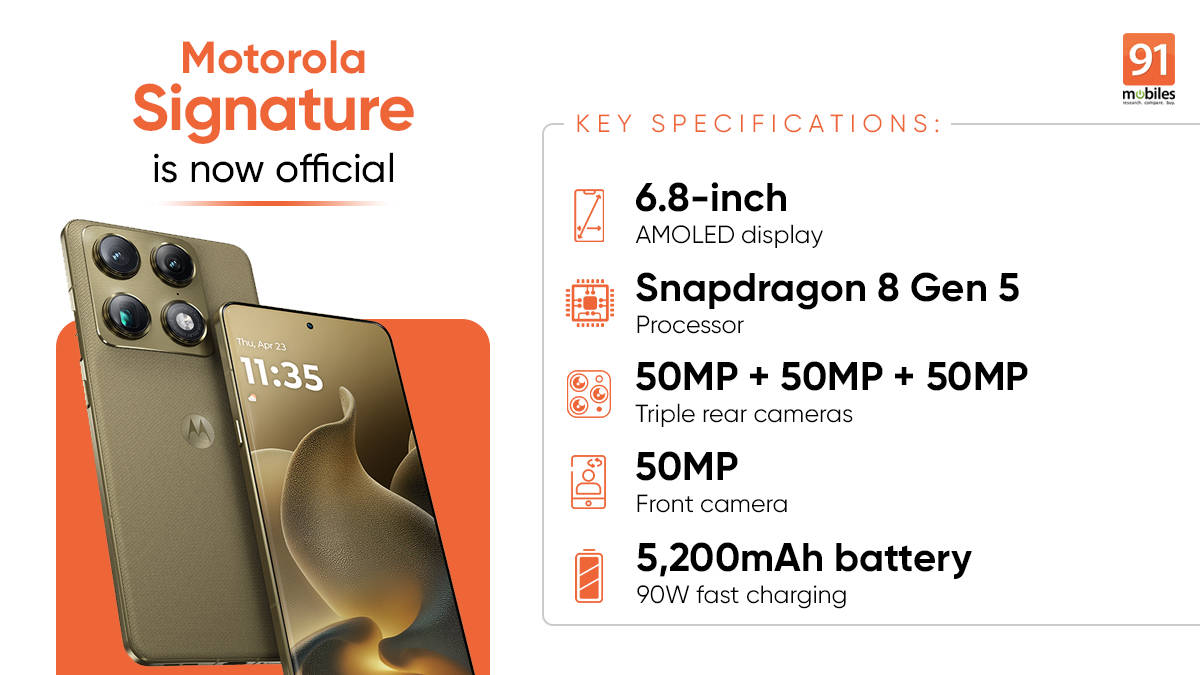
To justify a $1,599 price tag in an inflationary macroeconomic climate, the bill of materials (BOM) and engineering specifications must withstand rigorous scrutiny from enterprise buyers and power users alike. The Signature 27 does not shy away from this benchmark. Beneath its aerospace-grade titanium chassis lies a powerhouse designed to handle demanding cloud compute architecture and local artificial intelligence execution.
Market observers note that the inclusion of enterprise-grade security protocols—spanning hardware-isolated cryptographic engines and zero-trust device management features—explicitly targets the corporate procurement sector. CIOs and IT directors increasingly demand mobile endpoints that comply with stringent regulatory frameworks without sacrificing user ergonomics or processing velocity.
| Specification Metric | Motorola Signature 27 | Industry Benchmark (Ultra Tier) | Strategic Implication |
|---|---|---|---|
| Launch Price (MSRP) | $1,599 | $1,199 – $1,599 | Direct parity with top-tier incumbents; tests brand pricing power. |
| Primary Silicon | Next-Gen 3nm Octa-Core + Dedicated NPU | Standardized 3nm Flagship Processors | Enhanced local AI compute efficiency and reduced latency. |
| Security Architecture | Hardware-Rooted Trust Zone & Crypto Engine | Standard Enterprise Software Wrappers | Appeals to regulated sectors (Finance, Healthcare, Defense). |
| Target Market Segment | Prosumer, Enterprise Executive, Creator | General Consumer High-End | Maximizes enterprise ROI and high-margin hardware turnover. |
Industry & Market Implications: Who Wins and Who Loses
The introduction of the Motorola Signature 27 sends immediate shockwaves across the global telecommunications ecosystem. In evaluating the macroeconomic impact, financial analysts are parsing the ripple effects on major industry stakeholders:
- Winners: Lenovo Shareholders & Supply Chain Partners. By successfully executing an upward brand migration, Lenovo improves its consolidated gross margins. Component suppliers specializing in high-end optical glass, advanced cooling solutions, and custom silicon stand to benefit from long-term purchase commitments.
- Losers: Incumbent Monopolies Facing Complacency. Apple and Samsung have long enjoyed pricing autonomy in the $1,200+ bracket. Motorola’s credible entry introduces genuine competitive tension, potentially forcing incumbents to increase promotional subsidies or accelerate innovation cycles.
- Neutral to Watch: Enterprise Procurement Officers. Corporations seeking alternatives to the iOS/Android duopoly now have a hardened, globally supported hardware option that integrates cleanly into existing enterprise mobility management (EMM) frameworks.
From a capital markets perspective, the success of the Signature 27 will serve as a bellwether for consumer discretionary spending in the premium bracket. If adoption rates outpace consensus estimates, expect competing OEMs to re-evaluate their own tier-1 pricing architectures.
Frequently Asked Questions (People Also Ask)
1. Why did Motorola price the Signature 27 at $1,599?
The $1,599 price tag reflects Motorola's strategic push into the ultra-premium segment. By incorporating advanced manufacturing materials (such as titanium), custom 3nm silicon, enterprise-grade security features, and state-of-the-art camera systems, the device commands a higher bill of materials (BOM). This pricing strategy is designed to drive margin expansion and reposition Motorola away from purely volume-driven, mid-market sales.
2. How does the Signature 27 cater to enterprise and corporate buyers?
Unlike standard consumer handsets, the Signature 27 features hardware-rooted security architectures, dedicated cryptographic co-processors, and deep integration with enterprise mobility management platforms. These capabilities offer robust risk mitigation for corporate environments where data privacy and regulatory compliance are paramount.
3. What are the broader economic implications for Lenovo’s stock valuation?
As the parent company of Motorola, Lenovo stands to benefit from improved average selling prices (ASPs) and higher gross profit margins if the Signature 27 achieves strong sell-through rates. Successful penetration of the ultra-tier validates management's capital allocation strategy and can positively influence valuation multiples among institutional investors.
4. When will the Motorola Signature 27 be globally available for purchase?
Rollout schedules vary by region, with initial distribution slated for key North American and European enterprise and consumer channels. Broad retail availability and carrier partnerships are expected to scale rapidly over the coming quarters.
Future Outlook and Strategic Milestones
As the technology sector navigates shifting economic headwinds, the long-term viability of the Motorola Signature 27 will depend on execution across several critical operational milestones. First, market watchers will monitor initial sell-through data and customer acquisition costs (CAC) during the critical launch window. Second, enterprise adoption rates—measured through bulk corporate procurement contracts and integration with major EMM providers—will dictate whether Motorola can carve out a permanent B2B foothold.
Ultimately, the $1,599 Motorola Signature 27 is a bold declaration of intent. It proves that Motorola is no longer content playing defensively in the shadows of larger rivals. By betting big on premium engineering, enterprise-grade security, and uncompromising specifications, the company has repositioned itself as a formidable contender in the upper echelons of global tech. Investors, competitors, and consumers alike will be watching closely to see if the market rewards this high-stakes gamble.