Executive Takeaways
- Infrastructure Milestone: Astronauts have successfully installed and deployed the sixth and final ISS Roll-Out Solar Array (iROSA), completing a multi-year, multi-hundred-million-dollar power architecture modernization program.
- 30% Power Augmentation: The upgraded power grid restores degraded solar arrays, boosting total available station power from ~160 kilowatts to over 215 kilowatts, critical for power-intensive commercial microgravity research and life support operations.
- Enabling LEO Commercialization: The enhanced power budget directly de-risks private-sector investments, supporting commercial module attachments (such as Axiom Space) and enterprise orbital edge-computing infrastructure through 2030.
- Supply Chain & Market Implications: The successful execution validates Redwire Corporation’s deployable structure technology and Boeing’s primary integration management, cementing contract paradigms for future commercial space stations and Lunar Gateway architecture.
The Orbital Power Crisis: Upgrading Degraded Legacy Systems
Test Our Free AI & Tech Utilities Suite
Calculate LLM API token costs, analyze article dwell-time, or simulate tech DCA returns.
The completion of the final extravehicular activity (EVA) to install the space station's sixth add-on solar array marks the culmination of an ambitious orbital infrastructure program designed to solve a fundamental physics problem: environmental solar cell degradation in Low Earth Orbit (LEO). Operating in an environment characterized by severe thermal cycling (+121°C to -157°C every 90 minutes), atomic oxygen erosion, and micro-meteoroid impacts, the original legacy solar arrays—deployed between 2000 and 2009—had experienced predictable long-term power output decay.
Originally engineered by Boeing and Lockheed Martin to deliver a peak gross output of 240 kilowatts (generating roughly 80 to 120 kW of continuous operational power after battery storage allocations), the station's legacy silicon-based photovoltaic panels had degraded by over 30% after two decades of continuous exposure. As NASA, ESA, JAXA, and commercial partners scaled up power-intensive payloads—ranging from continuous advanced materials manufacturing to real-time high-throughput cloud compute nodes—the platform faced an operational power deficit that threatened to restrict scientific operations during the platform's final decade of operational life.
To address this baseline power degradation without the exorbitant capital expenditure of replacing the primary 35-meter truss-mounted array wings, NASA selected a high-yield, retrofitted augmentation strategy: installing compact, high-efficiency roll-out solar arrays over the existing wings. Positioned directly in front of the legacy panels, the new array units utilize high-efficiency solar cell technology to generate clean electricity while sharing the original mechanical tracking and power distribution infrastructure.
Engineering Marvel: The Roll-Out Solar Array (iROSA) Architecture
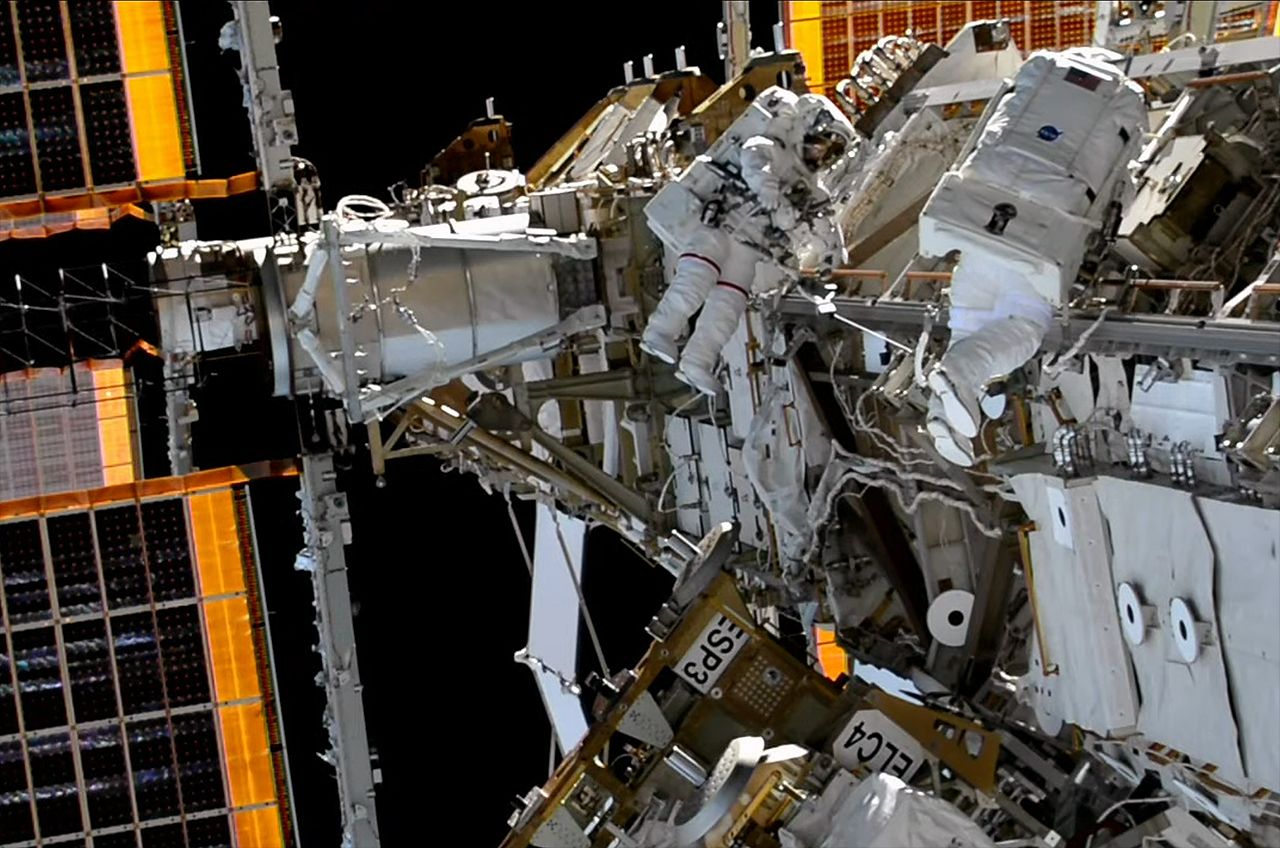
The structural design of the ISS Roll-Out Solar Array (iROSA) represents a paradigm shift from traditional, rigid, motor-driven deployable space structures to passive, stored-strain-energy flexible systems. Developed by Redwire Space (via its acquired subsidiary Deployable Space Systems) under contract with prime integrator Boeing, iROSA replaces complex mechanical hinges, motors, and structural trusses with composite carbon-fiber booms that unroll using intrinsic strain energy.
Transported to the station inside the unpressurized trunk of SpaceX’s Cargo Dragon spacecraft, each iROSA assembly features extremely light, high-density flexible blankets integrated with advanced Spectrolab triple-junction Gallium Arsenide (GaAs) photovoltaic cells. These cells achieve an energy conversion efficiency exceeding 30%, compared to the ~14% efficiency of the 1990s-era silicon solar cells on the original arrays.
Key Structural & Performance Specifications: Legacy vs. Upgraded System
| Parameter / Specification | Legacy ISS Primary Solar Arrays | Augmented iROSA Add-On Arrays | Combined Upgraded Architecture |
|---|---|---|---|
| Photovoltaic Technology | Silicon (Si) Photovoltaic Cells | Triple-Junction Gallium Arsenide (GaAs) | Hybrid (Active iROSA + Uncovered Legacy) |
| Cell Conversion Efficiency | ~14% (Degraded over 20+ yrs) | > 30% Efficiency | Net System-Wide Boost: +30% Output |
| Deployment Mechanism | Motorized Rigid Accordion Scissor-Truss | Passive Strain-Energy Carbon Composite Booms | Hybrid Integrated Structural Trusses |
| Dimensions (Per Unit) | 35m x 12m (115 ft x 38 ft) | 18.2m x 6m (60 ft x 20 ft) | Custom Overlaid Profile |
| Peak System Generation | ~160 kW (Degraded State, 2020) | ~120 kW (Aggregate 6 iROSA units) | 215 kW to 240 kW Peak Output |
| Primary Manufacturers | Boeing / Lockheed Martin / Spectrolab | Redwire Space / Boeing / Spectrolab | Integrated ISS Power Distribution Grid |
Execution of the Final Spacewalk: Orbital Precision Assembly
The final installation EVAs required surgical robotic coordination and physical spacewalk execution. Operating approximately 250 miles (400 kilometers) above Earth at an orbital velocity of 17,500 mph, astronauts integrated the sixth array onto the 4B power channel on the station’s starboard truss structure.
The operational sequence demonstrated the matured state of low-Earth orbit robotic and human intra-vehicular/extra-vehicular collaboration:
- Robotic Extraction & Staging: Ground controllers at NASA’s Johnson Space Center in Houston, working in tandem with station crew members, used the station's 57-foot Canadarm2 robotic arm to extract the folded iROSA package from the SpaceX Dragon trunk and maneuver it near the targeted installation site.
- Structural Mounting: Spacewalkers physically bolted a pre-installed modification bracket to the base of the legacy array truss, creating a structural foundation capable of transferring mechanical loads and structural torque.
- Electrical Integration: Astronauts connected high-voltage jumper cables, routing the electricity generated by the new array directly into the station's Main Bus Switching Units (MBSUs) and Sequential Shunt Units (SSUs). This step integrated the power bypass without interrupting the active 120-volt primary DC power grid powering critical life support hardware.
- Unfurling & Thermal Stabilization: After releasing mechanical retention pins, the strain-energy carbon booms smoothly unrolled the solar blanket. Crew members monitored thermal stabilization to ensure no structural warping occurred while the system adjusted to microgravity conditions and direct solar radiation.
Financial and Strategic Architecture: Securing the LEO Enterprise Economy
From an enterprise strategy perspective, this power upgrade is less about maintaining historic space exploration operations and more about securing the high-density infrastructure required for the emerging commercial space economy. With NASA committed to operating the ISS through 2030, capital allocation models heavily depend on leveraging the station as an in-orbit testbed for high-margin enterprise activities.
1. High-Density Microgravity Manufacturing
Advanced commercial endeavors—such as semiconductor crystal growth, high-purity optical fiber fabrication (e.g., ZBLAN), and protein crystallization for biopharmaceutical therapies—require continuous, uninterrupted energy. The 215+ kW upgraded power grid provides the margin necessary to run high-draw electric furnaces, environmental chambers, and continuous microgravity processing units simultaneously without power rationing.
2. De-Risking Private Sector Space Station Transitions
The arrival of Axiom Space's commercial modules, scheduled to dock with Node 2 beginning in the mid-2020s, relies directly on access to stable primary power from the ISS parent structure during early deployment phases. By ensuring an energetic surplus, NASA and its international partners mitigate operational risks for commercial developers, allowing private firms to focus capital deployment on revenue-generating orbital infrastructure rather than redundant standalone power generation assets.
3. Orbital Edge Computing & Dual-Use Cloud Architecture
Modern defense contractors and commercial enterprise compute providers are increasingly deploying high-performance processing hardware directly into orbit. Running cloud computing workloads, real-time synthetic aperture radar (SAR) data processing, and AI inferencing on orbital hardware reduces latency and ground-station downlink bandwidth bottlenecks. These server nodes demand substantial energy budgets for compute operations and active thermal management, which the completed iROSA installation now reliably supplies.
Market Implications & Supply Chain Winners
The successful execution of the six-array iROSA deployment provides critical competitive validation across the aerospace and defense sector, signaling clear market trends to institutional investors:
- Redwire Corporation (NYSE: RDW): As the primary developer of the strain-energy deployable boom technology, Redwire’s successful execution on all six units provides proof-of-concept for its proprietary space structures. This technology forms the structural backbone for future proprietary platforms, commercial stations, and deep-space missions, positioning Redwire for strong recurring revenue in deployable space infrastructure.
- Boeing Defense, Space & Security (NYSE: BA): Serving as the primary contractor for ISS sustained engineering, Boeing's management of the grid integration project reinforces its core operational capability in complex orbital integration, counterbalancing program delays in other legacy defense divisions.
- Commercial LEO Operators (Axiom Space, Voyager Space, Vast): Commercial entities designing next-generation stations (such as Orbital Reef and Starlab) are adopting iROSA-derived flexible array architectures. This standardizes supply chains, lowers manufacturing costs through volume production, and reduces launch mass requirements compared to legacy rigid panels.
Frequently Asked Questions (People Also Ask)
How does the completed iROSA solar array deployment impact the operational capacity of the ISS?
The final iROSA deployment restores degraded power channels and increases total station energy output by approximately 30%, raising operational capacity from ~160 kilowatts to between 215 and 240 peak kilowatts. This power surplus allows the station to operate all scientific payloads, life support systems, and commercial payloads simultaneously without power rationing through its planned operational end in 2030.
Why did NASA install add-on solar arrays instead of replacing the original solar wings entirely?
Replacing the original 35-meter solar arrays entirely would have required massive orbital demolition, multi-billion-dollar design and transportation costs, and hundreds of hours of risky extravehicular activities. The iROSA design offered a cost-effective, high-ROI alternative: smaller, ultra-high-efficiency panels mounted directly over parts of the existing arrays, utilizing the legacy tracking mounts, structural trusses, and main electrical buses.
What makes Roll-Out Solar Array (iROSA) technology superior to traditional rigid solar panels?
iROSA technology uses stored strain energy in flexible composite carbon-fiber booms to automatically unroll solar blankets without needing heavy mechanical motors, complex gearboxes, or rigid metal frames. This design dramatically reduces mass and launch volume, allowing arrays to be folded into tight payloads for launch while delivering high power density upon deployment.
How does this solar array upgrade support private enterprise and commercial space stations?
The upgraded grid guarantees reliable, continuous electrical power for commercial modules—such as Axiom Space’s planned commercial additions—that will dock to the ISS before its retirement. Furthermore, it de-risks private-sector research in pharmaceutical manufacturing, advanced materials, and orbital cloud computing, establishing a mature, flight-proven power architecture for future commercial free-flying space stations.
Strategic Future Outlook: The Path to 2030 and Beyond
With the ISS power generation architecture modernized, NASA and its international partners have eliminated a critical operational single-point-of-failure risk factor. The station enters its final operational decade with its highest power capability since construction was completed, providing a stable foundation for microgravity research, private enterprise manufacturing, and lunar mission technology validation.
As the commercial space sector prepares for the structural shift toward private LEO platforms post-2030, the legacy of the iROSA program extends beyond the space station grid. The flight-proven design, dynamic control data, and operational experience gained during these EVAs are already being applied to NASA’s Lunar Gateway power and propulsion element (PPE) and future deep-space exploration platforms. By turning an aging power infrastructure challenge into a successful technology deployment, the program demonstrates how targeted capital investment can extend legacy defense infrastructure while enabling the next generation of commercial LEO enterprise operations.