TOKYO/WASHINGTON — In the interconnected architecture of global finance, investors often fixate on the Federal Reserve’s terminal rate, European Central Bank policy shifts, or geopolitical friction in the South China Sea. Yet, according to a compelling analytical assessment published by Desmond Lachman at the American Enterprise Institute (AEI) on March 3, 2026, a far more potent and underappreciated risk to the US economy is quietly brewing thousands of miles away: the structural destabilization of Japan’s massive sovereign debt market.
For decades, Japan has functioned as the ultimate liquidity anchor for international capital markets. However, as the Bank of Japan (BOJ) abandons its historical era of radical monetary experimentation and negative interest rates, shockwaves are reverberating across asset classes. With Japan maintaining a staggering $8 trillion sovereign debt market, any violent upward repricing of Japanese Government Bonds (JBs) immediately alters global capital allocation strategies, threatens corporate valuation multiples, and forces institutional risk mitigation protocols across Wall Street and beyond.
Executive Takeaways
- Global Liquidity Anchor: Japan’s $8 trillion sovereign bond market acts as a primary engine for global capital flows, heavily influencing US Treasury yields and institutional portfolio balancing.
- The Policy Pivot: As inflationary pressures force the Bank of Japan to normalize monetary policy, rising domestic yields threaten to trigger a massive repatriation of Japanese capital away from foreign assets, including US Treasuries.
- Valuation Compression: Rising Japanese interest rates directly impact enterprise capital costs and equity valuation multiples, creating structural headwinds for multinational corporations and leveraged balance sheets.
- Systemic Spillover: US fixed-income markets, mortgage rates, and infrastructure scalability financing face indirect volatility as domestic liquidity conditions tighten.
The Anatomy of Japan’s Sovereign Debt Dilemma
Test Our Free AI & Tech Utilities Suite
Calculate LLM API token costs, analyze article dwell-time, or simulate tech DCA returns.
To understand why a shift in Tokyo’s yield curve sends immediate tremors through New York trading desks, one must examine the mechanics of global capital allocation. For over twenty years, Japan pursued an aggressive monetary easing playbook characterized by quantitative and qualitative easing (QQE) and Yield Curve Control (YCC). By artificially pinning its 10-year sovereign bond yields near zero—and at times into negative territory—the BOJ forced domestic institutional investors, including massive pension funds, life insurers, and mega-banks, to look abroad for yield.
This desperate search for returns transformed Japanese institutional capital into the lifeblood of foreign debt markets. Trillions of dollars flowed out of Tokyo into higher-yielding US Treasuries, European sovereign debt, and risk assets worldwide. This dynamic successfully kept global borrowing costs artificially depressed, supporting infrastructure scalability, corporate mergers and acquisitions, and robust equity valuation multiples.
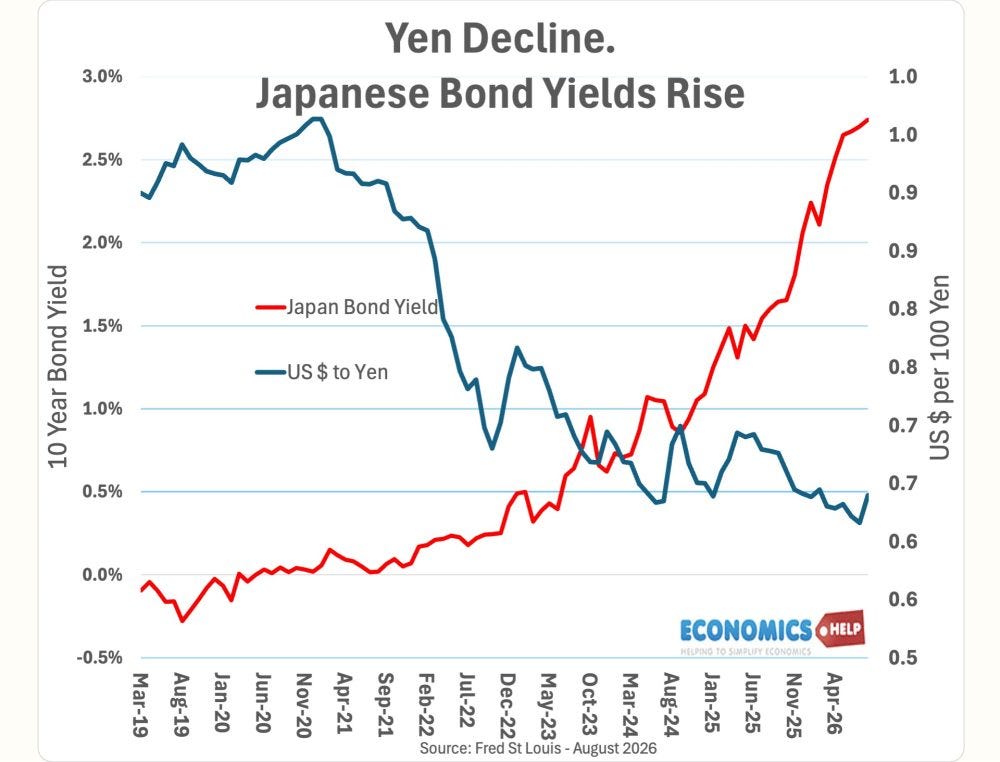
However, the economic reality of persistent global inflation and a weakening yen has fundamentally altered the calculus. As documented in the AEI analysis, the structural breakdown of Japan’s debt suppression strategy means domestic yields are finally rising to market-clearing levels. When domestic Japanese assets begin offering attractive, risk-free yields for the first time in a generation, the gravitational pull on Japanese capital changes completely.
The Repatriation Threat: How Tokyo Affects US Treasuries

The primary transmission channel between Japan’s bond market and the US economy is the looming threat of capital repatriation. Japanese financial institutions are among the largest foreign holders of US Treasury securities. If domestic Japanese yields rise significantly, the yield pickup of holding US government debt—after accounting for currency hedging costs—shrinks dramatically.
When hedging costs outweigh the yield differential, institutional investors are forced to reallocate capital back to domestic markets. This orderly or disorderly exit from foreign assets creates a direct supply-demand imbalance in the US Treasury market. As Japanese buyers step back or actively divest, US bond prices fall and yields rise. Because US mortgage rates, corporate bond issuances, and consumer loans are directly benchmarked against US Treasury yields, the ripple effect hits Main Street with immediate force.
Furthermore, corporate CFOs managing enterprise ROI must contend with a broader tightening of global financial conditions. As risk-free rates rise globally, the discount rate applied to future corporate cash flows increases, compressing equity valuations across technology, industrial, and financial sectors.
Verified Data & Metrics Breakdown
To quantify the systemic exposure between the Japanese and US financial ecosystems, consider the following comparative metrics tracking sovereign debt scale, institutional holdings, and macroeconomic indicators:
| Metric / Indicator | Japan Financial Baseline | US Economic Impact / Parallel | Systemic Significance |
|---|---|---|---|
| Sovereign Debt Market Size | Approx. $8 Trillion (JGBs) | US National Debt exceeds $34T | High market liquidity sensitivity |
| Foreign Treasury Holdings | Largest foreign holder of US debt | Exceeds $1.1 Trillion in Treasuries | Direct pricing pressure on US yields |
| Monetary Policy Shift | Abandonment of Negative Rates / YCC | Synchronized global monetary tightening | Elevated cost of capital worldwide |
| Currency Volatility | USD/JPY exchange rate fluctuations | Impacts US export competitiveness | Triggers regulatory compliance scrutiny |
Industry & Market Implications: Winners and Losers
The structural transformation of Japan’s bond market creates clear divergences across global sectors. Understanding these shifts is critical for institutional asset managers executing risk mitigation and capital allocation strategies.
The Losers: Leveraged Entities and Debt-Dependent Sectors
- Real Estate & Construction: Higher global benchmark yields translate directly into elevated commercial and residential mortgage rates, stalling property valuation growth and development pipelines.
- High-Growth Technology: Venture-backed firms and tech enterprises relying on low-cost debt for infrastructure scalability face severe valuation contraction as future cash flows are discounted at higher rates.
- US Federal Borrowing: With foreign demand for US Treasuries potentially waning, the US Treasury Department faces higher auction yields, increasing the federal government's annual debt service burden.
The Winners: Savers and Net-Margin Financial Institutions
- Japanese Domestic Banks: Decades of compressed margins under zero-rate policies gave way to profitable lending spreads as domestic sovereign yields normalized.
- Fixed-Income Value Investors: Institutional funds focusing on absolute yield generation benefit from higher baseline interest rates across both Japanese and international debt instruments.
Frequently Asked Questions (People Also Ask)
Why does Japan’s bond market directly impact the US economy?
Japan is one of the largest foreign creditors to the United States, holding over $1 trillion in US Treasury securities. When Japanese bond yields rise, domestic institutional investors find higher returns at home, reducing their appetite for foreign debt. This reduction in demand can push US Treasury yields higher, increasing borrowing costs for American consumers, corporations, and the federal government.
What was Yield Curve Control (YCC) and why is its abandonment important?
Yield Curve Control was a monetary policy where the Bank of Japan set a hard ceiling on long-term interest rates by unlimited bond-buying. As inflation forced the BOJ to dismantle this policy, Japanese bond yields rose toward market-clearing levels. This ended the era of cheap global liquidity that had previously subsidized international asset valuations.
How does capital repatriation from Japan affect US equity markets?
Capital repatriation occurs when Japanese institutional investors sell foreign assets—such as US stocks and bonds—to reinvest the proceeds in higher-yielding domestic Japanese instruments. This outflow of capital from US markets increases asset price volatility, tightens financial liquidity, and compresses valuation multiples across US equity sectors.
What role do currency hedging costs play in this dynamic?
To invest in US assets without taking on foreign exchange risk, Japanese investors must hedge the USD/JPY currency exposure. When US-Japan interest rate differentials narrow or hedging costs rise, the net yield on US Treasuries for Japanese investors becomes uncompetitive, accelerating the shift of capital back to Tokyo.
Future Outlook & Key Milestones to Watch
As global financial markets navigate the post-YCC era, executive leadership and institutional investors must monitor specific macroeconomic milestones. The pace at which the Bank of Japan unwinds its massive balance sheet will dictate the velocity of global capital flows. If normalization proceeds too quickly, it risks triggering sharp JGB volatility that could spill over into international repo and foreign exchange markets.
Conversely, a too-slow adjustment risks entrenched domestic inflation and a dangerously weak yen, which invites aggressive currency market intervention. For US financial planners, corporate treasurers, and policymakers, the message from Desmond Lachman’s AEI analysis is unequivocal: ignoring Tokyo’s bond market is no longer an option. In an integrated global economy, the tremors in Japan’s $8 trillion debt market will continue to shake the foundations of US financial stability.