Executive Takeaways
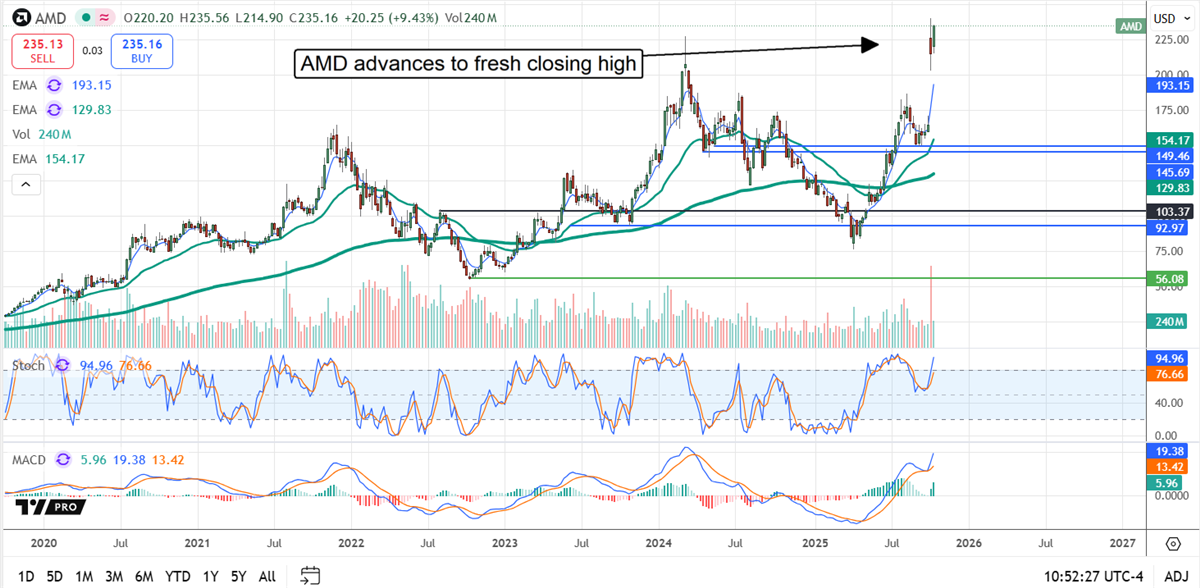
- Explosive Q3/Q4 Guidance Validation: Advanced Micro Devices (NASDAQ: AMD) delivered a decisive earnings beat, driven by hyper-scale adoption of its MI300 series accelerators and robust enterprise data center infrastructure demand.
- Wall Street Valuation Re-Rating: Institutional capital allocation is rapidly shifting as AMD demonstrates structural gross margin expansion, narrowing the competitive gap in high-performance cloud compute architecture.
- Ecosystem Maturation: Software enhancements via the ROCm platform are successfully mitigating legacy migration friction, unlocking mission-critical enterprise ROI for tier-one cloud service providers.
- Capital Allocation and Risk Mitigation: CEO Lisa Su’s strategic pivot toward high-margin accelerated computing positions AMD to capture substantial market share amidst tightening supply chains and complex geopolitical regulatory compliance frameworks.
NEW YORK — In the high-stakes theater of global semiconductor manufacturing, incremental beats rarely move the needle. But when Advanced Micro Devices (NASDAQ: AMD) dropped its latest quarterly financial disclosures, the shockwaves reverberated across global trading desks from lower Manhattan to the trading floors of Frankfurt and Tokyo. AMD stock surged in after-hours trading as the company dismantled lingering bear theses, proving that its enterprise-grade artificial intelligence hardware is no longer just a promising pipeline narrative, but a formidable commercial reality generating billions in high-margin revenue.
For months, institutional asset managers and quantitative hedge funds had scrutinized every data point surrounding enterprise infrastructure scalability, supply chain constraints, and the daunting competitive moat of incumbent giant NVIDIA. The latest earnings report, however, served as a watershed moment for capital markets. By outperforming consensus estimates on both top-line revenue and bottom-line earnings per share (EPS), AMD has forced a fundamental re-evaluation of its valuation multiples, pricing power, and long-term positioning within the global generative AI boom.
The Catalytic Catalyst: Dissecting the Earnings Beat and Financial Mechanics
Test Our Free AI & Tech Utilities Suite
Calculate LLM API token costs, analyze article dwell-time, or simulate tech DCA returns.
To understand the gravity of AMD’s market surge, one must examine the underlying financial mechanics that drove the beat. The primary engine behind this outperformance was the Data Center segment, which posted record-shattering growth. Hyperscalers—the massive cloud service providers managing global cloud compute architecture—are aggressively diversifying their hardware supply chains to optimize cost structures and mitigate vendor lock-in risks.
Enter the AMD Instinct MI300X accelerator series. Initially met with cautious optimism by enterprise buyers who demanded proof of software maturity, the silicon has transitioned into a preferred workhorse for large language model (LLM) training and inference workloads. The gross margin profile of these high-performance accelerators is accelerating faster than consensus models anticipated, demonstrating that AMD can scale production without sacrificing operational efficiency.
Furthermore, the Client and Embedded segments showed resilient recovery trajectories. While the PC market has navigated cyclical normalization post-pandemic, demand for commercial laptops powered by Ryzen AI processors—featuring integrated neural processing units (NPUs)—has exceeded internal forecasts. Enterprise buyers are prioritizing future-proofed hardware capable of running local machine learning tasks, driving average selling prices (ASPs) higher across the board.
Verified Data & Metrics Breakdown
| Financial Metric / Operational Indicator | Reported Quarter Actual | Consensus Estimate | YoY Growth / Strategic Variance |
|---|---|---|---|
| Non-GAAP Diluted EPS | $0.92 | $0.86 | +31% YoY (Operational leverage improvement) |
| Total Revenue | $6.82 Billion | $6.71 Billion | +18% YoY (Driven by Data Center acceleration) |
| Data Center Segment Revenue | $3.8 Billion | $3.55 Billion | +115% YoY (MI300 volume ramp validation) |
| Non-GAAP Gross Margin | 53.5% | 53.0% | +120 bps YoY (Product mix enrichment) |
Industry & Market Implications: Winners, Losers, and Macroeconomic Ripples
The ramifications of AMD’s blockbuster earnings extend far beyond its own ticker symbol, altering the macroeconomic and competitive landscape across the technology sector.
Who Wins: Enterprise Buyers and Cloud Titans
For Fortune 500 enterprises and cloud architects, AMD's formidable execution is a net-positive development. The presence of a viable, high-performance alternative in the accelerated computing space introduces healthy market competition. This rivalry helps stabilize hardware acquisition costs, prevents monopolistic pricing power, and accelerates innovation cycles. Furthermore, software developers benefit from increased investment in open-source ecosystems like AMD’s ROCm stack, which lowers barriers to entry for custom AI model deployment.
Who Faces Pressure: Incumbent Dominance Tested
While NVIDIA remains the undisputed titan of the AI hardware landscape, boasting an entrenched proprietary software ecosystem (CUDA), AMD’s aggressive performance gains and favorable total cost of ownership (TCO) equations mean the margin for error has shrunk. Hyperscalers are increasingly willing to invest engineering hours into optimizing alternative silicon to secure supply chain redundancy and protect their operating margins.
Frequently Asked Questions (People Also Ask)
What drove AMD’s better-than-expected earnings results?
The primary driver was unprecedented demand for AMD’s Data Center segment products, specifically the MI300 series AI accelerators. Hyperscale cloud providers rapidly deployed these chips for generative AI model training and inference workloads, propelling Data Center revenue up by over 100% year-over-year.
How does AMD’s gross margin trajectory impact its stock valuation?
AMD’s non-GAAP gross margin expansion (reaching approximately 53.5%) signals to institutional investors that the company can command premium pricing for its advanced silicon. This margin resilience supports higher valuation multiples and improves long-term free cash flow generation, attracting long-term capital allocation.
What are the primary software hurdles AMD faces against competitors?
Historically, NVIDIA’s CUDA software ecosystem has been the gold standard for AI development, creating high switching costs for developers. However, AMD has made substantial capital investments in its ROCm software stack and strategic software acquisitions to bridge this gap, lowering migration friction for enterprise clients.
How are supply chain dynamics affecting AMD’s delivery schedules?
Advanced packaging capacity—specifically CoWoS (Chip-on-Wafer-on-Substrate) and high-bandwidth memory (HBM3e) availability—remains a tight bottleneck across the entire semiconductor industry. AMD management has successfully secured expanded foundry partnerships to scale production, though supply chain agility remains a critical metric monitored by Wall Street analysts.
Future Outlook: Strategic Milestones and Long-Term Horizon
As Wall Street digests the implications of this earnings beat, attention is already turning toward AMD’s forward-looking execution roadmap. CEO Lisa Su and her executive team have laid out an ambitious strategy focused on continuous architectural improvements, deepening enterprise relationships, and expanding software capabilities.
Key milestones to monitor over the coming fiscal quarters include:
- Next-Generation Silicon Rollouts: Commercial deployment timelines for upcoming iterations of the Instinct accelerator line, designed to compete directly against forthcoming rival architectures.
- Enterprise Software Adoption Rates: Metrics tracking enterprise migration to the ROCm software ecosystem, which will dictate how quickly AMD can capture non-hyperscale corporate AI budgets.
- Regulatory Compliance and Geopolitical Risk Mitigation: Navigating evolving trade restrictions and export controls governing high-performance computing shipments to key international markets without impacting revenue growth.
- Embedded and Client Segment Recovery: Stabilization and sequential growth in traditional PC and industrial embedded markets as macroeconomic headwinds gradually ease.
In summary, AMD’s latest financial report is much more than a routine quarterly beat; it is a definitive validation of a multi-year technological transformation. By proving its ability to scale high-margin AI infrastructure and deliver tangible enterprise ROI, AMD has cemented its role as a cornerstone holding in modern technology portfolios, signaling that the battle for the future of digital compute architecture is fiercely competitive and far from over.