Executive Takeaways
- Unprecedented Duration: Four volunteer crew members successfully completed a grueling 378-day confinement inside the Crew Health and Performance Exploration Analog (CHAPEA), simulating a realistic Martian mission profile without external physical contact.
- Advanced Additive Manufacturing: The mission relied heavily on a 17,000-square-foot, 3D-printed habitat known as Mars Dune Alpha, proving the viability of autonomous in-situ resource utilization (ISRU) and automated construction techniques for deep-space infrastructure scalability.
- Commercial and Capital Implications: The success of the deployment accelerates risk mitigation frameworks for private aerospace conglomerates, influencing venture capital allocation, valuation multiples, and the burgeoning low-Earth and deep-space economy.
- Data-driven physiological and psychological metrics captured throughout the year will dictate NASA's operational compliance, risk management, and mission architecture for Artemis and subsequent crewed Mars excursions.
HOUSTON — After more than a year sealed inside a hermetically isolated, 3D-printed enclosure at the Johnson Space Center, four individuals stepped back into the Houston sunlight, blinking against a reality they had not physically touched for 378 days. The conclusion of NASA’s first Crew Health and Performance Exploration Analog (CHAPEA) mission marks a watershed moment not only for human spaceflight, but for the burgeoning industrial complex preparing to commercialize extraterrestrial infrastructure.
For 1,274 hours, mission commander Kelly Haston, structural engineer Ross Brockwell, emergency physician Nathan Jones, and microbiologist Anca Selariu lived as de facto Martians. Their home: Mars Dune Alpha, a sprawling 378-day crucible designed to test the limits of human endurance, psychological resilience, and automated construction technology. As private aerospace firms look toward capital-intensive lunar and Martian development, the data harvested from this closed-loop ecosystem offers crucial insights into risk mitigation, life-support reliability, and enterprise capital allocation.
The Catalyst: Engineering the Martian Frontier
Test Our Free AI & Tech Utilities Suite
Calculate LLM API token costs, analyze article dwell-time, or simulate tech DCA returns.
As space agencies and private equity titans turn their gaze toward the Red Planet, the logistical hurdles of deep-space habitation have come into sharp focus. Traditional supply chains—the backbone of International Space Station (ISS) operations—fail entirely when latency and distance make resupply impossible. A mission to Mars requires absolute self-sufficiency, demanding that life-support systems, waste recycling, and structural integrity operate flawlessly without terrestrial intervention.
To simulate these hostile variables, NASA partnered with ICON, an advanced construction-technologies company specializing in large-scale 3D printing. The resulting habitat, Mars Dune Alpha, was constructed using proprietary polymer-fiber-reinforced concrete, showcasing the potential for autonomous building techniques on planetary surfaces. By relying on robotic extrusion rather than manual labor, space agencies aim to slash capital expenditure and payload mass constraints.
"The overarching objective of the CHAPEA campaign is to evaluate how humans perform under extreme isolation and confinement while managing scarce resources," said a senior NASA human research program investigator. "Every drop of water, every calorie of food, and every kilowatt of energy was accounted for, simulating the exact constraints a real Martian crew will face."
Inside the Crucible: Life Within Mars Dune Alpha
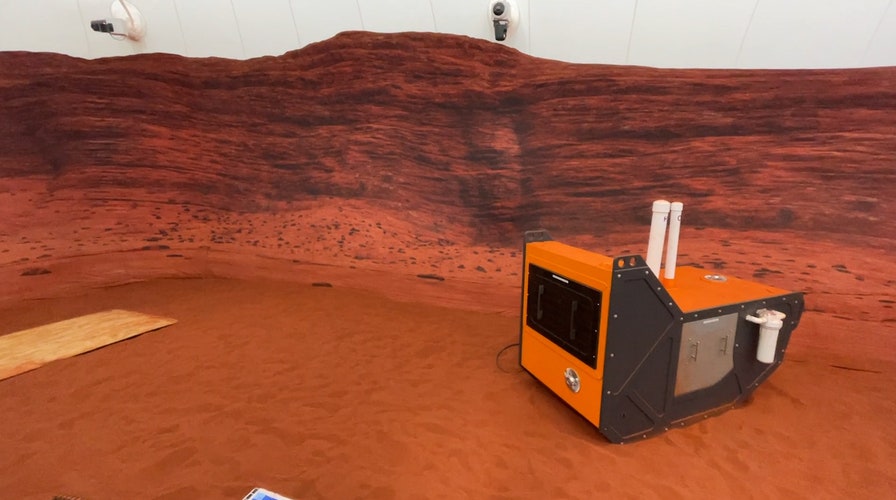
Throughout their 378-day tenure, the CHAPEA 1 crew operated under conditions mirroring a genuine planetary deployment. This included simulated communication delays of up to 22 minutes each way—recreating the vast radio distance between Earth and Mars—which forced the crew to solve critical systems failures autonomously.
The daily routine within Mars Dune Alpha was relentless. Crew members managed vertical hydroponic crop production, maintained complex life-support loops, conducted simulated geological "Marswalks" within a specialized 4,000-square-foot sandbox, and underwent rigorous psychological and physiological evaluations. Every behavioral twitch, sleep cycle disruption, and interpersonal friction point was meticulously logged by researchers monitoring telemetry from mission control.
From an enterprise infrastructure perspective, the mission tested the limits of autonomous cloud-compute architecture and local diagnostic systems. Without real-time support from ground engineers, the crew had to rely on onboard diagnostic software and localized data processing to troubleshoot equipment degradation—a crucial proof-of-concept for future remote mining and manufacturing operations.
Verified Data & Metrics Breakdown
To understand the scope and technical parameters of the CHAPEA 1 mission, the following comparative metrics outline the baseline parameters of the simulation:
| Metric Parameter | Mission Specification | Operational Significance |
|---|---|---|
| Total Isolation Duration | 378 Days (June 25, 2023 – July 6, 2024) | Validates long-duration psychological resilience and closed-loop system stability. |
| Habitat Footprint | 1,700 Square Feet (Mars Dune Alpha) | Optimized volumetric space for a four-person crew over multi-year deployments. |
| Construction Methodology | Robotic 3D Printing (Lavacrete polymer) | Proves autonomous in-situ resource utilization (ISRU) for planetary building. |
| Communication Latency | Up to 22 minutes each way | Forces absolute crew autonomy and decentralizes mission control oversight. |
| Simulated Environment | Martian Dune Field with VR Integration | Tests ergonomic efficiency of EVA suits and heavy-duty field geology tools. |
Industry & Market Implications: Winners and Losers
While the CHAPEA mission is ostensibly a scientific enterprise, its ripples are felt deeply across global capital markets, defense contractors, and private space technology firms. As governments pivot toward sustainable space exploration, the economic architecture surrounding infrastructure scalability is undergoing a profound transformation.
The Winners
- Additive Manufacturing & Construction Tech: Companies pioneering automated 3D printing and robotic infrastructure deployment are seeing a surge in investor confidence. The validation of Mars Dune Alpha proves that terrestrial construction tech has direct, highly lucrative applications in off-world development.
- Life Support & Bioregenerative Tech Firms: Enterprises specializing in closed-loop water purification, air revitalization, and controlled-environment agriculture are positioned to capture substantial government procurement contracts.
- Aerospace Risk Mitigation Consultants: Actuarial and engineering firms specializing in mission-critical redundancy and behavioral health frameworks are experiencing heightened demand as commercial spaceflight expands.
The Vulnerabilities
- Legacy Aerospace Contractors: Traditional providers reliant on heavy-mass, rocket-launched infrastructure face strategic disruption from agile firms utilizing lightweight, locally printed habitat models.
- Short-Horizon Venture Funds: Investors seeking rapid, multi-fold valuation multiples within traditional tech sectors may find deep-space infrastructure too capital-intensive, leading to a bifurcation in venture capital deployment.
Frequently Asked Questions (People Also Ask)
What was the primary objective of NASA's CHAPEA mission?
The primary objective was to collect data on human physiological and psychological performance during a prolonged, highly isolated 378-day deployment. By monitoring how four individuals adapted to strict resource limitations, communication blackouts, and close-quarters living, NASA can refine crew selection, training protocols, and life-support system design for future Artemis lunar bases and crewed Mars missions.
How was the Mars Dune Alpha habitat built?
Mars Dune Alpha was constructed using advanced 3D-printing technology developed by ICON. Utilizing a proprietary cement-like material called Lavacrete, large robotic gantries extruded the structure layer by layer without human intervention. This method drastically reduces the payload weight that must be transported from Earth, serving as a blueprint for future planetary construction.
Did the crew experience real communication delays with Earth?
Yes. Throughout the mission, communication between the CHAPEA crew and mission control was subjected to simulated delays ranging up to 22 minutes each way. This forced the crew to independently resolve simulated equipment failures, medical scenarios, and operational hurdles without immediate support from ground specialists.
What happens next now that CHAPEA 1 has concluded?
With CHAPEA 1 successfully completed, NASA researchers will spend months analyzing the extensive biomedical, psychological, and performance datasets. Meanwhile, preparations are already underway for subsequent CHAPEA missions (CHAPEA 2 and CHAPEA 3), which will test new cohorts of volunteers under similar conditions to validate and expand upon these initial findings.
Future Outlook: Milestones to Watch
The successful emergence of the CHAPEA 1 crew signals the end of a single experiment, but it initiates a much broader strategic roadmap for space exploration and industrial development. Over the next 24 to 36 months, industry stakeholders will monitor several pivotal milestones:
- CHAPEA Mission Iterations: NASA is slated to launch subsequent analog missions to test variable crew dynamics, upgraded life-support hardware, and next-generation software interfaces.
- Commercial Lunar Infrastructure Rollouts: Private aerospace entities will begin testing scaled versions of 3D-printed habitats in lunar regolith environments ahead of permanent Artemis basecamps.
- <Regulatory and Compliance Frameworks: As private enterprise deepens its footprint in deep-space development, international bodies will accelerate policy discussions regarding resource rights, environmental protection, and infrastructure interoperability.
Ultimately, the 378 days spent inside Mars Dune Alpha have proven that while human psychology and biological limitations remain our most delicate variables, engineering ingenuity and rigorous preparation can bridge the chasm between Earth and the final frontier. As valuation multiples shift toward sustainable space tech, the roadmap to Mars is no longer a theoretical exercise—it is an actively capitalized enterprise.