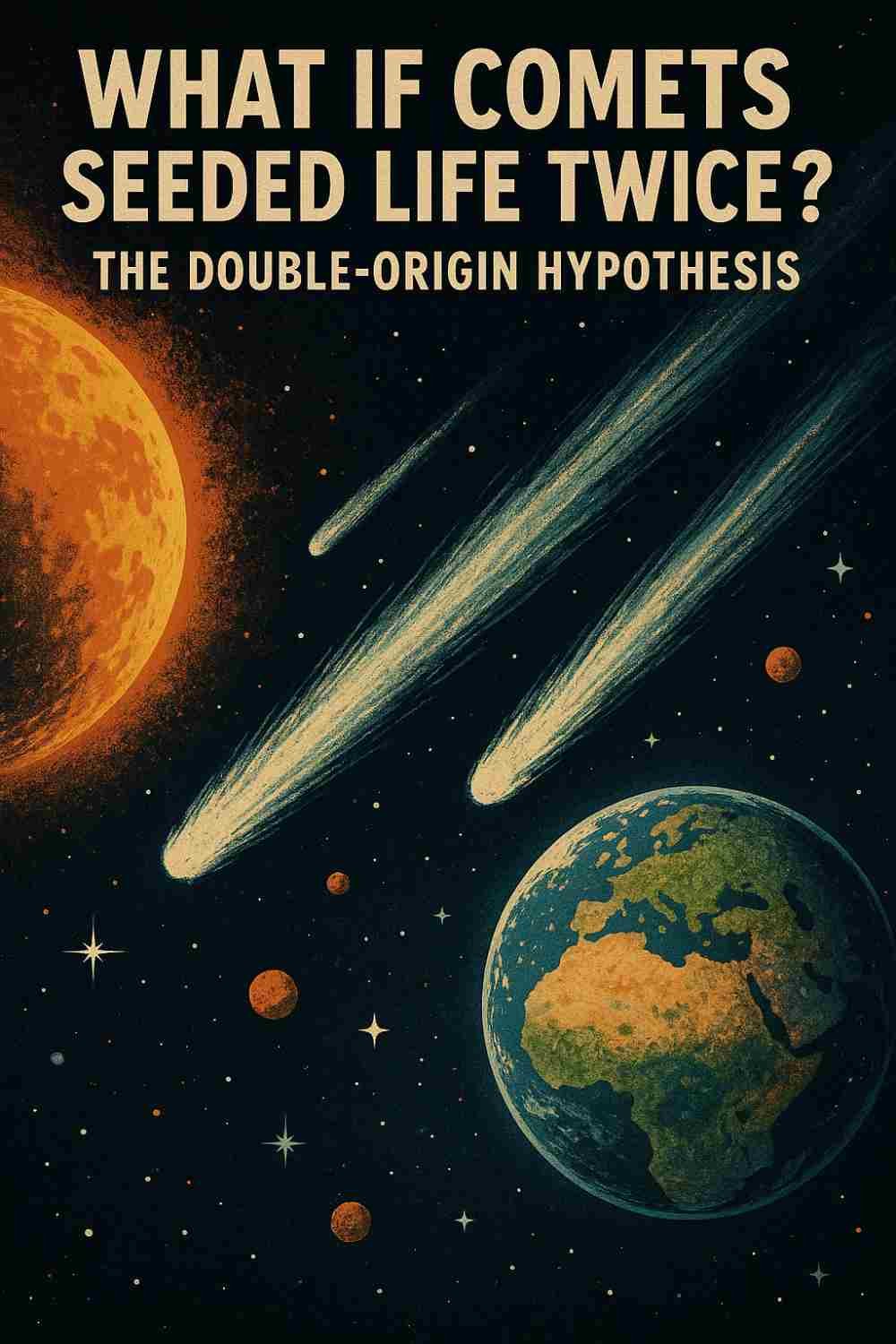
For over half a century, the reigning orthodoxy of planetary science and astrobiology was built upon a neat, mathematically convenient narrative: icy comets slammed into the primordial Earth during the Late Heavy Bombardment, delivering the delicate organic building blocks—amino acids, nucleotides, and complex hydrocarbons—necessary to jump-start terrestrial biology. It was a neat kinetic equation where celestial impactors acted as high-speed delivery trucks for the raw materials of life.
Today, that foundational paradigm is facing an unprecedented intellectual crisis. Recent laboratory simulations, deep-space spectral analyses, and high-energy impact physics are forcing a brutal reassessment across global research institutions. The consensus is fracturing. We may have been fundamentally wrong about how comets seeded life on Earth, and the paradigm shift threatens to rewrite textbooks, reshape aerospace risk mitigation strategies, and alter how venture capital and sovereign wealth funds allocate capital toward deep-space exploration and private-sector astrobiology startups.
Executive Takeaways
Test Our Free AI & Tech Utilities Suite
Calculate LLM API token costs, analyze article dwell-time, or simulate tech DCA returns.
- The Destruction Paradox: High-velocity kinetic impact models demonstrate that the extreme thermal and shock pressures of hypervelocity comet impacts likely obliterate, rather than preserve, complex organic molecules.
- The Chondritic Pivot: Astrobiologists are shifting their focus from volatile-rich comets to carbonaceous chondrite meteorites and interplanetary dust particles (IDPs) as the primary engines of prebiotic chemistry.
- Economic and Capital Reallocation: The paradigm shift directly impacts long-term valuation multiples and capital allocation strategies for commercial space enterprises, asteroid prospecting ventures, and planetary defense infrastructure.
- Methodological Revolution: Advanced quantum chemical modeling and laser-driven shock-tube experiments are replacing outdated thermal degradation models across premier research laboratories.
The Anatomy of an Astrobiological Dogma

To understand the magnitude of the current revisionism, one must examine the institutional inertia that protected the cometary delivery theory for decades. Following the landmark Apollo missions and the flybys of Halley's Comet by the international flotilla in 1986, planetary scientists developed a compelling geochemical narrative. Comets, largely composed of volatile water ice, carbon dioxide, carbon monoxide, and complex organic polymers, were viewed as pristine refrigerators preserving the chemical makeup of the early solar nebula.
In this framework, the physics were treated as secondary to the inventory. Comets possessed the inventory; therefore, when they collided with the young Hadean Earth roughly 4.1 to 3.8 billion years ago, they deposited vast oceans of water alongside an intricate pharmacopeia of prebiotic molecules. For institutional grant boards, academic departments, and NASA mission architecture, this model provided a stable framework that justified billion-dollar robotic interceptors like ESA’s Rosetta spacecraft and its Philae lander.
However, cracks in the facade began to appear when researchers attempted to replicate hypervelocity impacts in controlled laboratory environments. Using two-stage light-gas guns capable of accelerating projectiles to velocities exceeding 10 kilometers per second—standard orbital impact speeds—scientists fired amino-acid-laced ice analogs into high-density targets. The results were sobering, if not catastrophic, for the cometary hypothesis.
Instead of surviving the impact intact or synthesizing more complex polymers, over 80% of the delicate organic structures suffered complete thermal pyrolysis and shock-induced dissociation. The kinetic energy of a comet hitting Earth at 35 kilometers per second does not gently deposit its cargo; it acts as a molecular incinerator.
The Physics of Annihilation: Why Hypervelocity Changes Everything
At the heart of the revisionist movement are advanced thermodynamic calculations and hydrocode simulations executed on high-performance cloud compute architectures. These models simulate the shock wave propagation when a kilometer-scale icy body impacts a rocky planetary surface.
When a comet strikes Earth, the peak shock pressure routinely exceeds 50 gigapascals (GPa), accompanied by transient temperatures soaring past 3,000 degrees Celsius. Under these extreme conditions, carbon-nitrogen and carbon-carbon bonds—the structural backbone of organic life—are systematically cleaved. What survives the initial impact flash is subsequently subjected to prolonged thermal scorching within the vapor plume.
"We treated comets as gentle cosmic couriers when the physics clearly dictate they are molecular demolition sites," explains a senior planetary chemist advising European research consortia. "If you detonate a thermal bomb containing biological precursors, you don't get life; you get elemental carbon, nitrogen gas, and simple carbon dioxide. The mechanism simply didn't scale."
This realization forces a profound strategic pivot. If high-velocity comets destroyed their own organic payloads, how did the Earth acquire the inventory necessary to transition from chemistry to biology?
Verified Data: Comets vs. Carbonaceous Chondrites vs. IDPs
To evaluate the shifting consensus, financial analysts and scientific strategists look closely at the comparative metrics governing prebiotic delivery mechanisms:
| Delivery Agent | Average Impact Velocity (km/s) | Organic Survival Rate (%) | Primary Volatile Contribution | Prebiotic Efficiency Score |
|---|---|---|---|---|
| Oort Cloud Comets | 50.0 - 70.0 | < 5% | High (H2O, CO, CH4) | Low (High destruction rate) |
| Jupiter-Family Comets | 20.0 - 30.0 | 10% - 15% | Moderate-High | Moderate |
| Carbonaceous Chondrites | 12.0 - 18.0 | 45% - 60% | Moderate (Hydrated silicates) | High (Robust amino acid yield) |
| Interplanetary Dust Particles (IDPs) | < 15.0 (atmospheric braking) | 75% - 90% | Low-Moderate | Very High (Gentle atmospheric entry) |
The data clearly illustrates the analytical advantage of low-velocity carbonaceous chondrites and gentle atmospheric deceleration of interplanetary dust particles. These bodies deliver organic molecules with integrity intact, offering a far more viable mechanism for seeding a habitable planet.
Industry and Market Implications: Reallocating Capital in the New Space Economy
This scientific paradigm shift is far from an isolated academic debate; it carries immediate economic and strategic ramifications across global industries:
- Space Mining and Valuation Multiples: Private-sector enterprise valuations for asteroid prospecting startups have historically factored in the extraction of volatile-rich cometary bodies for water and fuel. If comets are deemed chemically hostile or less efficient delivery systems for foundational biomolecules, capital allocation strategies are shifting rapidly toward near-Earth carbonaceous asteroids (C-type asteroids).
- Aerospace Infrastructure & Risk Mitigation: Defense contractors and planetary defense agencies are recalibrating their risk models. Understanding the precise mechanical properties and impact dynamics of various celestial bodies dictates the engineering specifications required for kinetic deflection systems (such as NASA’s DART mission successors).
- Biotech and Synthetic Biology Synergy: Understanding the exact environmental constraints under which prebiotic molecules survive informs laboratory synthesis protocols. Synthetic biology firms utilizing automated cloud laboratories are leveraging these findings to optimize chemical reaction pathways for industrial biomolecule production.
As institutional investors demand rigorous risk mitigation and tangible enterprise ROI from deep-space ventures, aligning corporate research with peer-reviewed geochemical reality is no longer optional—it is a fiduciary imperative.
Frequently Asked Questions (People Also Ask)
Does this new research mean comets had nothing to do with Earth's water?
No. While comets may have struggled to deliver intact organic molecules due to high-impact destruction rates, they remain prime candidates for contributing a significant fraction of Earth’s oceanic water, though isotopic ratios (such as Deuterium-to-Hydrogen ratios) continue to spark intense debate among geochemists.
What replaced comets as the primary theory for seeding life?
The current scientific consensus is trending toward a hybrid model emphasizing low-velocity carbonaceous chondrite meteorites and a continuous rain of interplanetary dust particles (IDPs) that entered the upper atmosphere gently enough to preserve their delicate organic payloads.
How does this impact private space exploration and asteroid mining?
Commercial space entities are reallocating capital away from volatile-heavy distant comets and toward near-Earth carbonaceous asteroids, which offer stable structural integrity and a high yield of preserved organic compounds and hydrated minerals.
Are space agencies altering their upcoming mission profiles?
Yes. Future deep-space missions and sample-return architectures are increasingly prioritizing carbonaceous asteroid targets—such as those visited by OSIRIS-REx and Hayabusa2—over cometary interceptors to better understand the true nature of prebiotic chemistry.
Future Outlook: Milestones to Watch in Astrobiology
As the academic community digests these revelations, several critical milestones will dictate the trajectory of planetary science and commercial space enterprise over the next decade:
First, the comprehensive laboratory analysis of samples returned from asteroid Bennu by NASA’s OSIRIS-REx mission will provide definitive baseline data regarding the preservation limits of extraterrestrial amino acids under natural conditions. Second, advances in quantum-level hydrocode modeling will allow researchers to simulate multi-stage impact scenarios with unprecedented fidelity, bridging the gap between theoretical physics and organic chemistry.
For investors, corporate strategists, and geopolitical policymakers, keeping a close watch on these developments is essential. The story of how life began on Earth is not merely a historical curiosity; it is the master blueprint that informs our search for habitable worlds across the galaxy—and dictates where humanity deploys its capital in the stars.