For decades, humanity’s view of the deep cosmos has been defined by moments of agonizingly narrow focus. While the James Webb Space Telescope (JWST) has captivated the world with its ultra-deep, needle-point glimpses of the early universe, astronomers have long harbored a silent frustration: they are looking at the cosmos through a magnifying glass when what they desperately need is a panoramic camera.
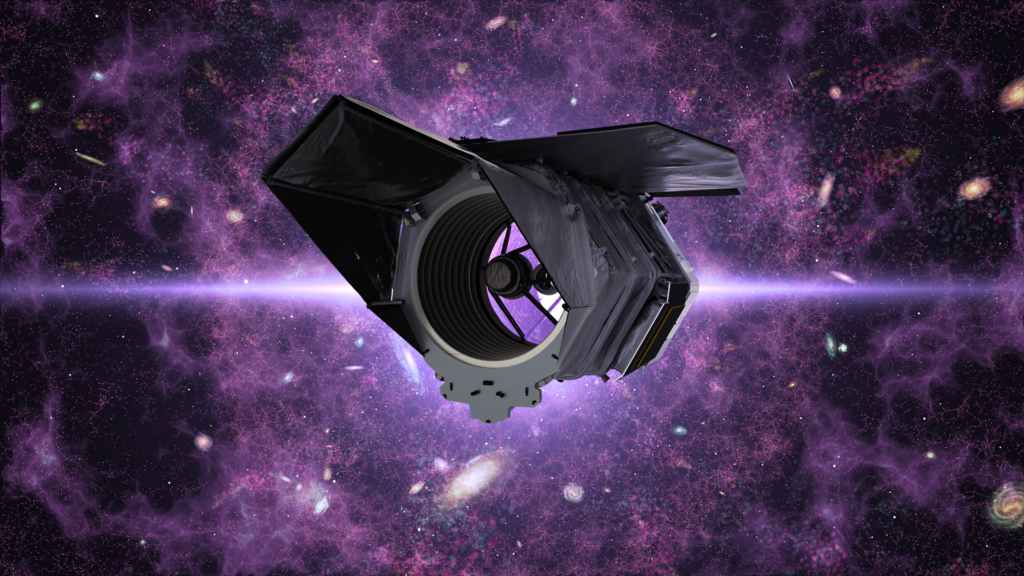
That is about to change. NASA is preparing to launch its next major astronomical powerhouse—the Nancy Grace Roman Space Telescope. Positioned as the spiritual successor to both Hubble and Webb, this multi-billion-dollar mission promises to revolutionize astrophysical science by mapping the universe at speeds never before imagined. Recently spotlighted by NPR’s Shortwave, the imminent arrival of this space observatory has sent shockwaves through the global scientific and aerospace sectors, signaling a paradigm shift in how we study dark energy, dark matter, and foreign planetary systems.
Executive Summary: What You Need to Know
- The Core Mission: Designed to unravel the mystery of dark energy and detect thousands of new exoplanets using a field of view 100 times larger than that of the Hubble Space Telescope.
- Economic & Scientific Footprint: A key driver for the aerospace defense sector, pushing the boundaries of precision optics, infrared sensors, and large-scale data processing pipelines.
- The Timeline: Currently undergoing rigorous thermal vacuum testing, with a scheduled launch window targeted for no later than May 2027 aboard a SpaceX Falcon Heavy rocket.
- The Ultimate Goal: To answer whether the expansion of the universe is accelerating indefinitely, and to catalog thousands of Earth-like planets in our galactic neighborhood.
The Wide-Angle Revolution: Beyond Hubble and Webb

To understand why the Nancy Grace Roman Space Telescope is causing such a stir in scientific circles, one must look at the physical limitations of current observatories. The James Webb Space Telescope is an extraordinary instrument, but it is designed for highly targeted, deep-space examinations. It views a tiny fraction of the sky at any given moment.
If JWST is a sniper rifle, the Roman Space Telescope is a wide-angle artillery barrage. Utilizing a 2.4-meter mirror—the same size as Hubble’s—Roman features a specialized 300-megapixel camera that allows it to capture a single image with 100 times the field of view of Hubble, without sacrificing image resolution. In just a few months of operation, Roman will map more of the sky in infrared light than Hubble has in over thirty years of service.
"We’ve been studying the universe by looking through a straw," said a senior NASA astrophysicist involved in the mission's optical testing. "Roman gives us the entire horizon. It allows us to conduct a cosmic census, finding the rare, needle-in-a-haystack anomalies that we can then instruct Webb to inspect closely."
Unlocking the Dark Universe: Energy, Matter, and Gravity
The primary economic and scientific justification for Roman’s $3.9 billion price tag lies in the mysterious forces that govern our universe. Roughly 95% of the cosmos is made up of dark matter and dark energy—invisible components that humanity has yet to directly detect or understand. Dark energy, in particular, acts as a cosmic accelerator, pushing galaxies away from each other at an ever-increasing rate.
By mapping hundreds of millions of galaxies across vast swathes of time and space, Roman will create a highly precise 3D map of the universe. This will allow scientists to measure how the distribution of galaxies changes over cosmic history. If dark energy is a constant force, Roman’s data will show it; if it is dynamic and changing over time, the telescope's massive statistical sample size will expose the cracks in Einstein’s General Theory of Relativity.
The Search for Second Earths: Gravitational Microlensing
Beyond mapping the dark universe, Roman is poised to become the ultimate exoplanet hunter. Unlike previous missions that relied on the "transit method" (watching a planet pass in front of its host star), Roman will utilize gravitational microlensing. This technique relies on the gravitational pull of a foreground star to bend and magnify the light of a background star, revealing the presence of orbiting planets—even those as small as Mars.
This method is particularly potent at detecting planets that are far from their stars, cold worlds, and even "rogue planets" that drift through the cold void of space without a parent star. Astronomers estimate that Roman will identify over 2,600 new exoplanets, vastly expanding our catalog of potentially habitable worlds.
Comparing the Titans: How Roman Fits into NASA's Fleet
The following table outlines how the upcoming Roman Space Telescope compares to its legendary predecessors in terms of design, capabilities, and primary scientific objectives:
| Feature / Spec | Hubble Space Telescope | James Webb Space Telescope | Nancy Grace Roman Telescope |
|---|---|---|---|
| Launch Year | 1990 | 2021 | Targeted by May 2027 |
| Primary Mirror Diameter | 2.4 meters | 6.5 meters | 2.4 meters |
| Wavelength Coverage | Ultraviolet, Visible, Near-Infrared | Near-Infrared, Mid-Infrared | Visible, Near-Infrared |
| Field of View | Baseline (1x) | ~0.1x to 0.5x Hubble | 100x Hubble |
| Primary Science Focus | General astrophysics, deep field imaging | The first stars, early universe chemistry | Dark energy, exoplanet census, wide-area mapping |
The Aerospace and Market Impact
For defense contractors and aerospace firms like L3Harris Technologies (which constructed the telescope’s primary optical assembly) and Ball Aerospace, the Roman Space Telescope represents a major industrial milestone. The development of its high-performance infrared detectors and its cutting-edge Coronagraph Instrument—designed to block out starlight to image planets directly—has driven significant innovation in semiconductor fabrication and wavefront sensing technologies.
As space exploration transitions into a commercialized era, the high-precision imaging technologies developed for Roman are expected to find secondary applications in Earth observation satellites, agricultural monitoring, and defense surveillance systems, proving once again that investments in deep-space science yield substantial dividends back on Earth.
Frequently Asked Questions
When is the Nancy Grace Roman Space Telescope launching, and how will it get to space?
The telescope is scheduled to launch no later than May 2027. It will be carried into orbit by a SpaceX Falcon Heavy rocket from Kennedy Space Center in Florida. Roman will travel to the second Lagrange point (L2), a gravitationally stable location about 1 million miles from Earth, which offers an unobstructed view of the deep cosmos.
How does Roman's field of view compare to Webb and Hubble?
While Roman has a mirror of the same size as Hubble (2.4 meters), its advanced camera optics allow it to capture an area of sky 100 times larger in a single exposure. This means it can perform massive cosmic surveys in a fraction of the time it would take Hubble or Webb, making it the most efficient mapping tool in NASA's arsenal.