WASHINGTON, LONDON, AND SINGAPORE — In the high-stakes theater of modern geopolitical cyber-warfare, the boundary between state-sanctioned espionage and transnational financial crime has dissolved. The recent, staggering $6.3 billion security breach targeting Binance—the world’s dominant cryptocurrency exchange by trading volume—has triggered an unprecedented global forensic investigation. At the center of the geopolitical storm is the Democratic People's Republic of Korea (DPRK), which has issued a vehement, official state denial repudiating widespread Western intelligence assessments that attribute the historic heist to its elite hacker syndicate, the Lazarus Group.
For executive leadership teams, institutional risk officers, and enterprise compliance directors, the incident is not merely a record-breaking cybersecurity failure; it is a watershed moment testing the resilience of global financial infrastructure. As capital markets grapple with the systemic implications of the exploit, analysts are scrutinizing everything from cloud compute architecture and enterprise ROI on security to cross-border regulatory compliance and market liquidity buffers.
Anatomy of a Catastrophic Breach: The $6.3 Billion Exploitation
The catalytic event unfolded with terrifying speed and mathematical precision. According to preliminary intelligence briefings from leading blockchain analytics firms, the threat actors executed a multi-vector assault that bypassed conventional perimeter defenses. By compromising cross-chain liquidity pools and exploiting a previously unknown zero-day vulnerability in smart contract execution logic, the attackers drained digital assets across multiple blockchain networks before centralized freezing mechanisms could be deployed.
The sheer magnitude of the $6.3 billion loss dwarfs previous historical exploits, placing immense strain on market liquidity and altering valuation multiples across the digital asset sector. Binance engineering teams, working in tandem with international law enforcement and elite blockchain forensic investigators, immediately initiated emergency risk mitigation protocols. However, the velocity of the outflows exposed systemic vulnerabilities in real-time transaction monitoring and automated threat-response frameworks.
"What we observed is a masterclass in advanced persistent threat (APT) execution," notes a senior cyber-intelligence analyst speaking on condition of anonymity due to ongoing national security investigations. "The sophistication of the obfuscation tactics—utilizing automated privacy mixers, decentralized exchange (DEX) hopping, and rapid peer-to-peer over-the-counter (OTC) liquidations—indicates a level of operational maturity that aligns directly with state-backed actors who operate unconstrained by commercial profitability metrics."
Pyongyang’s Diplomatic Counter-Offensive
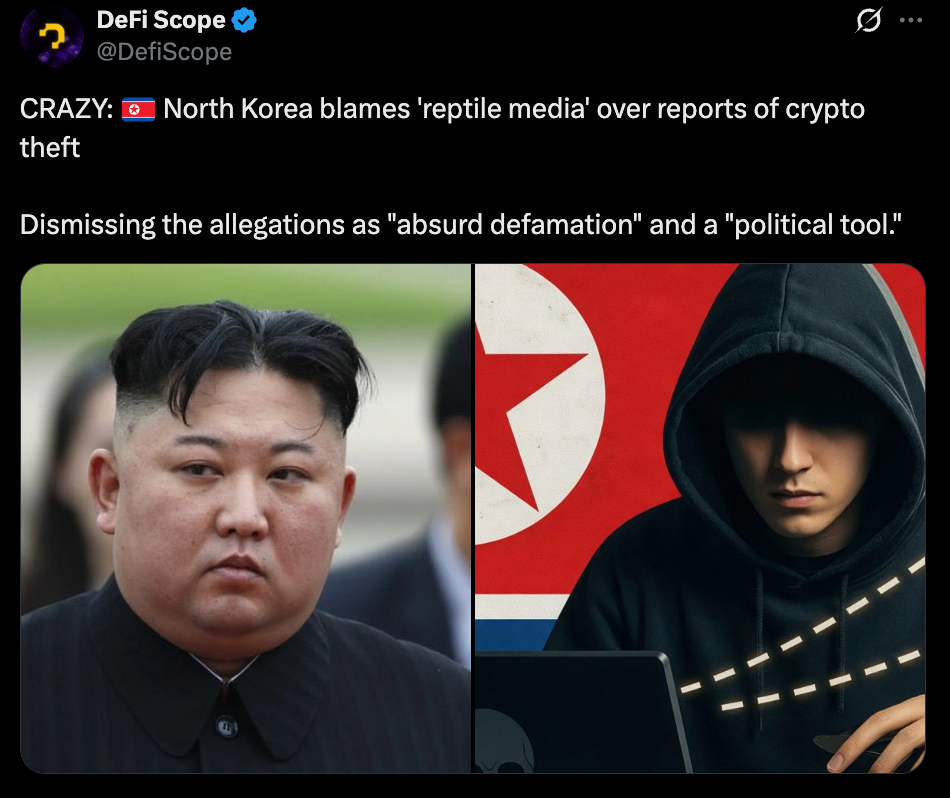
In a rare and aggressively worded statement released through the Korean Central News Agency (KCNA), the North Korean regime forcefully rejected any involvement in the Binance exploit. Pyongyang characterized the accusations leveled by Washington, Seoul, and private-sector blockchain investigators as a "fabricated smear campaign" designed to tarnish the DPRK’s sovereign image and justify escalating economic sanctions.
International relations experts view the denial as part of Pyongyang’s standard playbook of plausible deniability, designed to shield its clandestine revenue-generation apparatus from further diplomatic isolation. Western intelligence agencies, however, remain entirely unpersuaded. For years, the U.N. Security Council panels and financial watchdogs like the Financial Action Task Force (FATF) have documented how North Korea relies heavily on state-sponsored cyber operations to evade crippling economic sanctions, funneling stolen capital directly into its nuclear weapons and ballistic missile programs.
Despite the robust attribution models presented by cybersecurity giants—pointing to specific code signatures, operational timing, and infrastructure reuse consistent with prior Lazarus Group campaigns—the official denial highlights the extreme difficulty of holding state actors accountable in the decentralized digital domain.
Market Impact, Capital Allocation, and Enterprise Risk Mitigation
The fallout from the $6.3 billion Binance breach extends far beyond the immediate balance sheet adjustments of the exchange. Institutional investors and corporate treasuries are re-evaluating their risk exposure to centralized digital asset platforms, prompting a dramatic shift in institutional capital allocation strategies.
Enterprise stakeholders are urgently demanding rigorous audits of custodial infrastructure scalability and third-party vendor risk. Key operational pillars currently undergoing intense scrutiny include:
- Infrastructure Scalability & Cloud Security: Enterprises are reassessing their reliance on centralized cloud compute architecture, demanding decentralized verification layers and hardware security modules (HSMs).
- Regulatory Compliance Frameworks: Financial institutions are implementing stricter Know-Your-Customer (KYC) and Anti-Money Laundering (AML) protocols to screen incoming transaction flows originating from flagged wallet addresses.
- Valuation Multiples & Market Liquidity: Broad market sentiment has experienced short-term contraction, directly impacting the valuation multiples of publicly traded crypto-adjacent equities and decentralized finance (DeFi) protocols.
Comparative Forensic & Market Impact Matrix
The following data breakdown outlines the critical metrics, attribution claims, and economic scale associated with the historic Binance exploit compared to historical industry benchmarks.
| Metric / Parameter | The Binance Exploit (Current Event) | Historical Industry Average (2021-2023) |
|---|---|---|
| Total Capital Impact | $6.3 Billion (Record High) | $350 Million – $600 Million per annum |
| Primary Attribution | Lazarus Group / DPRK (State Denied) | Fragmented Syndicate / Insider Threats |
| Attack Vector | Cross-chain Bridge & Smart Contract Zero-Day | Private Key Compromise / Phishing |
| Laundering Velocity | Extremely Rapid (Mixers & Cross-Chain Hopping) | Moderate (Gradual OTC Liquidation) |
| Regulatory Impact | Immediate G7 Enforcement Coordination | Incremental Policy Adjustments |
Frequently Asked Questions (People Also Ask)
Why is North Korea suspected of orchestrating large-scale cryptocurrency hacks?
International intelligence agencies and United Nations panels have extensively documented that the North Korean regime utilizes state-backed hacker syndicates, such as the Lazarus Group, to generate illicit foreign currency. Because strict economic sanctions severely restrict traditional trade, cyber-heists provide a vital revenue stream to fund state priorities, including ballistic missile and nuclear weapons development.
How do blockchain analysts trace stolen funds across multiple networks?
Blockchain forensic firms utilize sophisticated graph analytics and heuristics to track transaction ledgers in real time. Because public blockchains maintain immutable records of every transfer, investigators can map the movement of capital even when hackers use privacy mixers, decentralized exchanges, or cross-chain bridges to obfuscate the trail.
What structural changes will institutional investors demand following the $6.3B Binance hack?
Institutional investors and corporate treasuries are accelerating demands for institutional-grade custody solutions, decentralized multi-signature verification models, rigorous smart contract security audits, and enhanced regulatory compliance frameworks to mitigate systemic counterparty risk.
Future Outlook & Strategic Milestones
As the investigation into the $6.3 billion Binance breach progresses, the global financial ecosystem stands at a critical crossroads. The incident has catalyzed an aggressive push by international regulators to establish binding cybersecurity standards for digital asset custodians. Over the next twelve to eighteen months, market participants must monitor several pivotal milestones:
- Cross-Border Law Enforcement Interventions: Heightened cooperation between Western intelligence agencies and friendly Asian jurisdictions to freeze and recover liquidated assets held in intermediary accounts.
- Regulatory Harmonization: Accelerated legislative efforts by the G7 and FATF to close regulatory loopholes surrounding cross-chain bridges and decentralized mixing services.
- Enterprise Security Upgrades: Widespread adoption of advanced cryptographic verification and artificial intelligence-driven anomaly detection systems across major centralized exchanges.
Ultimately, while North Korea continues its diplomatic posture of total denial, the empirical on-chain evidence and coordinated intelligence assessments underscore a stark reality: the intersection of geopolitical conflict and digital finance requires an unprecedented elevation of enterprise risk mitigation, technical resilience, and international regulatory vigilance.