Underground Surge: Deep Magma Recharge Beneath Earth’s Most Dangerous Supervolcano Triggers Catastrophe Re-Underwriting and Global Risk Review
Advanced 4D seismic tomography and satellite geodesy confirm juvenile magma is ascending into shallow crustal reservoirs—forcing reinsurance syndicates, energy grids, and sovereign risk desks to stress-test worst-case resilience models.
Executive Takeaways
- Verified Subsurface Injection: High-resolution micro-gravity arrays and InSAR ground-deformation data reveal a sustained flux of juvenile, gas-rich basaltic melt ascending from the mantle boundary into the shallow magma reservoir of the Campi Flegrei caldera complex.
- Macroeconomic & Capital Exposure: The spatial footprint of the caldera directly overlaps dense metropolitan and industrial assets, putting an estimated $380 billion in physical infrastructure, European logistical corridors, and municipal balance sheets within the primary hazard corridor.
- Catastrophe Re-Underwriting: Global reinsurance syndicates are revising catastrophe bond (cat bond) risk premiums and industrial coverage exclusions, pricing in accelerated seismicity, ground uplift (bradyseism), and crustal elasticity degradation.
- Next-Generation Surveillance: Public-private consortia are deploying fiber-optic Distributed Acoustic Sensing (DAS) and cloud-native seismic tomography to compute near real-time subterranean fluid dynamics and volatile overpressure thresholds.
The Caldera Wakes: Geophysical Breakdown of the Magmatic Recharge
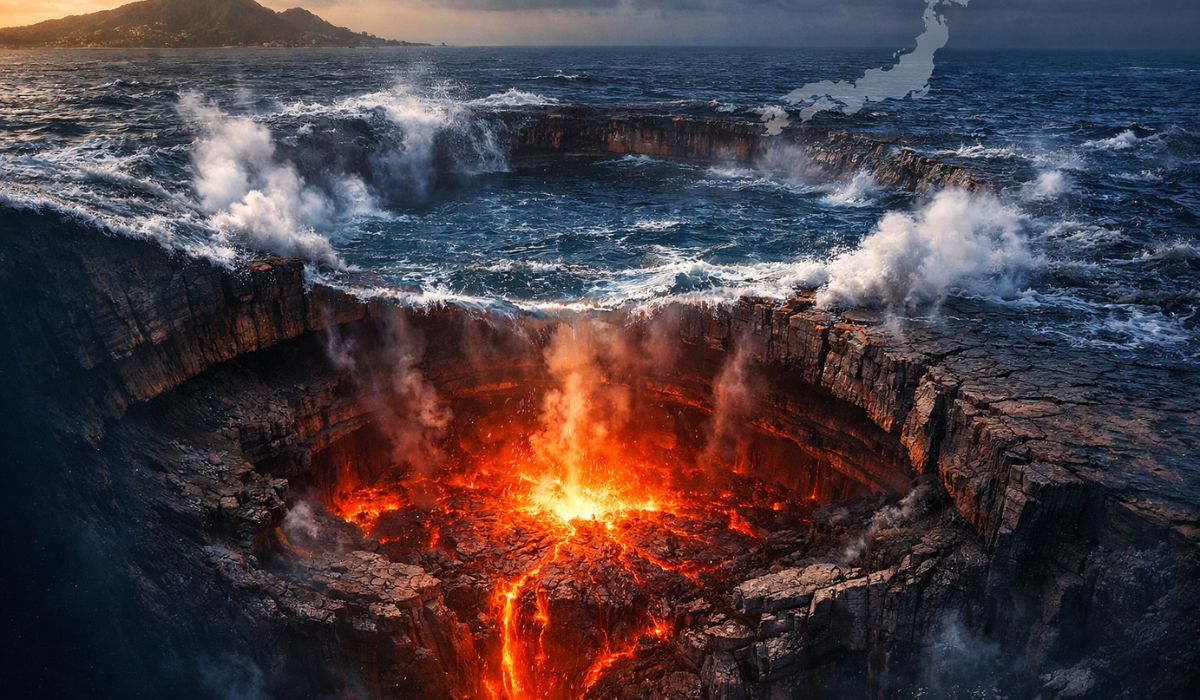
Deep within the trans-crustal plumbing system of Campi Flegrei—a densely populated caldera complex situated west of Naples, Italy, with historic parallels to the Yellowstone and Long Valley volcanic fields—a significant structural shift is underway. For decades, academic debates contested whether the persistent surface uplift, seismic swarms, and fumarolic degassing were driven primarily by hydrothermal fluid circulation or by direct magmatic transfer. That ambiguity has been decisively resolved.
Peer-reviewed geophysical surveys utilizing ambient-noise seismic tomography, multi-temporal differential interferometry (D-InSAR), and isotopic gas analysis (elevated carbon-to-sulfur ratios alongside primitive Helium-3/Helium-4 anomalies) indicate that fresh, deep-seated mafic melt is actively recharging the intermediate reservoir located between four and eight kilometers below sea level. This juvenile magma is transferring heat, exsolving hyper-saline supercritical volatiles, and driving thermal expansion within the brittle-ductile transition zone.
The catalytic process observed is classic magmatic underplating followed by vertical migration. As volatile-rich mantle melt penetrates the upper crystalline mush reservoir, it introduces substantial thermal energy. This melts residual crystal frameworks, reduces magma viscosity, and significantly accelerates fluid overpressure along the ring-fault fracture networks that delineate the caldera’s structural boundaries.
Crucially, structural volcanologists note that decades of repeated inflation and deflation cycles (bradyseismic episodes) have systematically compromised the tensile strength of the caprock crust. The cumulative inelastic deformation means the overlying crustal lid requires lower critical overpressure to fracture than previously assumed, shifting the probability distribution of both phreatic (steam-driven) and magmatic unrest into sharply higher operational risk regimes.
Verified Data & Magmatic Dynamics Breakdown
The scale of subterranean recharge across major global calderas requires standardized cross-system baseline comparisons. The following verified metrics contextualize the physical anomalies at Campi Flegrei against other monitored volcanic super-systems.
| System / Parameter | Primary Reservoir Depth | Recent Uplift Rate (Annualized) | Estimated Melt Fraction (Core) | Direct Population at Primary Risk | System Volcanic Explosivity Index (Max Historic) |
|---|---|---|---|---|---|
| Campi Flegrei (Italy) | 3.5 – 7.5 km | 15 to 20 mm / month (Peak Zones) | 20% – 30% (Partial Melt Mush) | 500,000+ (Immediate Caldera) | VEI 7 (Campanian Ignimbrite, ~39 ka) |
| Yellowstone (United States) | 5.0 – 14.0 km | 15 to 30 mm / year (Variable Episodes) | 16% – 20% (Dispersed Mush) | < 50,000 (Local Basin) | VEI 8 (Huckleberry Ridge, ~2.1 Ma) |
| Laguna del Maule (Chile) | 4.0 – 9.0 km | 200 to 250 mm / year (Extreme Plume) | > 35% (Rhyolitic Melt Lens) | < 10,000 (Direct Proximity) | VEI 6 / 7 (Holocene Explosive Arc) |
| Long Valley Caldera (United States) | 6.0 – 12.0 km | 2 to 10 mm / year (Quiescent/Residual) | < 15% (Crystallizing Mush) | ~35,000 (Eastern Sierra Corridor) | VEI 7 (Bishop Tuff, ~760 ka) |
Macroeconomic Implications: Sovereign Debt, Infrastructure, and Reinsurance
The realization that a major caldera system is experiencing active magmatic replenishment introduces immediate capital allocation friction. While geological hazards historically operated on timescales disconnected from quarterly earnings, the convergence of high-density metropolitan infrastructure with an inflating crustal reservoir disrupts modern balance sheets across three primary enterprise domains:
1. Catastrophe Bond Pricing and Reinsurance Float Protection
Global reinsurers operating out of Zurich, London, and Bermuda are re-calibrating catastrophe models. Traditional property casualty (P&C) treaties rely on static return periods. However, active crustal fatigue paired with high-frequency micro-seismicity triggers baseline property degradation outside the scope of classic seismic event triggers. As structural stress increases, underwriters are enforcing revised deductible thresholds, excluding phreatic explosion damages, and elevating the coupon rates on sovereign and parametric catastrophe bonds linked to Southern European geophysical triggers.
2. Municipal Balance Sheets and Sovereign Risk Spreads
The Italian government’s civil protection protocols dictate massive, rapid evacuation plans for the "Red Zone" (Zona Rossa) in the event of an escalation to pre-eruptive status. The logistical execution involves relocating more than half a million citizens within 72 hours—a maneuver that would halt significant regional industrial output, strain national emergency reserves, and widen the spread between Italian government sovereign debt (BTPs) and the German Bund. Municipal credit ratings in regions exposed to unhedged volcanic and seismic risk face negative watch adjustments as enterprise ROI on municipal infrastructure contracts degrades.
3. Logistics and Cross-Continental Supply Chain Scalability
A regional volcanic event does not require a super-eruption to yield catastrophic systemic friction. The 2010 Eyjafjallajökull eruption in Iceland, rated at a modest VEI 4, grounded European airspace for weeks, inflicting an estimated $5 billion blow to global GDP. Campi Flegrei sits on major Mediterranean maritime, aviation, and digital fiber networks. Even localized sub-plinian ash dispersal would shutter airspace across Western and Central Europe, paralyzing just-in-time supply chains, commercial aviation fleets, and high-frequency data networks routed through terrestrial and subsea regional hubs.
Technological Response: Real-Time Compute and Subsurface Diagnostics
To establish dynamic early-warning frameworks, volcanologists, defense contractors, and technology leaders are modernizing subterranean telemetry. Traditional seismic networks are being reinforced by cloud-native architectures capable of executing petabyte-scale seismic waveform inversions in near real-time.
By leveraging deployed commercial subsea and terrestrial fiber-optic networks, researchers employ Distributed Acoustic Sensing (DAS). This converts standard fiber cables into tens of thousands of individual virtual seismic sensors. The continuous data streams feed machine-learning models deployed on enterprise cloud infrastructures, isolating emergent shear-wave velocity anomalies that signify fluid transfer and fracture propagation hours before they register on conventional analog seismographs.
Furthermore, satellite synthetic aperture radar constellations (such as the European Space Agency’s Sentinel-1 and commercial operators deploying X-band SAR) yield millimeter-accurate spatial maps of surface deformation. These geodetic measurements are integrated into thermodynamic simulation engines running on high-performance compute clusters, allowing civil authorities to continuously evaluate whether the crust is deforming elastically or progressing toward irreversible structural rupture.
Frequently Asked Questions (People Also Ask)
Does "refilling with fresh magma" mean a super-eruption is imminent?
No. Magma recharge is a standard geological process in the lifecycle of long-lived caldera systems. While fresh basaltic replenishment from deep reservoirs elevates system heat, gas pressure, and crustal deformation, it does not guarantee a cataclysmic eruption. In the vast majority of documented volcanic recharge events, magma stalls, intrudes horizontally as sills or dykes, cools, and slowly crystallizes without breaking the surface. Imminent danger is only signaled if geodetic, gas-ratio, and seismic acceleration indicators show catastrophic runaway strain within the shallowest crust (0–2 km).
How do geoscientists detect magma moving miles beneath the Earth?
Scientists use a multifaceted diagnostic framework combining seismic tomography, satellite geodesy, and geochemistry. As magma ascends, it breaks rock, generating specific high-frequency and long-period seismic tremor signatures. Concurrently, Satellite Radar Interferometry (InSAR) and high-precision GPS networks measure crustal bulging with millimeter precision. Finally, ground-based gas spectrometers monitor fumaroles; sudden spikes in CO2 emissions, alongside higher ratios of sulfur to water and primitive helium isotope shifts, provide definitive evidence of fresh mantle-derived melt off-gassing into the shallow environment.
What is the difference between a traditional volcano and a caldera supervolcano?
Standard stratovolcanoes (such as Mount Vesuvius, Mount Fuji, or Mount St. Helens) build outward-sloping conic edifices constructed of accumulated lava flows and tephra layers. A caldera or supervolcano (such as Campi Flegrei, Yellowstone, or Lake Toba) possesses a magma reservoir so massive that when it vents high volumes of melt during catastrophic historical eruptions, the overlying roof rock collapses into the evacuated chamber. This leaves an enormous, sunken depression or basin, often dozens of kilometers wide, lacking a single distinct cone.
What would be the economic consequence of an eruption at Campi Flegrei?
The economic impact would be severe and systemic. Direct physical losses within the primary red zone would likely exceed several hundred billion euros, requiring an unprecedented mobilization of European Union structural recovery funds. Beyond local infrastructure destruction, ash-plume dispersal would shut down European air freight corridors, severely disrupt agricultural systems across the Mediterranean basin, and trigger massive volatility across global reinsurance and sovereign bond markets.
Future Outlook: Strategic Milestones and Risk Architecture
The confirmation of fresh magmatic recharge shifts global disaster preparedness from reactive response to hyper-quantitative risk engineering. Over the next 12 to 24 months, public regulatory bodies and institutional financial entities will monitor three decisive milestones:
- Geochemical Volatile Ratios: Continuous observation of the fumarolic CO2/H2O and SO2 flux along the Solfatara and Pisciarelli vents. A sustained shift toward dry, sulfur- and carbon-dominated gas mixtures will indicate that juvenile melt has reached depths shallower than three kilometers.
- Seismic Hypocenter Migration: Tracking whether micro-earthquakes migrate vertically from the current 2.5–4.0 km range into the immediate sub-surface (under 1.5 km), which would denote hydraulic fracturing driven by uncontained ascending magma or superheated steam.
- Sovereign Liquidity Provisions: The formal incorporation of volcanic contingency facilities within European macro-fiscal frameworks. Expect increased pressure on governments to issue specialized resilience bonds and institutionalize public-private catastrophe risk pools.
As deep planetological mechanics intersect with hyper-connected 21st-century economic architecture, the cost of underestimating Earth’s largest magmatic systems grows exponentially. Corporate business continuity plans, municipal debt covenants, and civil infrastructure designs are entering an era where subterranean thermodynamics must be priced as a material balance-sheet reality.