Inside Spotify’s Family Plan Crackdown: How the New QR Code Verification System Triggers a 12-Month Ban on Account Sharing
Executive Takeaways
- The Enforcement Mechanism: Spotify is deploying an aggressive QR-code-based proximity verification framework designed to mechanically validate that Premium Family and Duo plan members physically reside at the same residential address.
- The 12-Month Penalty: Sub-account users who fail the dynamic authentication scan or miss the verification window are automatically excised from the subscription and barred from joining any other Family or Duo plan for a rolling 365-day period.
- The Financial Imperative: The initiative represents a pivotal strategic pivot to lift stagnating Average Revenue Per User (ARPU), capture leakage among its 250+ million premium subscribers, and expand gross margins under pressure from major music label royalties.
- Architectural Shift: Departing from contentious, battery-draining continuous GPS pings, the platform is adopting cryptographic, localized handshakes to balance user privacy compliance against enterprise-level subscription leak remediation.
The Architectural Pivot: Engineering Out the Digital Freeloader

For more than a decade, the streaming music industry operated on an unwritten pact of engineered leniency. To accelerate top-line monthly active user (MAU) metrics, satisfy institutional venture allocations, and demonstrate ecosystem dominance, platforms systematically ignored the widespread sharing of group plans among distributed social circles, non-cohabitating relatives, and college dormitories. That era of growth-at-all-costs has officially concluded.
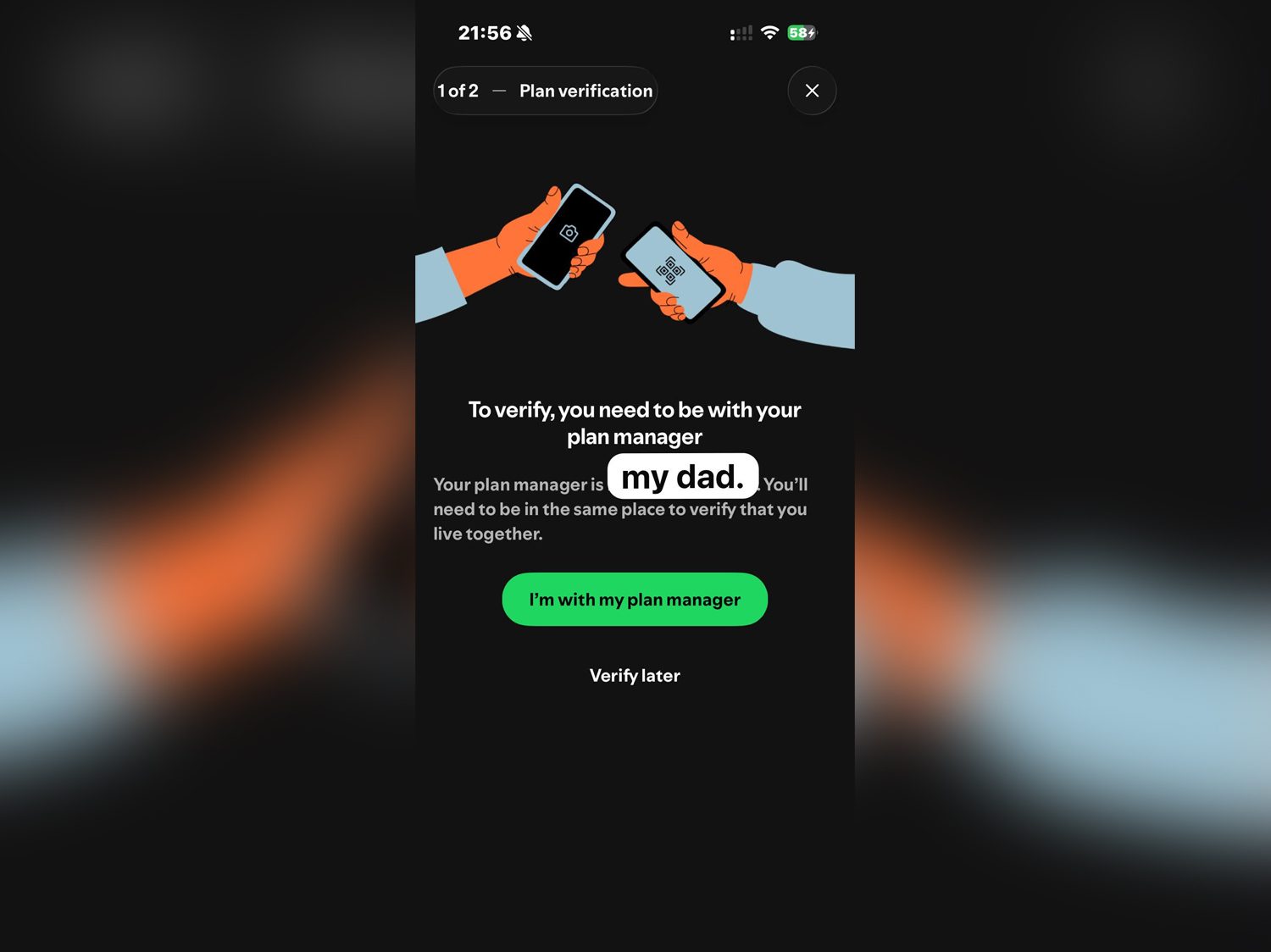
Spotify Technology S.A. is now rolling out a stringent, device-level QR code verification pipeline engineered to eradicate out-of-household password sharing. The upgraded protocol requires secondary account holders on Spotify Premium Family ($19.99/month in the U.S.) and Spotify Premium Duo ($16.99/month) to physically interface with the primary account holder’s primary hardware device. Unlike passive location checks or manual address entry fields—which users historically bypassed using copy-pasted postal codes—the new deployment demands a real-time, cryptographic handshake.
Under this system, the primary account manager generates a short-lived, encrypted dynamic QR code on their local client. Secondary profiles linked to the plan must scan this matrix directly via their own device’s hardware camera within an active, synchronized time frame. The mechanism validates localized hardware proximity and local area network (LAN) telemetry, rendering remote screenshot sharing and asynchronous verification structurally ineffective.
The 365-Day Penalty Box: Algorithmic Enforcement and Commercial Lockout
The operational teeth of Spotify’s anti-sharing architecture lie not merely in the technical friction of scanning, but in the punitive severity of non-compliance. According to interface documentation, internal testing telemetry, and user reports surfaced across developer ecosystems, any secondary profile that fails to authenticate within the designated verification window is instantly decoupled from the host tier.
More critically, the evicted user account is slapped with an algorithmic 12-month blacklist. Under this enforcement rule, the account identifier, associated device fingerprints, and payment profile metadata are barred from joining any multi-user tier—whether a separate Family plan or a Duo account—for a full 362 to 365 calendar days.
This penalty architecture represents a calculated exercise in churn-versus-conversion behavioral engineering. Displaced users are systematically stripped of discounted shared access and channeled directly toward Spotify’s full-priced Individual tier ($11.99/month) or forced into its ad-supported, margin-dilutive free listening tier. By imposing a punitive one-year cooldown, Spotify creates an asymmetric barrier to entry: the perceived risk of permanently forfeiting shared plan access outweighs the utility of gaming the system for distributed peer groups.
The Wall Street Mandate: ARPU Optimization in a Maturing Market
The aggressive posture of Spotify’s product engineering teams cannot be decoupled from Stockholm and Wall Street boardroom pressures. In its high-growth cycle, Spotify prioritized gross MAU acceleration over per-subscriber yields. However, the macroeconomic reality of streaming has shifted toward capital allocation efficiency, cash flow durability, and gross margin optimization.
Spotify pays out approximately 65% to 70% of its gross audio revenues to rights holders, led by the Big Three music labels: Universal Music Group (UMG), Sony Music Entertainment (SME), and Warner Music Group (WMG). Because label payouts are fundamentally calculated via a complex market-share-pro-rata pool, every unmonetized or heavily discounted stream drags down the effective royalty pool per play. Under a standard six-person Family plan fully populated by unrelated individuals, Spotify’s realized ARPU plunges to roughly $3.33 per user per month before operational overhead.
By forcing out-of-household freeloaders onto standalone tiers, Spotify targets a meaningful upward inflection in blended ARPU. The playbook mirrors the masterclass executed by Netflix, which leveraged its "paid sharing" and household IP mesh verification to drive historic subscriber net additions and pricing power throughout 2023 and 2024. For Spotify, converting just 8% to 12% of unauthorized shared-plan occupants into single-user accounts represents hundreds of millions of dollars in highly recurring annual enterprise cash flows, immediately flowing through to operating income.
Comparative Analysis: Modern Streaming Anti-Sharing Enforcement
The migration toward multi-factor proximity verification signifies a broader technological arms race between subscription services and digital consumers. The table below delineates how market leaders across the entertainment spectrum are structuring access boundaries, device handshakes, and user penalties.
| Platform | Verification Architecture | Enforcement Cadence | Non-Compliance Penalty | Regulatory & Privacy Exposure |
|---|---|---|---|---|
| Spotify | Dynamic QR Code + Localized Device Handshake | Triggered periodically or upon suspicious access anomaly | Immediate plan decoupling; 12-month ban from all shared plans | Low; avoids continuous background GPS tracking via transient optical handshake |
| Netflix | Household Primary Wi-Fi Mesh + IP/SSID Fingerprinting | Continuous; mandatory 31-day check-in on primary network | Access blocked on peripheral client until "Extra Member" fee is remitted | Moderate; consumer friction regarding travel access and ISP dynamic IP churn |
| Disney+ | One-Time Passcode (OTP) via Email + Device Graph Analysis | Heuristic-triggered based on concurrent stream locations | Stream session termination; prompt to establish primary household | Low; standard two-factor authentication methodology |
| Apple Music | Apple ID Family Sharing with Centralized Payment Instrument | Ecosystem-integrated; persistent iCloud family linkage | Disabling of shared cloud media assets; administrative expulsion | Very Low; leverages proprietary operating system-level entitlements |
Privacy Architecture: Why Optical Handshakes Replace GPS
The transition to QR verification also solves a fraught compliance dilemma that has haunted Spotify’s operational divisions since 2018. The company previously tested passive background GPS coordinates to confirm household integrity. That deployment catalyzed immense public pushback and prompted immediate regulatory scrutiny from European Union data protection authorities operating under GDPR frameworks.
Continuous or periodic geographic geolocation queries represent high-liability data collection. Storing, processing, and auditing real-time longitude and latitude logs introduces significant compliance costs, third-party attack surfaces, and consumer pushback. An optical, transient QR code transaction eliminates this regulatory overhead. The system operates locally: the primary user's app generates a cryptographically signed payload incorporating a millisecond-precision timestamp, an ephemeral session token, and local sub-network attributes. When the secondary hardware client captures the code, the verification resolves via an instantaneous, encrypted handshake against Spotify’s authentication servers. The platform confirms physical adjacency without ever logging the physical street coordinates of either user.
Market Implications: Industry Winners, Churn Dynamics, and Collateral Damage
The aggressive enforcement posture redraws the competitive landscape across digital audio streaming, producing clear cohorts of market beneficiaries and vulnerable demographics:
- The Winners (Labels & Publishers): Universal Music Group, Sony Music, and independent rights aggregators stand to benefit directly. Increased conversion to standalone tiers lifts the global royalty denominator, amplifying per-stream payouts and driving top-line distribution returns.
- The Losers (Fragmented Families & Nomads): Real-world families with non-traditional dynamics—such as co-parenting households, children attending domestic or international universities, and frequent business travelers—face profound operational friction. These legitimate users risk accidental inclusion in the 12-month administrative lockout due to physical separation during arbitrary verification sweeps.
- The Competitors (Apple and Amazon): Spotify’s calculated friction provides an immediate inbound customer acquisition opportunity for Apple Music and Amazon Music. Apple’s ecosystem-level Family Sharing is tied to shared payment liabilities rather than forced physical proximity, positioning it as an intuitive alternative for users alienated by Spotify’s 12-month punitive measures.
Frequently Asked Questions (People Also Ask)
How does Spotify’s QR code verification actually verify family household members?
The system mandates that the designated Family or Duo plan manager open their Spotify client and render an internally generated, time-sensitive, encrypted dynamic QR code. The secondary family member must then physically use their own smartphone or tablet camera within the Spotify interface to scan the host display. The verification engine matches session keys, timestamps, and localized network signatures, certifying that both hardware devices are in direct physical proximity at the moment of validation.
What triggers the 12-month ban, and can it be appealed through customer support?
The one-year lockout is systematically triggered if a sub-account user fails to complete the verification challenge within the designated compliance window, attempts to validate via expired or invalid credentials, or fails anomalous location checks. While Spotify maintains standard customer support channels, reversing programmatic account sanctions historically requires comprehensive documentation proving legal cohabitation at the primary account’s billing address. Bypassing the ban to immediately join another multi-user plan with the same profile is blocked by the platform's user-graph database.
Can secondary users simply bypass the scan by using a screenshot sent over messaging apps?
No. Spotify’s engineering architecture deploys dynamic rendering technology. The generated QR code incorporates rotating cryptographic tokens that refresh every few seconds, much like enterprise-grade two-factor authentication (2FA) authenticators or modern transit boarding passes. A static screenshot sent via SMS, email, or messaging platforms will expire before it can be parsed and accepted by a remote device, rendering remote asynchronous scans technically unviable.
How does this policy affect college students who legitimately share a family plan?
This is the primary flashpoint of the enforcement model. Students living in off-campus housing or university dormitories will inevitably fail the physical proximity check if the verification cycle triggers while they are away from their primary family residence. Unless these users physically travel back home to scan the manager’s device during the compliance window, they face algorithmic expulsion and the subsequent 12-month shared-tier restriction, forcing them onto the discounted Spotify Student tier ($5.99/month) or standard Individual pricing.
Future Outlook and Strategic Horizon
The global rollout of dynamic QR code verification signals that Spotify’s executive tier is confident in the inelasticity of its subscriber base. The critical variable moving into upcoming fiscal quarters will be whether the gains extracted from churned freeloaders converting into $11.99/month Individual subscribers outpace the collateral attrition of alienated family units migrating to Apple Music or YouTube Music.
Investors should track Spotify’s churn metrics, churn mitigation spend, and blended ARPU figures in upcoming quarterly earnings calls. If the platform successfully traverses the predictable initial consumer backlash, expect proximity-based hardware verification to become the standardized operational baseline across all shared digital subscription models worldwide.