Executive Takeaways
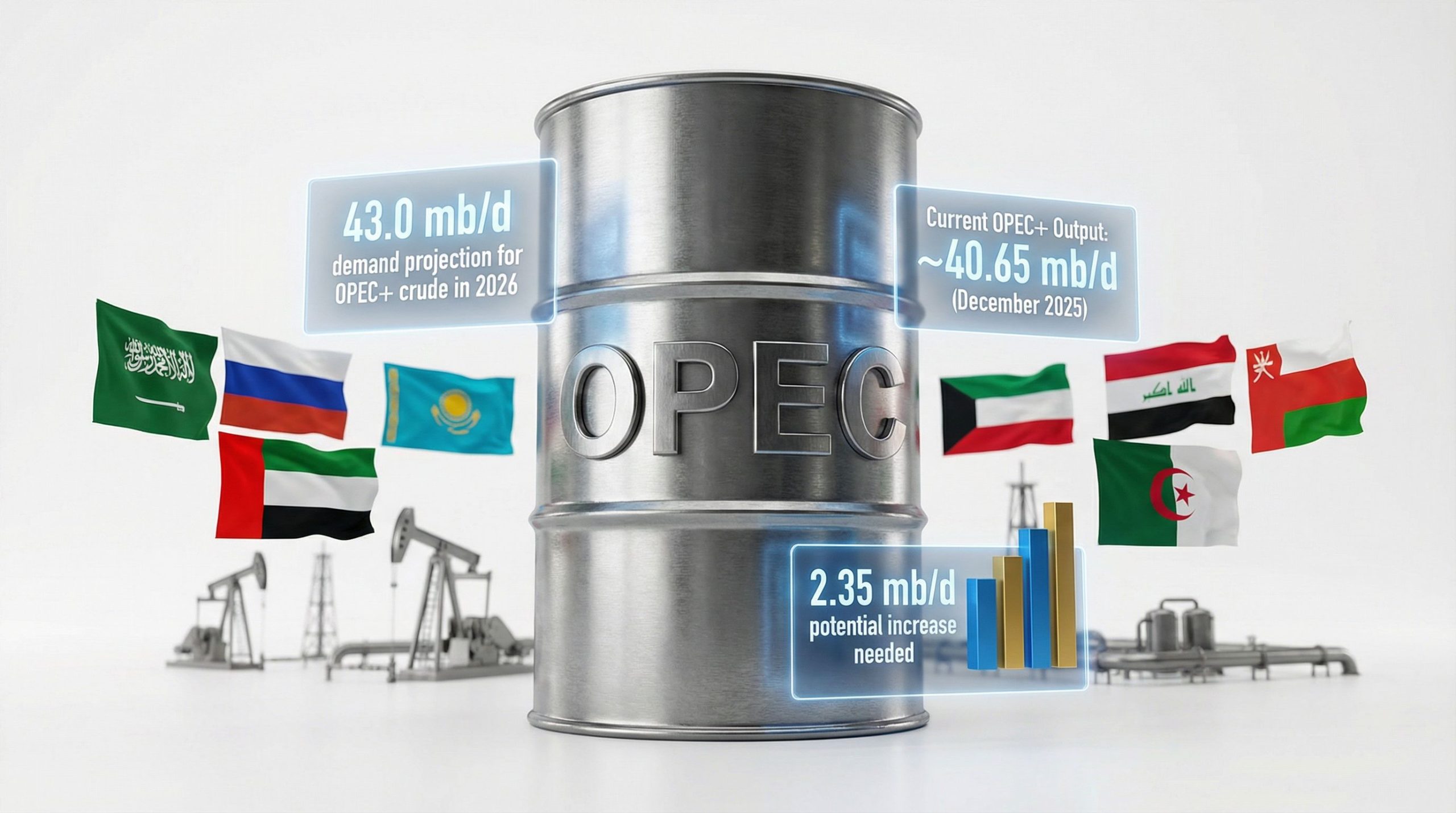
- Current Policy Maintained: OPEC+ delegates confirmed that existing production quotas will remain steady through December, prioritizing market stability over aggressive market-share expansion.
- The 2027 Horizon: Beneath the surface calm, ministers are quietly positioning themselves for a much more contentious structural review in 2027 involving baseline adjustments and shifting non-OPEC supply dynamics.
- Capital Allocation Dilemma: Upstream energy majors face complex risk mitigation strategies as volatile valuation multiples collide with prolonged capital expenditure freezes.
- Liquidity & Macro Pressures: Global market liquidity and industrial demand forecasts out of Asia continue to dictate pricing floors, keeping futures range-bound.
VIENNA & LONDON — In a move widely anticipated by institutional trading desks and macroeconomic analysts, the Organization of the Petroleum Exporting Countries and its allies (OPEC+) have opted to maintain their current December crude output targets. The decision, finalized following a series of virtual ministerial consultations, reflects a calculated desire among key producers to safeguard near-term price stability amid persistent macroeconomic headwinds. However, financial markets are already looking past the immediate horizon. Behind closed doors in Vienna and Riyadh, energy ministers are laying the groundwork for what policy insiders describe as a brutal, high-stakes structural showdown over production baselines heading into 2027.
The Catalytic Events: Balancing Near-Term Stability with Long-Term Survival
Test Our Free AI & Tech Utilities Suite
Calculate LLM API token costs, analyze article dwell-time, or simulate tech DCA returns.
The latest ministerial consensus comes at a critical juncture for global energy infrastructure. Over the past three quarters, crude benchmarks have wrestled with competing macroeconomic forces: sluggish industrial recovery metrics across core European economies, fluctuating manufacturing data from the People's Republic of China, and resilient non-OPEC supply growth led by aggressive shale production in the United States, Guyana, and Brazil. By locking in December output quotas, the cartel’s leadership—spearheaded by Saudi Arabia’s Ministry of Energy and supported by the Russian Federation—is attempting to prevent speculative downside volatility in paper markets.
Yet, maintaining current parameters is merely a holding pattern. The fundamental architecture of the global crude market is undergoing a seismic shift. For multinational energy corporations and sovereign wealth funds alike, capital allocation frameworks are being stress-tested. Upstream operators are balancing the necessity of long-cycle infrastructure scalability against strict shareholder demands for enhanced free cash flow yields and dividend distributions. Valuation multiples for traditional exploration and production (E&P) firms have decoupled from historical commodity correlations, driven largely by investor scrutiny over regulatory compliance and the accelerating global energy transition.
A Deep Dive into the 2027 Structural Dilemma
While December targets provide temporary comfort to physical traders, the real battleground for OPEC+ is the upcoming 2027 framework. As individual member states—most notably the United Arab Emirates and several West African producers—demand higher production baselines to reflect newly commissioned upstream capacity, the internal cohesion of the alliance faces unprecedented strain. Riyadh remains steadfast in its defense of market equilibrium, insisting that any upward revision of quotas must be matched by verified structural capacity and rigorous compliance monitoring.
This impending clash carries profound implications for global market liquidity. If member nations abandon voluntary production cuts in pursuit of domestic revenue generation, the resulting oversupply could trigger a rapid compression in Brent and WTI pricing benchmarks. Conversely, maintaining artificial scarcity risks ceding further market share to aggressive non-OPEC producers who face fewer regulatory and political constraints. Enterprise risk committees across the energy sector are currently running complex simulations to prepare for both scenarios, factoring in potential geopolitical flashpoints and shifts in global cloud compute architecture used for predictive reservoir modeling.
Verified Metrics: OPEC+ Production & Market Parameters
| Metric / Parameter | Current Status (Q4) | Projected 2027 Outlook | Strategic Implication |
|---|---|---|---|
| OPEC+ Output Target | Steady through December | Subject to baseline overhaul | Short-term price floor; long-term uncertainty. |
| Non-OPEC Supply Growth | Robust (US, Guyana, Brazil) | Peaking plateau expected | Erosion of cartel market share. |
| Upstream CapEx Budgets | Disciplined / Flat | Moderate upward revision | Focus on operational efficiency over volume. |
| Global Demand Forecast | Modest YoY expansion | Asymmetric regional growth | Heavy reliance on Asian refining margins. |
Industry & Market Implications: Who Wins and Who Loses?
The decision to hold December targets steady creates clear divergence across the financial landscape:
- The Winners: Low-cost Middle Eastern producers with state-backed balance sheets retain robust enterprise ROI metrics, insulating them from mid-cycle price dips. Additionally, oilfield services providers with proprietary drilling technologies and advanced digital reservoir optimization tools stand to benefit as operators demand maximum efficiency from existing wells.
- The Losers: Highly leveraged independent shale producers and fringe OPEC members facing severe economic domestic pressures. These entities struggle to generate sustainable enterprise value when output restrictions cap top-line revenue growth while fixed operational overheads continue to rise.
- Macroeconomic Fallout: Energy-importing nations across Asia and Europe receive a temporary reprieve from severe inflationary spikes, allowing central banks greater flexibility in their monetary policy easing cycles. However, sustained artificial price supports leave industrial supply chains vulnerable to sudden geopolitical shocks.
Frequently Asked Questions (People Also Ask)
Why did OPEC+ decide to keep December oil output targets steady?
OPEC+ chose to maintain its current production quotas through December to insulate physical and paper markets from persistent macroeconomic uncertainties, sluggish demand growth in key regions, and unpredictable seasonal inventory swings. The decision prioritizes immediate price defense over aggressive market-share expansion.
What makes the upcoming 2027 OPEC+ policy review so contentious?
The 2027 review involves a fundamental reassessment of individual member production baselines. Several high-capacity nations are demanding higher quotas to match newly developed upstream infrastructure. Reconciling these competing national ambitions without triggering a destructive price war remains the cartel's most difficult diplomatic and economic challenge.
How does the current production strategy impact upstream capital allocation?
Uncertainty surrounding long-term quota allocations forces energy majors to adopt highly disciplined capital expenditure programs. Rather than funding aggressive exploration projects, firms are prioritizing risk mitigation, operational cost containment, and shareholder returns through buybacks and dividends.
What role do non-OPEC producers play in shaping future OPEC+ decisions?
Non-OPEC supply growth—particularly from the Americas—acts as a direct counterweight to OPEC+ market management. As non-OPEC output scales up, it absorbs market share, forcing OPEC+ to continually weigh the financial cost of prolonged production cuts against the revenue losses of flooding the market.
Future Outlook: Critical Milestones to Monitor
As financial markets transition past the fourth quarter, executive focus turns immediately to the upcoming ministerial plenary sessions. Analysts will scrutinize compliance data reports, adherence metrics from historically over-producing member states, and real-time tracking of non-OPEC rig counts. For institutional investors, hedge fund managers, and corporate treasurers, navigating the next twenty-four months will require agile risk management frameworks capable of pivoting instantly when the 2027 baseline negotiations officially commence in Vienna.