
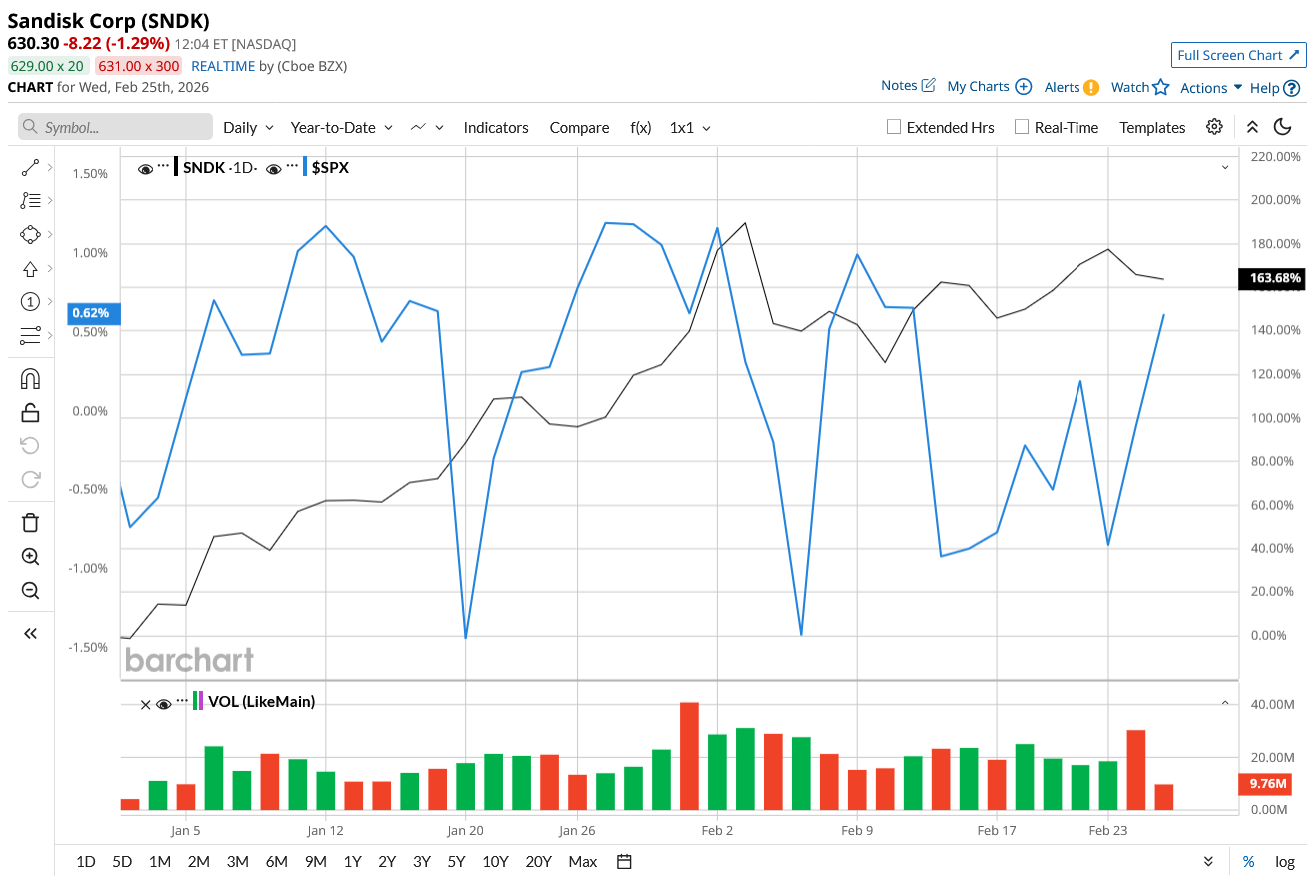
- SanDisk has officially announced a massive 8-for-1 stock split, injecting renewed retail liquidity into its capital structure.
- While stock splits do not alter fundamental enterprise value or underlying market capitalization, historical empirical data reveals a strong tendency for split-announcement equities to outperform baseline indices over a 12-month trailing window.
- Institutional investors must analyze this corporate action through the lens of capital allocation, options market dynamics, and underlying cloud compute and enterprise storage demand cycles.
- Execution risks remain tied to macroeconomic headwinds, supply chain constraints in semiconductor fabrication, and broader valuation multiples across the technology sector.
NEW YORK — In a decisive corporate maneuver signaling management’s long-term confidence in its enterprise storage roadmap and cash flow generation, SanDisk has formally announced an 8-for-1 stock split. The announcement has immediately galvanized retail traders and institutional desks alike, igniting fierce debates over how liquidity expansion and psychological price anchoring impact near-term equity performance. As market participants recalibrate their portfolios, financial analysts and quantitative researchers are once again dusting off the historical playbook to answer a perennial Wall Street question: What actually happens to a stock’s valuation trajectory after an aggressive split announcement?
Historically, stock splits have served as corporate signaling mechanisms. While corporate finance theory dictates that dividing a single equity share into multiple fractional units alters nothing regarding intrinsic value, empirical reality tells a more nuanced story. Companies executing splits frequently exhibit robust balance sheets, sustained earnings growth, and strong operational momentum. This investigative report dissects the macroeconomic catalytic events, historical precedent, and market mechanics driving SanDisk’s latest corporate realignment, offering an authoritative look at what lies ahead for investors navigating this high-stakes market event.
The Mechanics and Catalytic Drivers Behind SanDisk’s 8-for-1 Split
Test Our Free AI & Tech Utilities Suite
Calculate LLM API token costs, analyze article dwell-time, or simulate tech DCA returns.
To understand the magnitude of SanDisk’s 8-for-1 split, one must examine the operational foundation supporting the company's valuation. Operating at the vanguard of flash memory technology, solid-state drives (SSDs), and high-density storage infrastructure, SanDisk has experienced a profound surge in demand. This surge is propelled by relentless global expansion in cloud compute architecture, artificial intelligence model training data lakes, and enterprise-grade data center overhauls.
As institutional demand for high-performance storage solutions scaled upward, SanDisk’s nominal share price appreciated significantly. While rising share prices are the hallmark of successful equity execution, an elevated nominal price can introduce frictional costs for retail investors and limit participation in options market contracts. By executing an 8-for-1 split, SanDisk effectively lowers the barrier to entry per individual share, democratizing access while enhancing market liquidity.
From a corporate governance perspective, capital allocation strategies of this scale require meticulous coordination with underwriters, regulatory compliance officers, and exchange officials. The decision reflects executive alignment with broader market trends where industry leaders utilize splits to signal robust future earnings visibility and confidence in gross margin expansion. However, sophisticated market participants know that the headline-grabbing split ratio is merely the visible tip of a much deeper financial iceberg.
Historical Precedent: Decoding Post-Split Market Performance
Market historians and quantitative analysts have tracked the post-split performance of equities across the S&P 500 and Nasdaq for decades. The consensus data reveals distinct behavioral patterns that challenge pure efficient market hypotheses.
Statistically, companies that announce stock splits historically outperform the broader market benchmark over the subsequent 12 months. According to historical market studies spanning major bull and bear cycles, split-announcement equities generate an average excess return over the S&P 500 in the year following the announcement. This outperformance is not typically driven by the split itself, but rather by the underlying fundamental strength that justified the split in the first place. Companies do not arbitrarily divide their shares unless their earnings trajectory, cash flow generation, and competitive moats provide undeniable institutional backing.
| Metric / Analytical Dimension | Pre-Split Environment | Post-Split Realignment | Historical Market Impact |
|---|---|---|---|
| Nominal Share Price | Elevated / Premium Tier | Adjusted downward by factor of 8 | Increased retail accessibility & liquidity |
| Market Capitalization | Unchanged (Aggregate Value) | Unchanged (Aggregate Value) | Zero fundamental change in enterprise worth |
| Retail Volume & Flow | Constrained by fractional friction | Expanded participation | Short-term volatility surge, positive drift |
| Options Open Interest | Standard contract sizing | Contract multiplier adjusted to 8x | Enhanced hedging and speculative activity |
Nevertheless, cautionary tales exist within historical datasets. In macroeconomic environments characterized by tightening monetary policy, rising interest rates, or sector-specific compression in semiconductor valuations, stock splits can sometimes act as a temporary sugar high. If underlying enterprise ROI fails to keep pace with expectations, the post-split euphoria frequently fades, leading to mean reversion. Therefore, separating marketing hype from fundamental execution remains paramount for risk-conscious portfolio managers.
Industry & Market Implications: Winners, Losers, and Economic Realities
The ripple effects of SanDisk’s corporate action extend far beyond its immediate shareholder base, impacting the broader technology sector, institutional asset allocators, and competing hardware manufacturers.
Institutional vs. Retail Dynamics
While institutional asset managers rely on fundamental discounted cash flow (DCF) models rather than nominal share prices, they closely monitor liquidity metrics. An 8-for-1 split drastically deepens the order book, reducing bid-ask spreads and allowing large institutional blocks to be accumulated or distributed with minimized market impact. Simultaneously, retail investors benefit from lower nominal thresholds, enabling more efficient dollar-cost averaging and options strategy execution.
Sector-Wide Competitive Pressures
As SanDisk positions itself for enhanced market liquidity, rival semiconductor and flash storage entities face mounting pressure to demonstrate similar shareholder-friendly capital allocation policies. Competitors lagging in enterprise scalability or gross margin optimization risk seeing capital flow out of their equities and into newly liquid leaders like SanDisk.
Frequently Asked Questions (People Also Ask)
Does a stock split actually increase the value of an investment?
No. A stock split is a corporate action that divides existing shares into multiple new shares. While the number of shares you own multiplies (in this case, by 8), the price per share drops proportionally. Your total equity value remains mathematically identical immediately following the split.
Why do companies choose to split their stock if value doesn't change?
Companies typically split their stock to lower the nominal price per share, making the equity more accessible to retail investors and employees participating in equity incentive plans. Additionally, splits serve as a strong psychological signal of management confidence and past corporate success.
How do options contracts adjust during an 8-for-1 stock split?
When an 8-for-1 split occurs, existing options contracts are standardized by the Options Clearing Corporation (OCC). The number of contracts an investor holds is multiplied by 8, and the strike price is divided by 8, ensuring that the total value of the options position remains unchanged.
What does historical data say about stock performance after a split?
Historically, stocks that announce splits tend to outperform baseline market indices over a 12-month window. However, financial analysts emphasize that this outperformance is primarily driven by the robust underlying financial health and earnings momentum that prompted the split, rather than the split mechanism itself.
Future Outlook and Key Milestones to Watch
As SanDisk finalizes the operational mechanics of its 8-for-1 stock split, market participants must maintain a disciplined focus on forthcoming catalysts. Key milestones to watch over the next two to four quarters include:
- Quarterly Earnings Reports: Verification that enterprise storage demand and cloud infrastructure contracts are translating into sustained operating margin expansion.
- Supply Chain Resilience: Monitoring semiconductor fabrication yields, raw material procurement costs, and geopolitical risk mitigation strategies.
- Liquidity and Volume Metrics: Analyzing post-split daily trading volumes and institutional block trades to gauge structural market depth.
- Macroeconomic Conditions: Tracking central bank interest rate trajectories and broader technology sector valuation multiples to assess risk appetite.
Ultimately, SanDisk’s 8-for-1 stock split is a bold testament to its market leadership in high-performance data storage. While history suggests a favorable tailwind for equities following such announcements, prudent risk management, rigorous financial analysis, and constant vigilance regarding macroeconomic headwinds will remain the ultimate determinants of long-term investment success.




