Executive Takeaways
- The Initiative: NASA is officially inviting global citizens to submit their names to be microchipped and flown aboard the nuclear-powered Dragonfly rotorcraft bound for Saturn’s largest moon, Titan.
- Strategic Valuation: Beyond public engagement, deep-space citizen science initiatives serve as critical drivers for long-term capital allocation, public sector infrastructure scalability, and aerospace supply chain visibility.
- Technological Frontier: Dragonfly represents a paradigm shift in planetary exploration, leveraging dual-quadcopter mobility across dense nitrogen atmospheres and hydrocarbon seas under extreme fiscal discipline and risk mitigation protocols.
- Access window, enterprise-grade telecommunications backhauls, and regulatory compliance frameworks dictate how millions of records will be successfully archived onto a silicon microchip.
WASHINGTON and NEW YORK — In an unprecedented convergence of deep-space exploration and digital public participation, the National Aeronautics and Space Administration (NASA) has formally opened global registration for individuals wishing to dispatch their names to the outer solar system. The destination is Titan, Saturn’s hazy, organic-rich moon, via the upcoming Dragonfly mission. As institutional investors evaluate the valuation multiples of the burgeoning commercial space economy and enterprise leaders eye infrastructure scalability in low-Earth orbit and beyond, this public outreach campaign underscores the profound intersection of public-sector scientific ambition and consumer-grade digital engagement.
For financial institutions, defense contractors, and aerospace conglomerates, the Dragonfly mission is far more than an academic exercise in astrobiology. It represents a masterclass in risk mitigation, technological innovation, and capital allocation. With a total lifecycle budget scaling into the billions, the mission tests advanced cloud compute architectures, autonomous navigation algorithms, and radioisotope thermoelectric generator (RTG) power systems capable of operating over a billion miles from Earth.
The Catalytic Event: Bridging Deep Space and Terrestrial Digital Infrastructure
The initiative to send civilian names to Titan builds upon a proven NASA tradition of digital payload piggybacking, previously utilized on Mars rover campaigns and the Artemis lunar program. However, the logistical complexity of reaching Saturn makes the Dragonfly naming convention a historic milestone. Participants who submit their names via NASA’s secure portal will have their data compiled, etched onto a silicon microchip using electron-beam lithography, and mounted directly onto the chassis of the nuclear-powered rotorcraft.
Behind the user-friendly interface of the submission portal lies a complex web of data governance, cybersecurity risk mitigation, and enterprise database management. Handling millions of high-velocity database writes requires robust cloud compute architecture and airtight regulatory compliance regarding data privacy laws across multiple global jurisdictions, including the European Union's GDPR and California’s CCPA. IT infrastructure scalability is put to the test as millions of concurrent users hit NASA’s servers, driving peak bandwidth demands that rival major corporate product launches.
Technical Breakdown: Inside the Dragonfly Rotorcraft Architecture

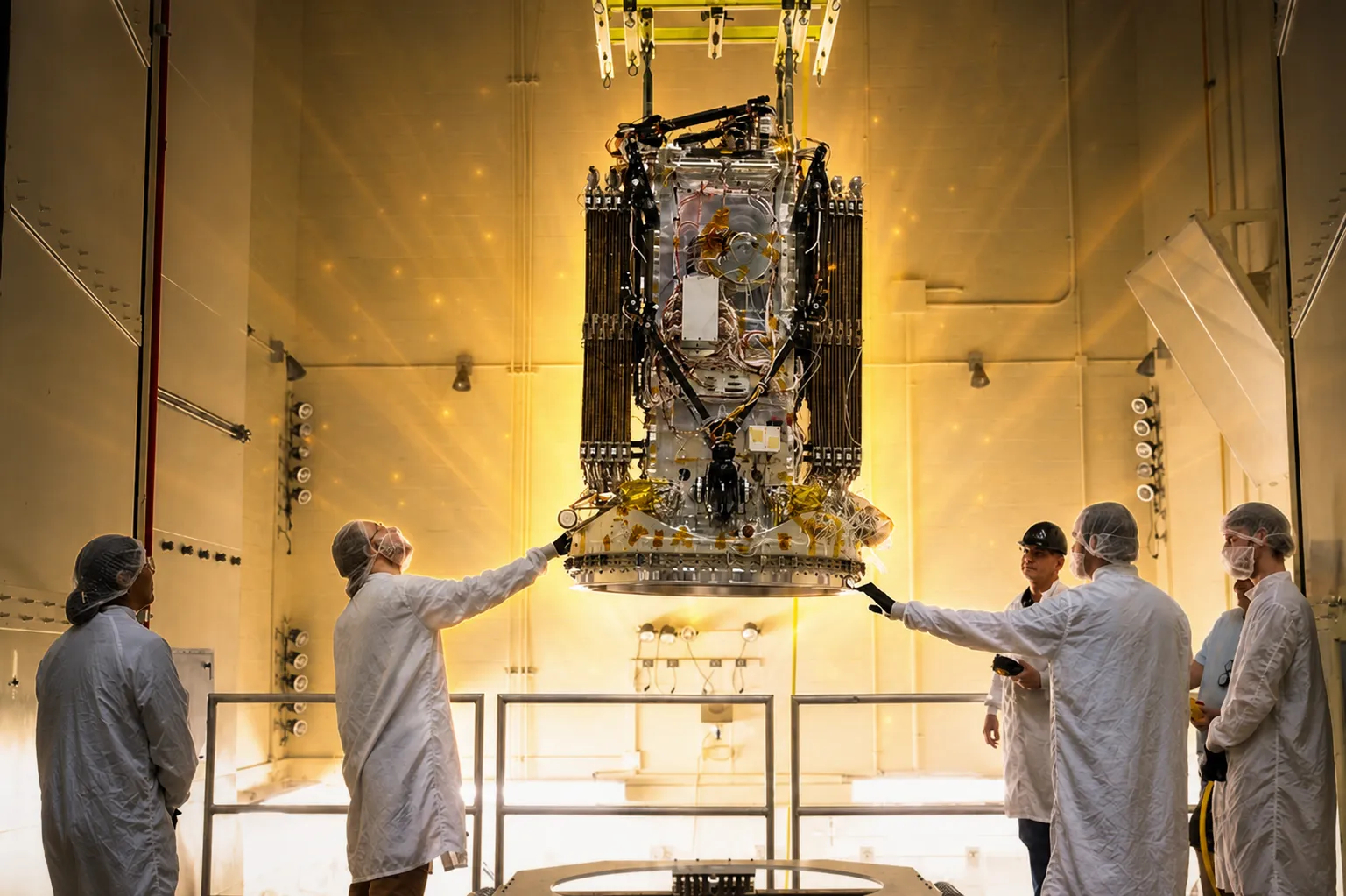
To appreciate the magnitude of this mission, one must examine the engineering specifications of the Dragonfly vehicle itself. Unlike traditional wheeled rovers that creep across rocky terrain at centimeters per hour, Dragonfly is a dual-quadcopter designed to fly through Titan’s dense, nitrogen-rich atmosphere, which is four times denser than Earth's.
Operating at a distance where solar power is entirely unviable, Dragonfly relies on a Multi-Mission Radioisotope Thermoelectric Generator (MMRTG)—a space-proven nuclear power source that converts heat from the natural radioactive decay of plutonium-238 into electricity. This power system ensures uninterrupted operational capability through Titan's 16-day nights and fluctuating weather patterns.
Verified Data & Specifications: NASA Dragonfly vs. Standard Deep-Space Missions
| Metric / Parameter | Dragonfly Mission Specification | Strategic / Economic Implication |
|---|---|---|
| Destination | Titan (Saturn's Largest Moon) | Opens outer solar system for organic chemical analysis and potential resource mapping. |
| Propulsion / Mobility | Dual-quadcopter (Flying Rotorcraft) | Drastically increases surface coverage area compared to tracked rovers. |
| Power Source | MMRTG (Nuclear Plutonium-238) | Requires strict international nuclear safety regulatory compliance and specialized supply chains. |
| Digital Engagement | Silicon Microchip Name Registry | Drives public-private synergy, high-volume cloud compute demand, and brand equity. |
Industry & Market Implications: Who Wins, Who Loses
The economic ripples of NASA’s flagship planetary missions extend far beyond government balance sheets. Defense primes, aerospace technology developers, and specialized component manufacturers experience direct capital inflows through long-term procurement contracts. Prime contractors responsible for spacecraft integration and thermal protection systems secure predictable revenue streams, insulating them from commercial aerospace volatility.
Conversely, legacy aerospace suppliers that fail to adapt to autonomous navigation, lightweight composite materials, and advanced cloud-based telemetry face severe valuation contractions. In the financial markets, institutional investors increasingly scrutinize government contractors for environmental, social, and governance (ESG) alignment, where public engagement programs like the Titan name registry serve as tangible metrics of societal impact and stakeholder inclusion.
Furthermore, telecommunications and data-encryption sectors benefit indirectly from the rigorous demands of deep-space communication protocols. Transmitting scientific data and archived name registries across billions of miles requires fault-tolerant error-correction algorithms and high-gain antenna technologies that eventually find dual-use applications in terrestrial high-frequency trading networks and secure satellite communications.
Frequently Asked Questions (People Also Ask)
How can individuals submit their names for the NASA Dragonfly mission to Titan?
Participants can navigate to NASA’s official "Send Your Name to Titan" web portal, enter their first and last name along with a secure PIN, and generate a commemorative boarding pass. The compiled database is subsequently encrypted and etched onto a silicon microchip destined for integration onto the spacecraft chassis.
What is the primary scientific objective of NASA’s Dragonfly rotorcraft on Titan?
Dragonfly’s primary directive is to fly to dozens of promising sites on Titan to sample and analyze prebiotic chemistry. Titan is considered a premier analog for Earth prebiotic conditions, possessing a dense atmosphere and surface reservoirs of liquid hydrocarbons, enabling researchers to study the chemical building blocks of life.
When is the scheduled launch window for the Dragonfly mission?
NASA’s current baseline schedule targets a launch later this decade, with transit times to the Saturnian system taking several years via gravity-assist maneuvers around inner planets. Exact launch windows are subject to rigorous payload readiness reviews and interplanetary trajectory optimization.
Does participating in the NASA name registry carry any financial cost or data security risks?
No. The name submission service is entirely complimentary, provided directly by NASA as an educational public outreach initiative. The infrastructure adheres to strict federal cybersecurity protocols to ensure user data anonymity and protection against unauthorized data harvesting.
Future Outlook: Milestones and Strategic Horizons
As the aerospace industry prepares for the next phase of deep-space exploration, stakeholders must monitor several critical operational milestones. Hardware environmental testing, software integration stress tests, and nuclear safety reviews by interagency oversight committees will dictate the final countdown to launch. For corporate strategists and portfolio managers, tracking these milestones provides valuable insight into the broader health of public-sector technology procurement and applied engineering.
Ultimately, campaigns like sending names to Saturn’s moon serve a dual purpose: democratizing the human aspiration for discovery while reinforcing the robust industrial and digital infrastructure required to make interplanetary travel a reality. As millions of digital signatures are etched into silicon and prepared for a billion-mile voyage, the boundary between terrestrial enterprise technology and cosmic exploration continues to dissolve.