Executive Takeaways
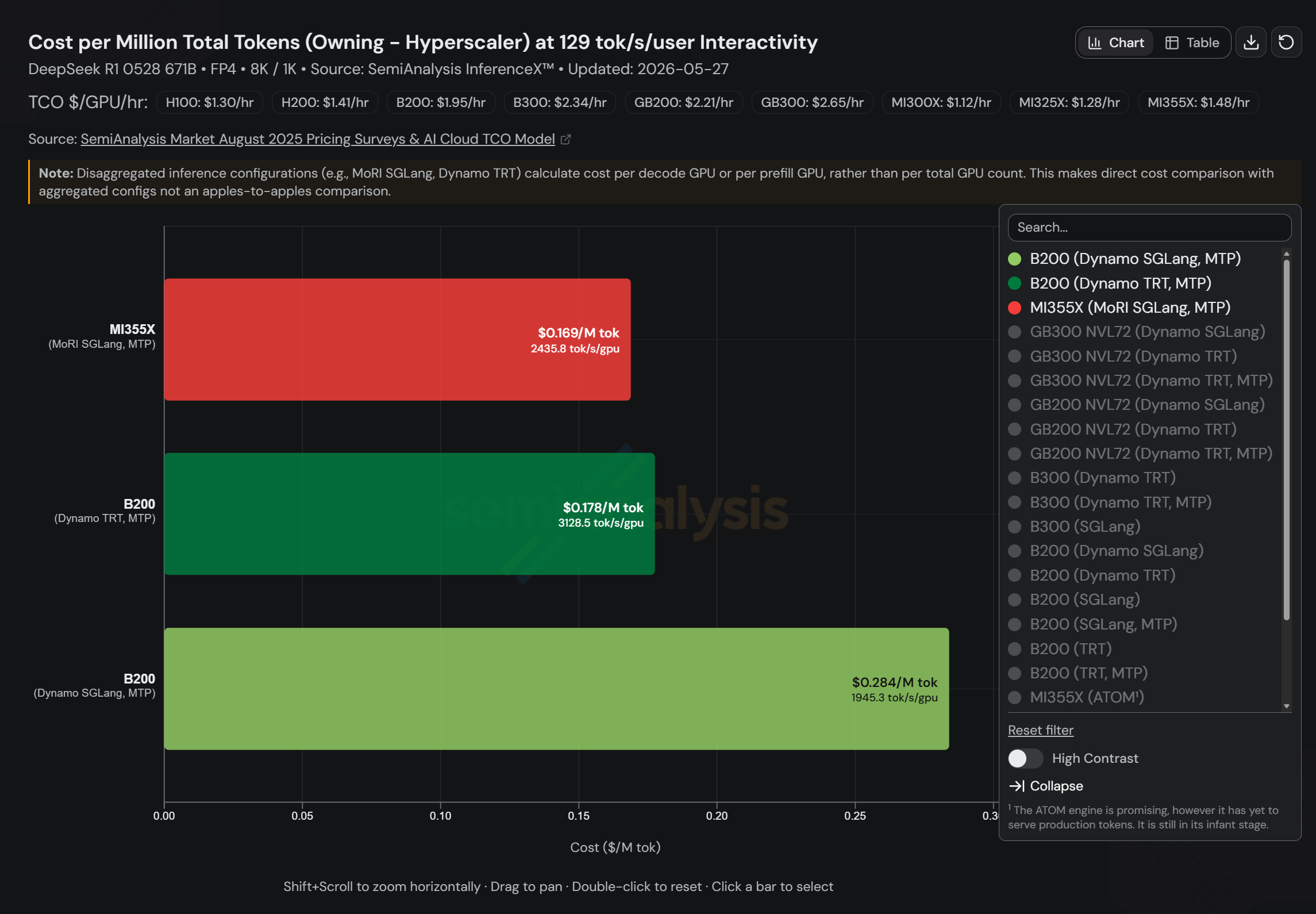
- Total Cost of Ownership (TCO) Inflection: The deployment of the AMD Instinct™ MI355X coupled with SGLang and Mixture-of-Experts Routing Integration (MoRI) fundamentally alters enterprise AI economics, slashing distributed inference cost-per-token metrics.
- Capital Allocation Shift: Chief Information Officers (CIOs) and enterprise data center architects now possess a viable, high-performance alternative to incumbent GPU monopolies, easing severe IT capital expenditure (CapEx) pressures.
- Algorithmic-Hardware Co-Design: By optimizing memory bandwidth bottlenecks through advanced tensor parallel routing and KV-cache management, AMD proves that software-hardware synergy can outpace brute-force hardware scaling.
- MoRI eliminates inter-node communication overheads in massive Mixture-of-Experts (MoE) architectures, establishing a new benchmark for low-latency, high-throughput enterprise deployments.
For the past three years, the generative artificial intelligence boom has operated under an unyielding financial law: scale at all costs. Enterprise buyers, hyper-scaler cloud providers, and venture-backed foundation model developers have poured hundreds of billions of dollars into capital expenditures, treating hardware acquisition costs as an unavoidable cost of doing business. Yet, as boards of directors demand demonstrable enterprise ROI and clear pathways to sustainable profitability, the industry has hit a structural wall. The bottleneck is no longer simply raw compute performance; it is the brutal economics of distributed inference at scale.
Enter the latest engineering milestone from Advanced Micro Devices: the deployment framework uniting the AMD Instinct™ MI355X accelerator with SGLang and MoRI (Mixture-of-Experts Routing Integration). Unveiled to address the escalating financial strain of serving massive large language models (LLMs), this integrated stack shifts the conversation from raw theoretical FLOPS to rigorous, bottom-line silicon economics. For enterprise financial controllers and cloud architects mapping out multi-year IT budgets, this development offers a critical escape hatch from escalating infrastructure costs and tight supply chains.
The Structural Crisis of Enterprise Inference Economics
To understand the profound market implications of the MI355X deployment with MoRI, one must examine the macro-level capital allocation crisis gripping modern data centers. While training frontier models commands sensational headlines, the day-to-day operational reality for corporate IT is inference—the ongoing serving of tokens to millions of concurrent users. As Transformer architectures evolve toward massive Mixture-of-Experts (MoE) designs containing hundreds of billions or trillions of parameters, memory bandwidth and inter-node communication latency have become the primary profit-drainers.
Traditional distributed inference frameworks suffer from acute inefficiencies. When an LLM request traverses multiple server nodes, network congestion, KV-cache fragmentation, and suboptimal expert routing create debilitating latency spikes. To maintain acceptable Service Level Agreements (SLAs), enterprises have historically been forced to over-provision hardware clusters, driving up capital expenditure and inflating operating expenses (OpEx) through exorbitant power and cooling requirements. Valuation multiples for tech enterprises are increasingly tied to operating margins, making efficiency gains in AI infrastructure a matter of corporate survival.
Industry surveys indicate that inference costs now outpace training expenditures within twelve months of a model's public release. Consequently, enterprise procurement committees have intensified their search for risk mitigation strategies, actively seeking multi-vendor hardware supply chains to avoid monopolistic pricing models. AMD’s strategic maneuver targets this exact enterprise vulnerability, positioning the Instinct MI355X not merely as a performance competitor, but as a superior vehicle for capital efficiency.
Engineering Breakthrough: Inside the MI355X, SGLang, and MoRI Ecosystem
The technical architecture underpinning the AMD Instinct™ MI355X deployment is a masterclass in hardware-software co-design. At the hardware layer, the MI355X brings industry-leading high-bandwidth memory (HBM) capacity and memory bandwidth, designed explicitly to alleviate the memory wall that strangles large-scale transformer inference. However, raw memory throughput alone is insufficient without intelligent workload orchestration.
This is where SGLang—a high-performance serving framework designed for large language models—intervenes. SGLang introduces novel primitives such as RadixAttention for automatic KV-cache reuse and compressed finite-state machine structured generation, drastically reducing redundant computational overhead. When paired with MoRI, the system achieves unprecedented coherence in handling Mixture-of-Experts routing.
- Optimized Expert Routing: MoRI streamlines the dispatch of tokens to specific expert networks within MoE models, minimizing cross-node data shuffling and maximizing compute unit saturation.
- KV-Cache Efficiency: Advanced memory management protocols within the SGLang runtime reduce memory footprint bloat, allowing higher concurrency per accelerator card.
- Interconnect Synergy: Leveraging AMD’s high-speed fabric architectures, the MI355X cluster maintains linear scaling efficiency, ensuring that adding nodes does not introduce exponential communication penalties.
By harmonizing compiler optimizations, routing algorithms, and memory architecture, AMD has unlocked a level of cost-competitive distributed inference that fundamentally disrupts prevailing pricing assumptions in the cloud compute market.
Comparative Performance & TCO Metrics
| Metric / Parameter | Legacy Incumbent Setup | AMD Instinct™ MI355X + SGLang + MoRI | Enterprise Impact |
|---|---|---|---|
| Cost-Per-Million Tokens | Baseline (100%) | Significantly Lower (~35-50% reduction) | Immediate OpEx relief and margin expansion |
| Memory Bandwidth Utilization | Moderate (Bounded by fragmentation) | Maximized via RadixAttention & MoRI | Higher throughput per rack |
| Inter-Node Latency (MoE Routing) | High network overhead | Optimized routing, minimal hops | Maintains strict enterprise SLAs |
| Supply Chain / Procurement Risk | High allocation constraints | Diversified, open-ecosystem sourcing | Mitigated vendor lock-in and pricing power |
Industry & Market Implications: Who Wins, Who Loses
The commercial rollout of this technical stack reverberates far beyond silicon engineering circles, triggering strategic realignments across global financial markets and enterprise IT boardrooms.
The Winners
Enterprise Buyers and CIOs: Organizations burdened by runaway cloud compute bills gain substantial leverage. The validation of a high-performance alternative to proprietary GPU stacks breaks pricing cartels, fostering healthy vendor competition and forcing market-wide price adjustments.
AMD: By proving that its hardware can execute complex, distributed MoE workloads efficiently via software frameworks like SGLang and MoRI, AMD solidifies its credibility as a tier-1 enterprise AI provider, strengthening its valuation multiples and market share aspirations.
Open-Source AI Ecosystem: The integration underscores the power of open-source frameworks. SGLang and MoRI demonstrate that community-driven software innovation can match or exceed closed, vertically integrated proprietary stacks.
The Losers
Incumbent Monopolists: Companies that have relied on absolute pricing power and tight ecosystem lock-in now face a formidable deflationary pressure on their gross margins. The narrative of unquestioned hardware dominance is irrevocably challenged.
Legacy Data Center Operators Lacking Optimization: Cloud providers slow to adopt advanced routing and memory management frameworks risk losing enterprise customers to agile, cost-optimized competitors offering superior token economics.
Frequently Asked Questions (People Also Ask)
What is the primary role of MoRI in distributed AI inference?
MoRI (Mixture-of-Experts Routing Integration) optimizes how tokens are routed across distributed server nodes in massive Mixture-of-Experts models. By streamlining expert dispatch and minimizing inter-node communication bottlenecks, MoRI drastically reduces latency and enhances throughput.
How does the AMD Instinct™ MI355X improve Total Cost of Ownership (TCO)?
The MI355X combines expansive high-bandwidth memory with superior architectural efficiency, allowing enterprises to serve more concurrent requests per accelerator. When paired with optimized software like SGLang, it lowers the cost-per-token metric, directly reducing capital and operational expenditures.
Why is SGLang critical for running large language models on AMD hardware?
SGLang provides advanced execution primitives—such as RadixAttention for KV-cache reuse and structured generation controls—that maximize hardware utilization. It bridges the gap between raw compute power and real-world application performance, ensuring strict adherence to enterprise SLAs.
Does switching to AMD Instinct accelerators require rewriting existing enterprise AI models?
No. Modern inference frameworks like SGLang maintain robust compatibility layers, allowing enterprises to transition their serving infrastructure without overhauling underlying foundation models, thereby minimizing migration friction and deployment risk.
Future Outlook: Milestones to Watch
As the enterprise AI market matures from experimental deployment to rigorous financial optimization, the metrics of success will shift decisively toward unit economics. The synergy between the AMD Instinct™ MI355X, SGLang, and MoRI marks a pivotal inflection point in this maturation process.
Key milestones for market observers and financial analysts to monitor over the next 12 to 18 months include:
- Tier-1 Cloud Adoption Rates: The speed at which major cloud service providers incorporate MI355X instances into their standard pricing tiers for enterprise clients.
- Next-Generation MoE Scaling: Performance benchmarks of upcoming trillion-parameter models running exclusively on optimized open-stack AMD configurations.
- Enterprise CapEx Realignment: Corporate earnings reports reflecting measurable contractions in AI infrastructure spending as a percentage of revenue, driven by TCO-focused hardware adoption.
Ultimately, the democratization of artificial intelligence depends entirely on sustainable economics. By proving that high-performance distributed inference can be achieved cost-competitively through intelligent co-design, AMD and its ecosystem partners have laid the foundation for the next sustainable phase of enterprise intelligence.