For the modern enterprise, the perimeter is no longer a physical firewall or a corporate office zip code; it is a fragmented, shifting ecosystem of remote endpoints, multi-cloud workloads, and third-party SaaS integrations. Yet, despite the catastrophic financial and reputational fallout of perimeter breaches—where average data breach costs now exceed $4.45 million globally—Chief Information Security Officers (CISOs) routinely find themselves stalled by a familiar corporate friction point: securing stakeholder alignment and capital expenditure (CapEx) approval for Zero Trust architecture implementations.
Moving an enterprise from legacy "trust-but-verify" models to a rigorous "never trust, always verify" framework requires more than technical execution. It demands an executive-level metamorphosis in how risk mitigation, infrastructure scalability, and business value are communicated to chief financial officers, boards of directors, and operational business unit heads. Drawing from recent insights published by industry leaders at Barracuda Networks, this investigative report unpacks the exact strategic playbooks, economic justifications, and technical frameworks required to win universal stakeholder support for Zero Trust transformation.
Executive Takeaways
- Framing Beyond Fear: Securing executive buy-in requires translating cybersecurity initiatives into balance sheet protection, regulatory compliance assurance, and improved valuation multiples rather than relying on fear-based appeals.
- The Business Case for Capital Allocation: Zero Trust must be presented not as an IT cost center, but as an essential operational safeguard that prevents catastrophic revenue disruption and protects enterprise market liquidity during security incidents.
- Overcoming Internal Inertia: Cross-functional friction—particularly resistance from business units worried about operational friction—can be neutralized through phased rollouts, user-centric identity management, and continuous productivity monitoring.
- Quantifying Infrastructure ROI: Demonstrating long-term cloud compute architecture efficiencies, reduced third-party vendor risk, and lower insurance premiums builds an unassailable financial justification for enterprise-wide adoption.
The Anatomy of Executive Resistance: Why Traditional Security Pitches Fail
In the upper echelons of corporate governance, the terminology of cybersecurity—lateral movement, credential dumping, endpoint telemetry, and micro-segmentation—frequently gets lost in translation. When a CISO approaches the C-suite requesting a multi-million-dollar budget re-allocation for a comprehensive Zero Trust implementation without grounding the request in financial fundamentals, the proposal routinely meets administrative hesitation or outright rejection.
The root cause of this disconnect lies in a fundamental misalignment of incentives. While security leaders evaluate infrastructure resilience through the lens of threat vectors and vulnerabilities, Chief Financial Officers (CFOs) and Chief Executive Officers (CEOs) evaluate capital allocation through risk-adjusted return on investment (ROI), regulatory compliance, and market liquidity preservation. To bridge this divide, technical leaders must pivot from pitching "security tools" to presenting a comprehensive business case that safeguards enterprise valuation.
Recent analysis from Barracuda Networks highlights that the transition to Zero Trust is as much a cultural and operational alignment challenge as it is a technical deployment. When stakeholders view Zero Trust as a productivity killer that introduces login friction and workflow bottlenecks, the initiative stalls. Conversely, when framed as an enabler of secure hybrid work, agile cloud migration, and accelerated digital transformation, stakeholder sentiment shifts dramatically.
Translating Technical Justification into Boardroom Value
To secure executive buy-in, the technical pillars of Zero Trust must be directly mapped to the financial priorities of the enterprise:
- Identity-Centric Access: Replaces porous perimeter defenses with continuous, context-aware identity verification, drastically reducing the blast radius of compromised credentials and preventing multi-million-dollar ransomware payouts.
- Micro-Segmentation: Limits lateral movement across cloud compute architecture. If a threat actor breaches a peripheral marketing server, micro-segmentation prevents access to core financial databases, preserving operational continuity.
- Continuous Monitoring & Validation: Provides immutable audit trails that satisfy evolving regulatory frameworks (such as SEC cybersecurity disclosure rules, DORA, and GDPR), avoiding crippling non-compliance penalties.
Constructing the Business Case: Metrics That Matter to the C-Suite
Capital is finite, and every dollar allocated to Zero Trust architecture is a dollar diverted from product development, sales expansion, or shareholder dividends. Therefore, building a bulletproof business case requires rigorous financial modeling. Stakeholders require clear answers to three critical questions: What is the downside risk of inaction? What is the total cost of ownership (TCO)? And what are the tangible financial returns?
| Strategic Dimension | Legacy Perimeter Model | Zero Trust Architecture | Financial & Operational Impact |
|---|---|---|---|
| Risk Mitigation Profile | Reactive; relies on perimeter defense with high lateral vulnerability. | Proactive; assumes breach, enforcing least-privilege access continuously. | Reduces potential breach remediation costs by an estimated 40% to 60%. |
| Insurance & Underwriting | Rising premiums due to frequent ransomware payouts and unchecked exposure. | Preferred risk category; lowers cyber insurance underwriting thresholds. | Secures lower premium rates and higher coverage caps from risk carriers. |
| Cloud Infrastructure Scalability | Complex VPN backhauling creates latency and bandwidth bottlenecks. | Direct, secure cloud-to-edge connectivity optimized for distributed teams. | Lowers cloud compute architecture overhead and boosts workforce velocity. |
| Regulatory Compliance | Fragmented logs complicate reporting and audit responses. | Centralized telemetry and automated access governance. | Minimizes exposure to regulatory fines and accelerates audit cycles. |
Beyond direct cost savings, enterprise ROI calculations for Zero Trust must factor in the preservation of market valuation multiples. In the wake of a publicized data breach, public companies frequently experience immediate equity devaluation, loss of customer trust, and executive turnover. By framing Zero Trust implementation as an essential form of corporate insurance that protects enterprise valuation multiples, security leaders can secure alignment from institutional investors and board members alike.
Overcoming Cross-Functional Friction and Operational Pushback
Winning the support of the C-suite is only the first battle; true implementation success requires winning over the operational stakeholders—the business unit leaders, engineering heads, and frontline employees who must live with the new architecture daily. Resistance often manifests as anxiety over operational friction: Will multi-factor authentication (MFA) fatigue slow down sales reps? Will restricted server access delay software release cycles?
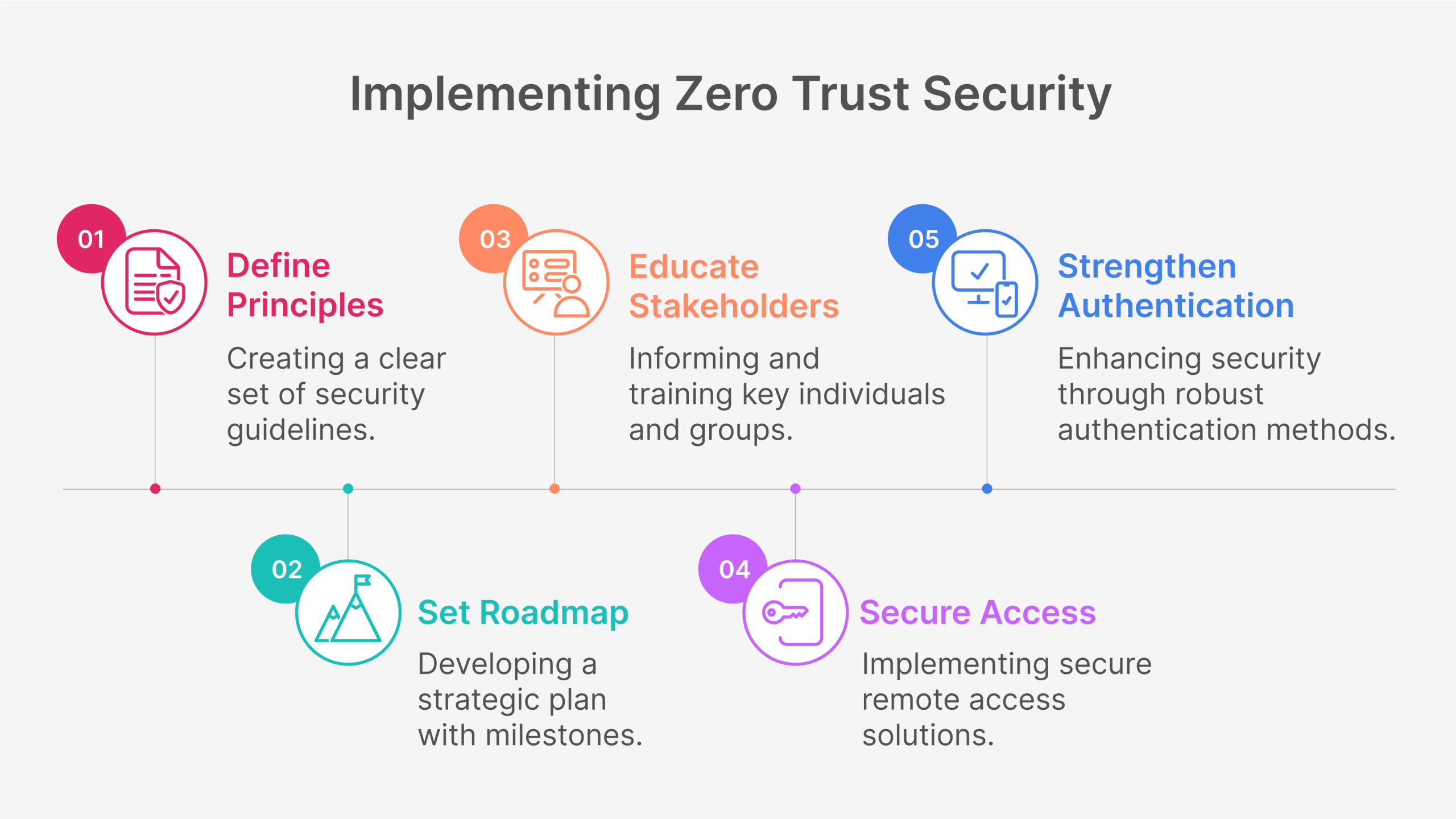
To dismantle this pushback, CISOs must adopt a collaborative, phased deployment strategy:
- Involve Business Unit Leaders Early: Consult operational heads during the planning phase to map out critical workflows. By co-designing access policies, security teams can ensure that zero-trust guardrails do not inadvertently paralyze business velocity.
- Prioritize User Experience (UX): Modern Zero Trust solutions leverage risk-based, adaptive authentication—prompting for verification only when anomalous behavior, unusual locations, or unmanaged devices are detected. This minimizes friction for routine tasks while maintaining rigorous security posture.
- An incremental rollout strategy starting with low-risk business segments allows organizations to fine-tune policies, gather telemetry, and demonstrate productivity preservation before scaling the architecture to mission-critical systems.
Frequently Asked Questions (People Also Ask)
What is the primary barrier to winning stakeholder support for Zero Trust?
The primary barrier is the communication gap between technical security teams and financial stakeholders. CISOs often pitch Zero Trust using complex technical jargon rather than framing it around financial risk mitigation, capital preservation, and protection of enterprise valuation multiples. Overcoming this requires presenting a clear business case tied directly to balance sheet protection and regulatory compliance.
How can an organization calculate the ROI of a Zero Trust implementation?
ROI is calculated by aggregating direct cost savings—such as reduced insurance premiums, lowered cloud infrastructure latency, and avoided regulatory fines—alongside indirect savings, including mitigated breach remediation costs and preserved market capitalization. Comparing these projected savings against the total cost of ownership (TCO) of software licenses, deployment labor, and training provides a clear financial model for the board.
Does Zero Trust architecture negatively impact employee productivity?
While legacy security models often introduced severe workflow friction, modern Zero Trust implementations leverage adaptive, context-aware access controls. By utilizing device posture checks, behavioral analytics, and risk-scored authentication, organizations can secure systems without disrupting daily business operations or slowing down employee velocity.
What role does executive sponsorship play in a successful rollout?
Executive sponsorship is critical for cross-functional alignment. Because Zero Trust impacts every department—from IT and finance to human resources and sales operations—having a champion at the C-suite or board level ensures that departmental friction is managed, budgets are protected, and organizational momentum is maintained throughout the migration.
Future Outlook: The Next Phase of Enterprise Security Maturity
As artificial intelligence accelerates the sophistication of cyber threats—enabling automated, polymorphic malware and hyper-realistic social engineering attacks—static perimeter defenses are destined for obsolescence. Zero Trust is no longer an optional security upgrade; it is the baseline operational standard for the modern digital economy.
Over the next 12 to 36 months, enterprise security maturation will increasingly intersect with automated compliance, AI-driven policy orchestration, and identity-first infrastructure. Stakeholders who view Zero Trust through a strategic lens—recognizing it as a vital enabler of cloud agility, regulatory resilience, and investor confidence—will position their enterprises to thrive in an increasingly volatile threat landscape. Those that delay will find themselves paying a far higher price when legacy perimeters inevitably fail.