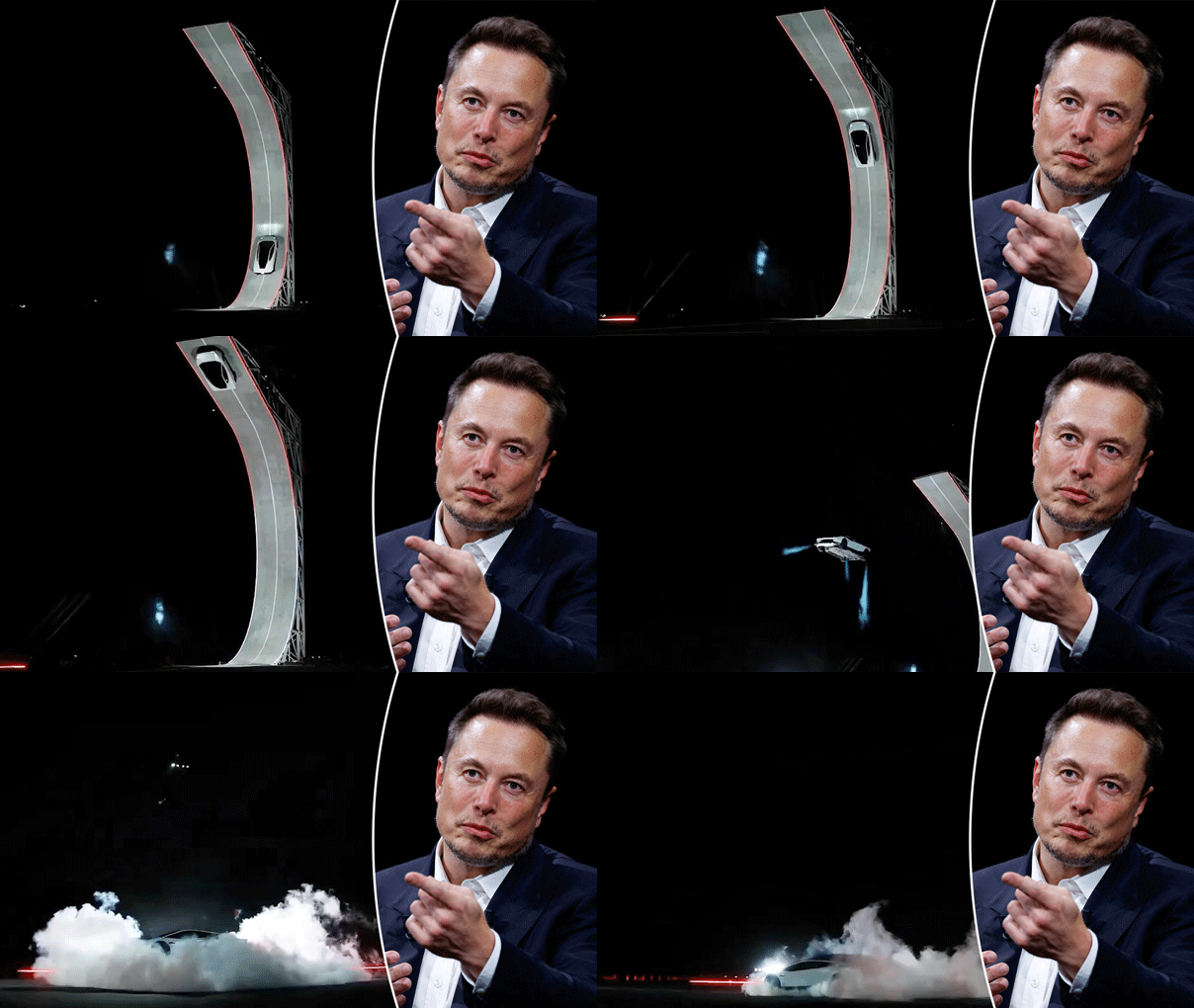
Tesla’s Sub-One-Second Roadster Takes Flight: Inside the Cold-Gas Engineering Feat, Decade-Long Delays, and Wall Street’s Deposit Reckoning
Executive Takeaways
- Physics-Defying Acceleration Benchmark: Tesla’s updated next-generation Roadster leverages a cold-gas thruster system engineered via SpaceX technology transfer, shattering classical mechanical tire-grip limits to target a 0–60 mph sprint in under 1.0 second.
- Substantial Unsecured Capital Pipeline: The decade-long development cycle leaves early reservation holders—who committed between $50,000 and $250,000 in interest-free capital starting in November 2017—navigating an opportunity cost exceeding 60% in real-dollar terms relative to broader S&P 500 capital allocation.
- Wall Street Divergence on Enterprise Value: While retail momentum surges on showroom displays, institutions including JPMorgan view the boutique hypercar not as a near-term revenue driver, but as a strategic brand moat counterbalancing core automotive gross margin compression.
- Complex Regulatory Clearance Landscape: Deploying aerospace-grade Composite Overwrapped Pressure Vessels (COPV) operating at ~10,000 psi on municipal roadways introduces unprecedented Federal Motor Vehicle Safety Standards (FMVSS) and National Highway Traffic Safety Administration (NHTSA) homologation hurdles.
The Showroom Shockwave: Breaking the Classical Friction Coefficient
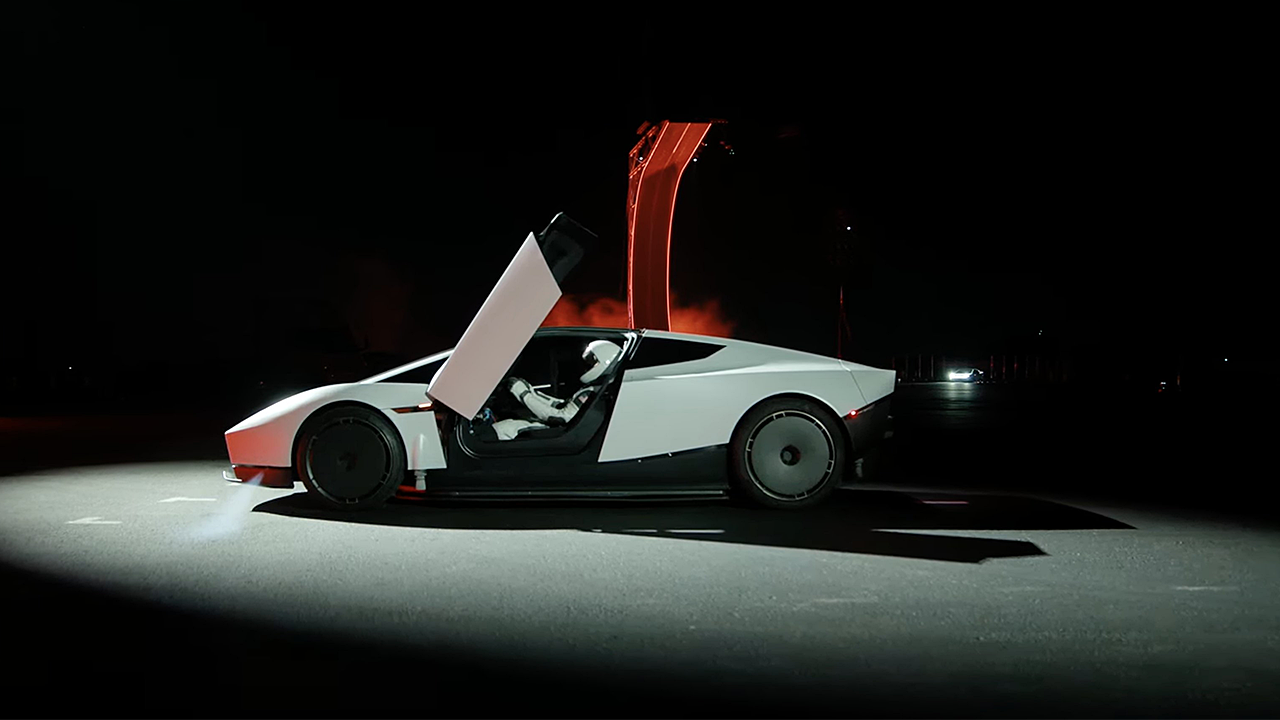
When the striking, aerodynamically aggressive red Tesla Roadster took center stage under showroom illumination, the automotive engineering and financial ecosystems faced an immediate paradigm shift. Tesla’s renewed pledge—asserting a zero-to-60 mph launch in under one second—transcends conventional internal combustion and battery-electric performance metrics. It forces a complete reassessment of road-car vehicle dynamics, pneumatic propulsion, and institutional capital priorities.
From an applied physics standpoint, pneumatic rubber on asphalt reaches a structural performance ceiling dictated by the coefficient of friction ($\mu$). Even on specialized, prepped-surface drag strips utilizing ultra-sticky compound slicks, mechanical friction rarely exceeds a $\mu$ of 1.6 to 1.8. Under purely rotational mechanical torque, achieving a 0–60 mph acceleration in 0.95 seconds requires an sustained longitudinal acceleration exceeding 2.8g. Simply stated: street-legal tires cannot generate the grip required to pull this off under battery and inverter power alone.
Tesla’s solution is not an incremental iteration of its tri-motor "Plaid" powertrain, but a cross-pollination of aerospace rocketry. By integrating cold-gas reaction control system (RCS) thrusters powered by high-capacity Composite Overwrapped Pressure Vessels (COPVs)—technology refined across a decade of SpaceX Falcon 9 launches—the Roadster introduces compressed atmospheric air or nitrogen thrusters through the rear, sides, and potentially underbody floor pan. This system delivers dual utility: instant supplementary longitudinal vectoring thrust, and sheer vertical downforce that artificially multiples normal force ($F_N$), effectively doubling tire-surface adhesion without saddling the chassis with deadweight curb mass.
The Decade of Delays: Working Capital and the Depositor Dilemma
The engineering audacity of the Roadster is inextricably bound to a complicated corporate timeline. When originally unveiled in Hawthorne, California, in November 2017, CEO Elon Musk projected a 2020 commercial release date. Enthusiasts, high-net-worth brand advocates, and institutional collectors lined up to purchase both standard reservations ($50,000 upfront) and the exclusive "Founders Series" editions, which demanded immediate, full-price upfront escrow deposits of $250,000.
Between 2017 and the current production window, these funds operated as zero-interest working capital for Tesla during its critical Model 3 production scale-up. In the intervening years, macroeconomic liquidity conditions changed dramatically. An investor who parked $250,000 in Tesla's escrow program in late 2017 forfeited eight years of historic equity market expansion; an equivalent capital allocation deployed into the benchmark S&P 500 index or diversified tech portfolios would have generated nominal returns upwards of 130% to 170%.
Tesla’s strategic engineering pivot away from low-volume halo vehicles toward high-volume platform scalability (Model Y), structural battery architecture, and compute infrastructure (Dojo, Full Self-Driving hardware suites) effectively relegated the Roadster project to secondary status. Now, as the vehicle reappears in operational trim, Tesla faces the contractual and brand necessity of fulfilling promises to its most loyal, deep-pocketed consumer base.
Wall Street Weighs In: Brand Moat vs. Core Capital Expenditure
Institutional desks remain split over the macroeconomic utility of the Roadster project. Analysts at investment banks like JPMorgan have consistently focused their valuation models on Tesla's core operating metrics: regulatory credit monetization, automotive gross margin (excluding credits), energy storage deployment capacity (Megapack), and the long-dated cash flows discounted from anticipated autonomous robotaxi networks.
From an enterprise cash-flow perspective, a boutique hypercar carrying an estimated production run between 2,000 and 10,000 units annually yields negligible aggregate top-line revenue for a firm sporting a valuation multiple contingent on mega-scale mobility. However, Morgan Stanley and boutique auto analysts point to the unquantifiable "halo equity." Much like the original 2008 Roadster laid the foundation for the luxury Model S, the second-generation Roadster functions as a technology demonstrator. By visually and mechanically outperforming multimillion-dollar hypercars from Ferrari, Bugatti-Rimac, and McLaren, the Roadster preserves Tesla’s technological brand premium amidst aggressive pricing pressure from Chinese original equipment manufacturers (OEMs) like BYD and Geely.
The Regulatory Minefield: Can Compressed Rocket Thrusters Clear FMVSS?
While dynamic demonstrations in closed environments validate the raw physics of sub-one-second propulsion, bringing such an architecture through international regulatory homologation remains a monumental task. The National Highway Traffic Safety Administration (NHTSA) enforces rigorous crashworthiness, occupant safety, and external impact mitigation protocols under the Federal Motor Vehicle Safety Standards (FMVSS).
Deploying cold-gas thrusters running at operating pressures between 7,000 and 10,000 psi demands catastrophic puncture testing, blast-containment validation in side-impact collisions, and public-corridor safety clearances. Key regulatory questions under review by safety engineers include:
- Pedestrian Safety Standards: Can an exterior-vented pneumatic discharge system guarantee zero risk to vulnerable road users (VRUs), cyclists, and adjacent motorists in stop-and-go urban environments?
- Acoustic and Decibel Violations: The sudden, sonic decompression of compressed nitrogen releases extreme localized decibel levels that challenge municipal noise ordinances.
- Pressure Vessel Structural Integrity: COPV systems are subject to Department of Transportation (DOT) composite vessel lifespan limits, requiring inspection regimes completely foreign to traditional franchised or direct-to-consumer automotive service centers.
Performance, Financial, and Engineering Benchmark Specifications
To understand the leap between traditional hyper-EV powertrains and Tesla’s thruster-integrated platform, the following table contrasts the baseline target specifications across legacy milestones and primary hypercar competitors.
| Vehicle Platform | Claimed 0–60 MPH | Powertrain Architecture | Propulsion Engineering Method | Starting Base MSRP | Market Homologation Status |
|---|---|---|---|---|---|
| Tesla Roadster (SpaceX Package) | < 0.99 sec | Tri-Motor AWD + COPV RCS | Electric Rotor Torque + Compressed Cold-Gas Thrusters | $200,000 – $250,000 | Prototypes Active; Production Pending DOT/FMVSS |
| Rimac Nevera Time Attack | 1.74 sec | Quad-Motor AWD (1,914 HP) | Independent Wheel Torque Vectoring (Pure Mechanical) | $2,200,000 | Fully Certified Global Hypercar Production |
| Porsche Taycan Turbo GT | 2.10 sec | Dual-Motor AWD (1,019 HP) | Silicon Carbide Inverters + Mechanical Surface Grip | $230,000 | Global Mass-Boutique Production |
| Tesla Model S Plaid | 1.99 sec* | Tri-Motor AWD (1,020 HP) | Carbon-Sleeved Rotors (*with 1-foot rollout deducted) | $89,990 | Full Commercial Availability |
| Bugatti Tourbillon | 2.00 sec | V16 Hybrid (1,800 HP) | Naturally Aspirated ICE + Triple Electric Motors | $4,100,000 | Scheduled Deliveries 2026 |
Industry Implications: Disrupting the Hypercar Capital Equilibrium
The commercial arrival of the Roadster destabilizes the bespoke hypercar segment. Boutique European manufacturers rely on extreme exclusivity, mechanical artisanry, and price tags between $2 million and $5 million to preserve EBIT margins on sub-500-unit runs. A vehicle priced at roughly one-tenth the cost of a Bugatti or Pagani that fundamentally out-accelerates them threatens to compress the perceived value proposition of traditional luxury exotics.
Conversely, Tesla carries the burden of execution. The capital cost of engineering bespoke COPV integration, carbon-fiber structural tubs, and non-standard safety systems could turn the Roadster into a margin-negative initiative if volume is suppressed by supply chain friction or localized bans on thruster hardware. Tesla's primary operational win will not manifest in unit economics, but in software, aerodynamics, and thermal energy management patents that cascade downward into mass-market architectures like the anticipated low-cost consumer platform.
Frequently Asked Questions (People Also Ask)
How can the Tesla Roadster accelerate from 0 to 60 mph in under one second?
Standard automotive tires are physically limited by the coefficient of friction, capping pure electric or combustion acceleration at roughly 1.7 to 1.9 seconds. The Tesla Roadster bridges this gap through an optional SpaceX thruster package. This system utilizes cold-gas thrusters powered by ultra-high-pressure composite overwrapped pressure vessels (COPVs). The thrusters fire compressed gas to provide immediate longitudinal forward thrust while simultaneously pressing the car down into the pavement, creating massive downforce that allows the tires to extract unprecedented mechanical grip.
Will the Tesla Roadster's SpaceX cold-gas thrusters be street-legal?
Achieving street-legality for active rocket thrusters on municipal roadways presents a massive hurdle. Tesla must clear Federal Motor Vehicle Safety Standards (FMVSS) overseen by NHTSA, along with hazardous materials and high-pressure vessel rules under the Department of Transportation (DOT). It is widely expected that the base tri-motor electric version will be fully street-legal, while the cold-gas thruster package may carry operational software locks, reserving maximum sub-second thrust profiles solely for closed circuits or designated drag strips.
What happened to the customers who deposited $250,000 for the Roadster in 2017?
Customers who paid for the Founders Series ($250,000 upfront) or standard models ($50,000 deposits) have held unsecured, interest-free reservations with Tesla for over eight years. While these deposits are theoretically refundable upon written request, reservation holders have lost significant purchasing power due to compound inflation and missed equity market returns. Tesla has continually reaffirmed its commitment to honor early reservation queues when commercial production officially commences.
What is the expected release date and final price point for the production Roadster?
Tesla targets commercial assembly rollouts following final manufacturing tooling validation, with customer deliveries forecasted to begin late 2025 into 2026. The baseline model is slated to enter the market with a starting MSRP around $200,000, while the SpaceX Thruster Package is projected to push final delivery figures past the $250,000 mark.
Future Outlook and Pivotal Milestones to Watch
As the Roadster transitions from visual showroom prototype to production-line hardware, the auto and financial sectors must monitor three decisive milestones:
- NHTSA and DOT Type-Approval Filings: The formal submission of safety and crash compliance documents will reveal whether the thruster architecture is viable for public highway registration or relegated to closed-circuit track limits.
- Battery Chemistry and Thermal Discharge Rates: Pushing tri-motor outputs past 1,500 continuous horsepower demands advanced cell chemistry and cooling manifolds to prevent rapid thermal throttling during consecutive high-power launches.
- Final Delivery Events for 2017 Depositors: Fulfilling initial allocation tranches to original reservation holders will close one of the most drawn-out development cycles in modern automotive history, confirming whether Tesla can turn an engineering thought experiment into scalable hypercar reality.