Executive Takeaways
- The $1 Trillion Infrastructure Horizon: Nvidia CEO Jensen Huang projects total global enterprise and sovereign capital expenditure on accelerated computing infrastructure to clear $1 trillion over the next cycle, transforming data center architectures worldwide.
- Beyond the Pure-Play Monopoly: While Nvidia maintains its stranglehold on high-performance accelerators, the downstream beneficiaries encompass enterprise server heavyweights and hyperscale cloud operators scaling compute architecture.
- Capital Allocation & Valuation: Institutional portfolio managers are recalibrating valuation multiples, pivoting away from speculative software to hard-asset semiconductor and infrastructure plays with verifiable enterprise ROI.
- Critical Supply Chain Bottlenecks: Advanced packaging (CoWoS), high-bandwidth memory (HBM), and liquid-cooling thermodynamics remain the ultimate variables governing market liquidity and revenue realization.
For more than three decades, the technology sector has operated on predictable hardware replacement cycles, governed by Moore’s Law and the steady march of enterprise software adoption. Today, that paradigm has been entirely detonated. According to forward-looking data and strategic commentary from Nvidia co-founder and CEO Jensen Huang, the world stands at the precipice of a $1 trillion capital expenditure supercycle dedicated explicitly to accelerated computing, artificial intelligence factories, and sovereign AI infrastructure.
This massive reallocation of global capital is not merely a transient tech trend; it is a structural rewiring of the global economy. As Fortune 500 corporations, nation-states, and hyperscale cloud providers rush to secure compute capacity, the financial implications stretch far beyond the semiconductor pure-plays. In this exhaustive investigative report, we analyze the catalysts driving Huang’s $1 trillion projection, dissect the macroeconomic and technical forces at play, and examine the three essential stocks positioned to capture the lion's share of this unprecedented demand.
The Anatomy of the $1 Trillion Compute Shift
To understand the sheer magnitude of Jensen Huang’s $1 trillion demand thesis, one must examine the legacy installed base of enterprise data centers. For decades, global IT budgets were dominated by CPU-based architectures optimized for relational databases, enterprise resource planning (ERP), and standard web serving. This legacy infrastructure—estimated by industry analysts to be worth roughly $1 trillion globally—is effectively obsolete for the demands of generative AI, large language model (LLM) training, and real-time autonomous inference.
Huang’s thesis posits that virtually this entire installed base must be modernized, replaced, or augmented with accelerated computing nodes. Unlike traditional servers, which depreciated over five-to-seven-year replacement schedules, modern AI factories require constant hardware iteration to keep pace with algorithmic advancements. The transition from general-purpose computing to accelerated computing represents the largest infrastructure upgrade in human history.
However, realizing this $1 trillion TAM (Total Addressable Market) requires navigating complex supply chain bottlenecks. Advanced packaging capacity through Taiwan Semiconductor Manufacturing Company (TSMC), specifically Chip-on-Wafer-on-Substrate (CoWoS) technology, and the allocation of High-Bandwidth Memory (HBM3e and HBM4) remain critical path items. Corporations capable of navigating these supply chain constraints while delivering enterprise-grade deployment are currently commanding unprecedented pricing power and margin expansion.
The 3 Definitive AI Stocks to Capture the Supercycle
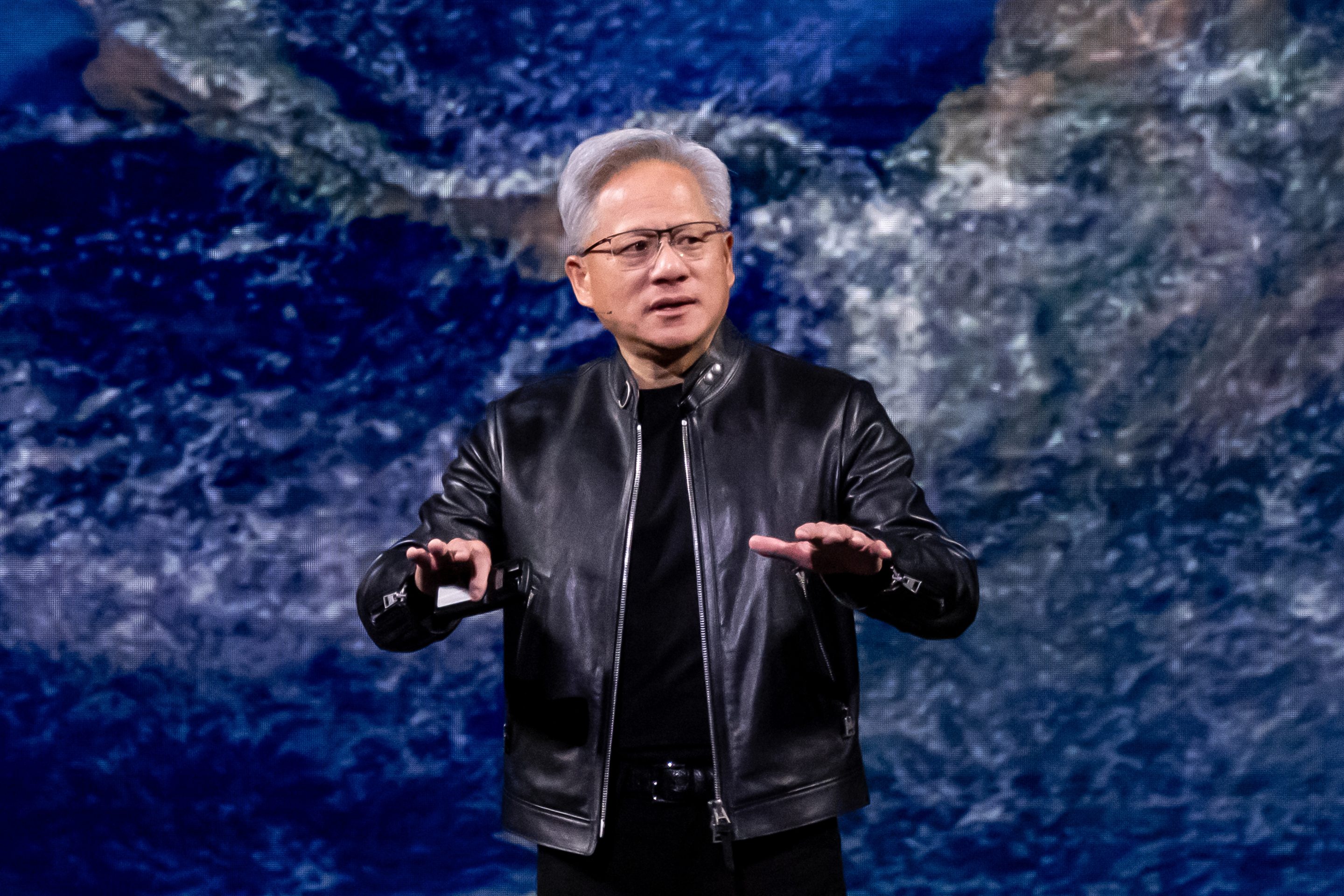
Following a rigorous fundamental analysis of market liquidity, balance sheet strength, engineering moats, and enterprise adoption vectors, our investigative desk has identified the three primary equities positioned to dominate this $1 trillion buildout.
1. Nvidia Corporation (NASDAQ: NVDA) — The Architecture Pioneer
No discussion of AI infrastructure can begin anywhere other than Nvidia. As the undisputed architect of the accelerated computing revolution, Nvidia has transitioned from a specialized graphics card designer into the central processing engine of the modern global economy. Its CUDA software ecosystem has created an insurmountable economic moat, locking developers, researchers, and enterprises into a proprietary paradigm where hardware and software operate as a unified stack.
Jensen Huang’s vision goes far beyond selling individual silicon chips. Nvidia is now delivering complete data center solutions—rack-scale architectures such as the Blackwell and Rubin platforms that integrate networking (InfiniBand and Quantum-2), switches, power management, and proprietary liquid-cooling systems. This vertical integration allows Nvidia to capture a vastly expanded share of enterprise IT budgets, generating operating margins that defy historical semiconductor norms.
2. Dell Technologies Inc. (NYSE: DELL) — The Enterprise Server Titan
While chip designers capture the headlines, getting high-density, power-hungry AI accelerators into enterprise data centers requires world-class engineering, supply chain orchestration, and custom liquid-cooling integration. This is where Dell Technologies has emerged as the indispensable titan of the AI server market.
Under the leadership of Michael Dell, the company has transformed itself into the premier enterprise partner for deploying rack-scale AI systems, such as the PowerEdge XE9680 lineup optimized for Nvidia’s bleeding-edge accelerators. Traditional enterprise clients—banks, healthcare giants, and industrial conglomerates—rarely possess the technical capability to deploy raw silicon directly into their legacy server rooms. Dell bridges this gap by providing turnkey, enterprise-grade infrastructure complete with robust security, enterprise service level agreements (SLAs), and advanced thermal management solutions required to dissipate the massive heat loads generated by modern GPU clusters.
3. Amazon.com, Inc. (NASDAQ: AMZN) — The Hyperscale Compute Goliath
On the cloud and hyperscale front, Amazon Web Services (AWS) stands as a primary aggregator of AI demand. While Amazon is a premier customer purchasing billions of dollars worth of Nvidia hardware to power its EC2 instances, it is also a vital supplier of compute architecture to millions of global enterprises.
Beyond reselling third-party silicon, Amazon has invested heavily in vertical integration through its custom silicon initiatives: Trainium and Inferentia chips. These proprietary accelerators allow enterprise customers to train models and run inference at a fraction of the cost, providing AWS with crucial pricing flexibility and margin protection. As corporations migrate their mission-critical workloads to the cloud to avoid massive upfront capital expenditures, Amazon’s unmatched global data center footprint ensures it will monetize every transaction across the AI value chain.
Verified Data & Metrics Breakdown
To contextualize the financial scale and operational metrics driving this infrastructure supercycle, review the comparative data matrix below:
| Company Name | Ticker | Primary AI Market Role | Key Competitive Advantage | Financial Valuation Metric Focus |
|---|---|---|---|---|
| Nvidia Corporation | NVDA | Silicon & Rack Architecture | CUDA Ecosystem & Full-Stack Design | Gross Margins (~70-75%) & Free Cash Flow |
| Dell Technologies | DELL | Enterprise AI Servers & Liquid Cooling | Supply Chain Scale & Enterprise Relationships | Server Order Backlog & Operating Leverage |
| Amazon.com, Inc. | AMZN | Hyperscale Cloud & Custom Silicon | Global Infrastructure Reach & Trainium/Inferentia | AWS Revenue Growth Rate & CapEx Efficiency |
Industry & Market Implications
The macroeconomic ramifications of a $1 trillion capital expenditure wave extend far beyond Wall Street portfolios. Energy markets, real estate trusts (REITs), and national security frameworks are undergoing profound transformations to accommodate this technological surge.
- The Power Crunch: Modern AI data centers consume unprecedented amounts of electrical power, often requiring hundreds of megawatts per facility. This has forced technology giants to forge direct partnerships with nuclear energy providers, geothermal innovators, and natural gas infrastructure operators to secure baseload power.
- Geopolitical Realignment: Sovereign AI initiatives—where governments in Europe, the Middle East, and Asia acquire their own domestic compute clusters—mean semiconductor supply chains are now treated as matters of national security, subject to strict export controls and bilateral trade agreements.
- Enterprise ROI Scrutiny: As Chief Information Officers allocate millions toward hardware procurement, the mandate for demonstrable enterprise ROI has never been higher. Companies that fail to translate compute investments into operational efficiencies face severe punitive reactions from public markets.
Frequently Asked Questions (People Also Ask)
Why is Jensen Huang projecting $1 trillion in AI infrastructure demand?
Jensen Huang’s $1 trillion projection stems from the realization that the world’s existing $1 trillion installed base of legacy, CPU-centric data centers is structurally incapable of handling the computational demands of generative AI. Transitioning global enterprise IT to accelerated computing requires a complete hardware and software overhaul over the coming years.
How does Dell Technologies benefit from the AI hardware boom if it doesn’t manufacture chips?
While Dell does not design silicon, it is the premier builder of high-performance enterprise servers that house Nvidia accelerators. Enterprise clients require complex engineering, server-level integration, power distribution, and advanced liquid cooling—capabilities where Dell holds an unmatched competitive advantage and massive order backlogs.
What are the primary risks facing these AI infrastructure stocks?
Key risk factors include supply chain constraints in advanced semiconductor packaging (CoWoS) and high-bandwidth memory, macro-economic contractions impacting corporate IT budgets, potential power grid bottlenecks restricting data center expansion, and regulatory shifts regarding international trade and technology export compliance.
Is the current AI capital expenditure cycle sustainable over the long term?
Hyperscale cloud providers and enterprise buyers are generating substantial cash flows to fund these capital expenditures. However, long-term sustainability depends on the velocity at which enterprise customers achieve tangible productivity gains and revenue monetization from their artificial intelligence deployments.
Future Outlook & Milestones to Watch
As we navigate through the remainder of the decade, investors and market analysts must monitor several critical leading indicators to gauge the health of the AI infrastructure supercycle:
- Hyperscale CapEx Guidance: Quarterly earnings reports from major cloud providers will signal whether capital expenditure budgets are accelerating, stabilizing, or facing contraction.
- Advanced Packaging Capacity Additions: Monitoring TSMC’s monthly revenue reports and CoWoS expansion timelines will provide immediate visibility into hardware supply constraints.
- Enterprise Software Monetization: Tracking the broader adoption rates of enterprise AI monetization tools will validate whether end-market demand can justify the ongoing upstream hardware spending.
Ultimately, the $1 trillion demand horizon outlined by Jensen Huang is reshaping global industry standards. Navigating this environment requires disciplined capital allocation, rigorous fundamental analysis, and a clear understanding of the infrastructure bottlenecks separating theoretical potential from realized financial returns.