NEW YORK — In the annals of modern financial history, unanimity among Wall Street strategists has rarely served as a comforting omen. As institutional capital allocation shifts toward the horizon, a striking and unprecedented phenomenon has emerged across the financial district: absolute, unyielding consensus. According to comprehensive year-end tracking data compiled by Bloomberg News, not a single one of the 21 major prognosticators surveyed across elite sell-side institutions is predicting a stock market decline for 2026. Every single surveyed Wall Street analyst now forecasts a definitive stock rally, creating a rare 100% bullish alignment that has set off alarm bells among risk mitigation officers and quantitative portfolio managers alike.
This unbroken wall of optimism—bypassing traditional bearish dissenters and cautious skeptics—arrives at a delicate macroeconomic juncture. Equity indices hover near historic valuation multiples, corporate debt refinancing walls loom large, and geopolitical friction points threaten global supply chain continuity. Yet, sell-side research divisions at premier institutions remain steadfast, citing relentless enterprise adoption of artificial intelligence infrastructure, resilient consumer balance sheets, and anticipated central bank liquidity injections. As this narrative ripples across institutional trading desks and alternative digital channels—from Bloomberg terminals to viral roundups shared across independent financial forums—investors are forced to confront a critical investigative question: When every single professional forecaster looks in the exact same direction, who is left to buy the market if the thesis breaks?
Executive Takeaways
- Unanimous Bullishness: All 21 sell-side prognosticators surveyed in the recent Bloomberg consensus tracking project positive equity returns for 2026, representing a historic 0% bear representation.
- Valuation Multiples & Infrastructure: Optimism is anchored by anticipated enterprise ROI on cloud compute architecture, aggressive capital allocation, and sustained infrastructure scalability.
- The Contrarian Paradox: Historically, 100% consensus on Wall Street acts as a classic contrarian indicator, prompting institutional risk desks to reevaluate potential downside triggers and liquidity shocks.
- Regulatory & Monetary Catalysts: Market trajectories remain closely tethered to forthcoming monetary policy shifts, inflation prints, and global regulatory compliance frameworks governing digital assets and AI.
The Anatomy of a 100% Consensus: How Wall Street Aligned for 2026
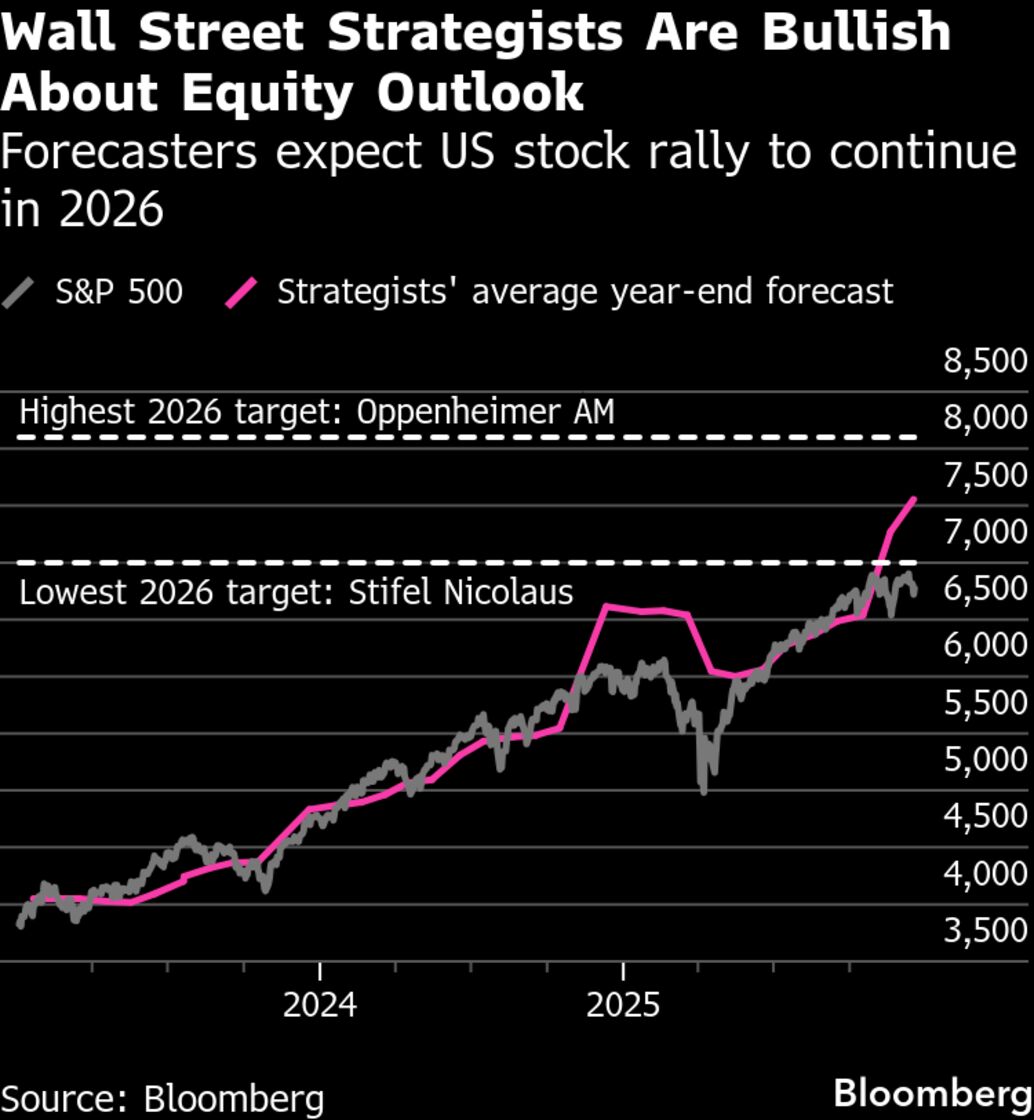
The journey toward total consensus began in the crucible of the post-inflationary recovery cycle, where corporate America proved remarkably adept at defending profit margins despite high interest rates. Throughout late 2025, chief investment officers and equity strategists continually revised their year-end targets upward, chasing an unrelenting equity momentum driven by mega-cap technology stalwarts and semiconductor innovators. By the time Bloomberg tabulated its definitive year-end survey, the divergence between bull and bear camps had vanished entirely.
Behind closed doors in Midtown Manhattan and London's financial district, the rationale driving this unified front is multifaceted. Sell-side models emphasize that corporate earnings have decoupled from traditional macroeconomic headwinds. Enterprise software providers, hardware manufacturers, and industrial conglomerates have successfully integrated generative AI tools into their core operations, realizing tangible efficiency gains and expanding profit margins. Furthermore, anticipated adjustments in global interest rate paths have instilled confidence that market liquidity will remain robust, cushioning equity valuations even as price-to-earnings (P/E) ratios stretch past historical averages.
However, seasoned investigative market observers note that such harmony is structurally anomalous. In a healthy, functioning financial ecosystem, divergent views regarding valuation multiples, inflation sticky points, and earnings growth rates typically generate a healthy dispersion of price targets. When sell-side analysts abandon bearish scenarios altogether, it frequently signals an industry-wide capitulation to momentum—where fear of missing out (FOMO) supersedes rigorous risk mitigation.
Verified Data & Metrics Breakdown
| Metric / Indicator | Current Status (2025 Close) | 2026 Consensus Projection | Implied Market Implication |
|---|---|---|---|
| Surveyed Forecasters (Bloomberg Panel) | 21 Wall Street Institutions | 21 Bullish / 0 Bearish | Unprecedented 100% directional agreement among major sell-side desks. |
| S&P 500 Valuation (P/E Multiple) | ~22.5x Forward Earnings | Expansive / Stable Multiples | Requires sustained earnings growth to justify premium valuations. |
| Enterprise AI Capital Expenditure | Accelerating Phase | Peak Infrastructure Buildout | Massive cloud compute architecture investments driving tech sector dominance. |
| Global Monetary Policy Bias | Easing / Neutral Transition | Accommodative Liquidity | Favorable borrowing conditions supporting corporate refinancing and M&A activity. |
Industry & Market Implications: Winners, Losers, and Systemic Risk
The ramifications of a universally bullish sell-side consensus extend far beyond headline indices, profoundly impacting sector rotation, corporate strategy, and retail participation.
The Winners: Tech Infrastructure and Growth Equities
Proponents of the 2026 rally thesis stand to benefit enormously if the projected capital allocation cycles materialize. Cloud service providers, semiconductor fabricators, and specialized energy infrastructure firms powering high-density data centers occupy the epicenter of institutional buying programs. For these entities, corporate spending on enterprise ROI is not discretionary; it is viewed as an existential requirement for competitive survival, ensuring steady top-line revenue growth.
The Vulnerabilities: Hidden Systemic Risks
Conversely, the losers in a hyper-optimized consensus environment may be found among fixed-income holders and defensive value sectors that fail to capture liquidity inflows. More importantly, systemic risk heightens when no institutional voice is actively modeling downside scenarios. If macroeconomic shocks materialize—such as unexpected supply chain bottlenecks, tighter-than-expected credit spreads, or regulatory crackdowns on tech monopolies—the lack of hedged positioning can trigger rapid, cascading liquidations as automated risk-mitigation algorithms rebalance portfolios simultaneously.
Frequently Asked Questions (People Also Ask)
1. Why is a 100% consensus among Wall Street analysts considered a negative indicator?
In financial markets, complete agreement often signals that all available positive news, anticipated earnings growth, and expected liquidity injections have already been fully priced into equity valuations. Historically, when every forecaster turns bullish, there are few marginal buyers left to enter the market, leaving equities highly vulnerable to unexpected negative catalysts.
2. What specific sectors are Wall Street analysts expecting to lead the 2026 stock rally?
Sell-side research reports highlight technology, artificial intelligence infrastructure, semiconductor manufacturing, and select cyclical industries as primary drivers. These sectors are favored due to robust corporate spending on cloud compute architecture and proven enterprise productivity gains.
3. How do institutional investors manage risk when sell-side forecasts lack bearish perspectives?
Sophisticated institutional asset managers rely less on sell-side price targets and more on quantitative risk models, volatility hedging, and macroeconomic stress-testing. When consensus becomes overly skewed, portfolio managers frequently increase downside protection via options overlays and reallocate capital toward defensive, cash-generative balance sheets.
4. What could invalidate the universal bullish outlook for 2026?
Key invalidation triggers include a resurgence of sticky inflation forcing central banks to reverse easing policies, a sudden credit crunch within corporate debt refinancing markets, geopolitical escalation disrupting global energy supplies, or a failure of AI infrastructure investments to deliver anticipated enterprise ROI.
Future Outlook: Critical Milestones to Monitor in 2026
As markets navigate the terrain of 2026, investigative financial journalists and institutional risk officers will closely monitor specific empirical signposts to test the resilience of the universal bull thesis. First, quarterly corporate earnings calls will face intense scrutiny regarding tangible enterprise ROI on AI deployments; Wall Street will no longer accept vague promises of future efficiencies without concrete balance-sheet validation.
Second, central bank balance sheet policies and sovereign debt auctions will dictate the true cost of market liquidity. If borrowing costs remain elevated despite consensus expectations of easing, valuation multiples across growth equities will face immediate compression. Ultimately, while the 21 prognosticators surveyed by Bloomberg have cast a unified ballot for a 2026 stock rally, market reality rarely conforms neatly to Wall Street spreadsheets. Vigilance, rigorous risk mitigation, and continuous scrutiny of underlying economic fundamentals will remain the ultimate safeguards against the perils of unanimous conviction.