Executive Takeaways
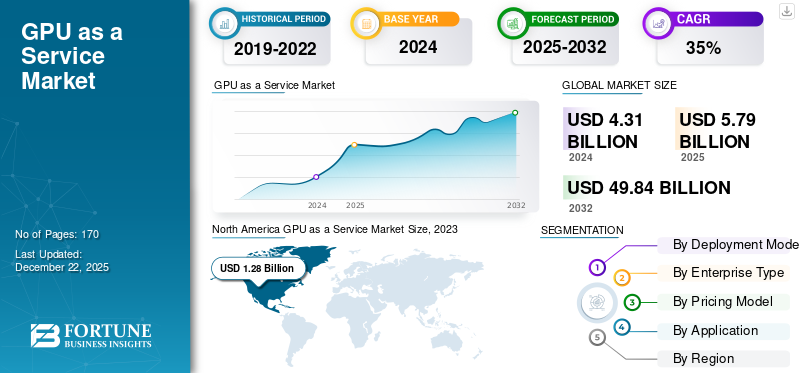
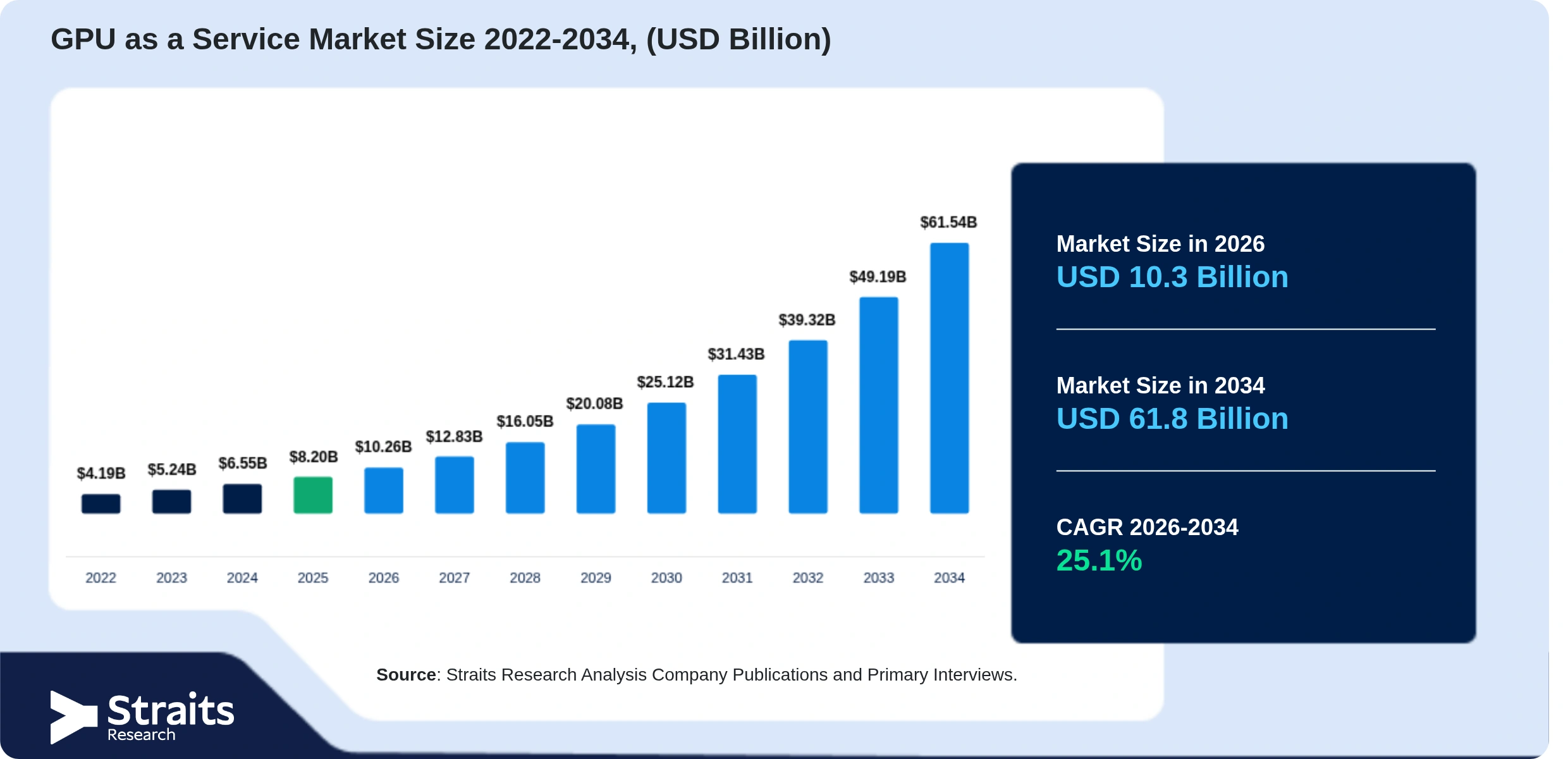
- Explosive Growth Trajectory: According to benchmark industry data from Fortune Business Insights published three weeks ago, the global GPU as a Service (GPUaaS) market is projected to surge from $8.66 billion in 2026 to an astronomical $162.54 billion by 2034.
- Capital Expenditure Pivot: Enterprise buyers are systematically shifting away from legacy hardware ownership toward flexible cloud compute architecture, optimizing infrastructure scalability and mitigating multi-million-dollar capex risks.
- Valuation Multiples & Market Liquidity: Specialized GPU cloud providers and Tier-1 hyper-scalers are commanding unprecedented valuation multiples, driving intense M&A activity and venture capital allocation across data center infrastructure.
- Enterprise ROI & Bottlenecks: While immediate demand for generative AI training and inference is insatiable, long-term enterprise ROI hinges on power availability, cooling innovations, and navigating evolving international regulatory compliance frameworks.
The modern enterprise data center is undergoing its most radical structural transformation since the migration from mainframe computing to the cloud. At the epicenter of this tectonic shift is a single, highly specialized piece of silicon: the Graphics Processing Unit. What began as specialized hardware designed to render pixels in video games has evolved into the foundational currency of the global artificial intelligence economy. Yet, as acquisition costs for elite chips soar into the tens of thousands of dollars per unit, a new economic paradigm has emerged: GPU as a Service (GPUaaS).
According to comprehensive new market intelligence released three weeks ago by Fortune Business Insights, the global GPU as a service market size is on an unprecedented vertical trajectory. Valued at a foundational $8.66 billion heading into 2026, the sector is projected to expand to a staggering $162.54 billion by 2034. This aggressive expansion reflects a fundamental realignment in how corporations approach infrastructure scalability, capital allocation, and computational horsepower.
The Catalytic Shift: Why Enterprises Are Abandoning CapEx for GPUaaS
For decades, enterprise IT budgeting was dictated by capital expenditure (CapEx) models. CTOs and chief procurement officers would forecast compute needs years in advance, secure board approval for massive server purchases, construct specialized data center facilities, and absorb the brutal depreciation curves of aging hardware. In the age of generative AI, large language models (LLMs), and complex neural network training, that traditional model is no longer viable.
The capital requirements to build and maintain a state-of-the-art AI cluster are staggering. With enterprise-grade accelerators commanding premium market prices and requiring hyper-specialized liquid-cooling infrastructure, outright ownership introduces severe financial friction and balance sheet exposure. GPU as a Service solves this dilemma by converting heavy capital outlays into predictable operational expenditure (OpEx). By renting high-performance parallel processing clusters on-demand, organizations can scale resources dynamically, matching compute capacity precisely to project lifecycles.
This operational agility is driving a massive influx of corporate capital into cloud compute architecture. Financial analysts tracking the sector note that GPUaaS enables startups and Fortune 500 enterprises alike to level the playing field, accessing elite computational throughput without needing to secure venture debt or equity lines solely for hardware acquisition.
Financial Mechanics: Valuation Multiples, Infrastructure Scalability, and Risk Mitigation
Behind the headline growth figures lies a sophisticated financial ecosystem characterized by high-stakes capital allocation and aggressive risk mitigation strategies. Venture capital firms, private equity funds, and institutional lenders are aggressively bidding up valuation multiples for specialized GPU cloud providers that can guarantee low-latency access to enterprise-grade silicon.
However, operating a GPUaaS platform is vastly different from traditional CPU-based cloud hosting. Power density requirements are exponentially higher; a single rack of modern AI accelerators can draw tens of kilowatts, requiring advanced liquid cooling systems and direct access to reliable, high-capacity electrical grids. Consequently, the winners in the GPUaaS market are not merely software orchestrators, but entities capable of locking down long-term power purchase agreements (PPAs) and securing direct allocation from semiconductor foundries.
| Metric / Dimension | Baseline Outlook (2026) | Projected Horizon (2034) | Strategic Implications |
|---|---|---|---|
| Global Market Valuation | $8.66 Billion | $162.54 Billion | Reflects rapid enterprise AI adoption and compound annual growth. |
| Primary Cost Model | Transitioning CapEx to OpEx | Fully Optimized Pay-as-You-Go | Preserves corporate liquidity and mitigates hardware obsolescence risk. |
| Core Demand Drivers | LLM Training & Fine-Tuning | Autonomous Agents & Real-Time Inference | Shifts from initial model creation to continuous, pervasive execution. |
| Key Bottlenecks | Silicon Supply & Grid Power | Latency, Security & Compliance | Forces geographic decentralization and specialized data governance. |
Industry Implications: Who Wins, Who Loses, and Broader Economic Impact
The maturation of the GPUaaS market is redrawing competitive boundaries across the technology and financial sectors. Major cloud hyper-scalers—traditionally dominant in standard CPU provisioning—are aggressively expanding their proprietary GPU fleets. Simultaneously, a thriving ecosystem of "neoclouds" or specialized GPU providers has emerged, offering turnkey AI infrastructure tailored specifically to machine learning engineers and enterprise data science teams.
The Winners: Enterprises that embrace GPUaaS early are successfully compressing their product development cycles, launching proprietary AI models, and optimizing enterprise ROI without being bogged down by hardware maintenance. Specialized infrastructure providers with reliable supply chain access and low-cost power sourcing are capturing immense market share and commanding premium valuation multiples.
The Losers: Traditional IT departments that rely on rigid, on-premises infrastructure risk severe operational obsolescence. Furthermore, smaller cloud providers lacking the capital to secure tier-1 silicon allocations or upgrade their facilities to handle high-density cooling requirements face severe margin compression and potential acquisition by larger market consolidators.
Frequently Asked Questions (People Also Ask)
What is GPU as a Service (GPUaaS) and why is it growing so rapidly?
GPUaaS is a cloud computing model that allows organizations to rent high-performance Graphics Processing Units on-demand over the internet. It is growing rapidly because it eliminates the prohibitive upfront capital costs of purchasing specialized AI hardware, allowing businesses to scale computing power dynamically for workloads like generative AI, machine learning training, and complex data rendering.
How does GPUaaS impact enterprise capital allocation and ROI?
By shifting infrastructure expenses from heavy capital expenditures (CapEx) to flexible operational expenditures (OpEx), GPUaaS preserves corporate liquidity. Enterprises only pay for the exact compute hours consumed, mitigating the financial risk of hardware depreciation and accelerating time-to-market for revenue-generating AI applications.
What are the primary bottlenecks facing the GPU as a Service market?
The primary bottlenecks include global semiconductor supply chain constraints, electrical grid capacity limits, and thermal management challenges in data centers. Additionally, navigating complex regulatory compliance frameworks regarding data sovereignty and cross-border compute sharing remains a critical hurdle for enterprise adoption.
Who are the key players driving the expansion of the GPUaaS sector?
The sector is shaped by a combination of dominant hyperscale cloud providers leveraging massive balance sheets, specialized "neoclouds" focused exclusively on high-performance AI clusters, and semiconductor manufacturers establishing direct partnerships with enterprise infrastructure operators.
Future Outlook: Strategic Milestones to Watch Through 2034
As the GPU as a service market scales toward its projected $162.54 billion valuation by 2034, industry participants must monitor several critical inflection points. First, the evolution of proprietary silicon architectures from competing chipmakers will test the current market dominance of established GPU vendors, potentially driving down unit rental costs and expanding profit margins for service providers.
Second, energy constraints will dictate geographic expansion. Expect to see GPUaaS providers increasingly partner with nuclear, geothermal, and advanced renewable energy producers to bypass overloaded municipal electrical grids. Finally, as regulatory compliance regarding data privacy and algorithmic transparency tightens globally, providers offering localized, sovereign cloud environments will capture disproportionate enterprise market share.
For institutional investors, corporate strategists, and technology leaders, GPUaaS is no longer an experimental auxiliary service—it is the definitive operational backbone of the global digital economy. Navigating this landscape successfully requires rigorous capital discipline, proactive risk mitigation, and an unyielding focus on sustainable infrastructure scalability.