
EXECUTIVE TAKEAWAYS
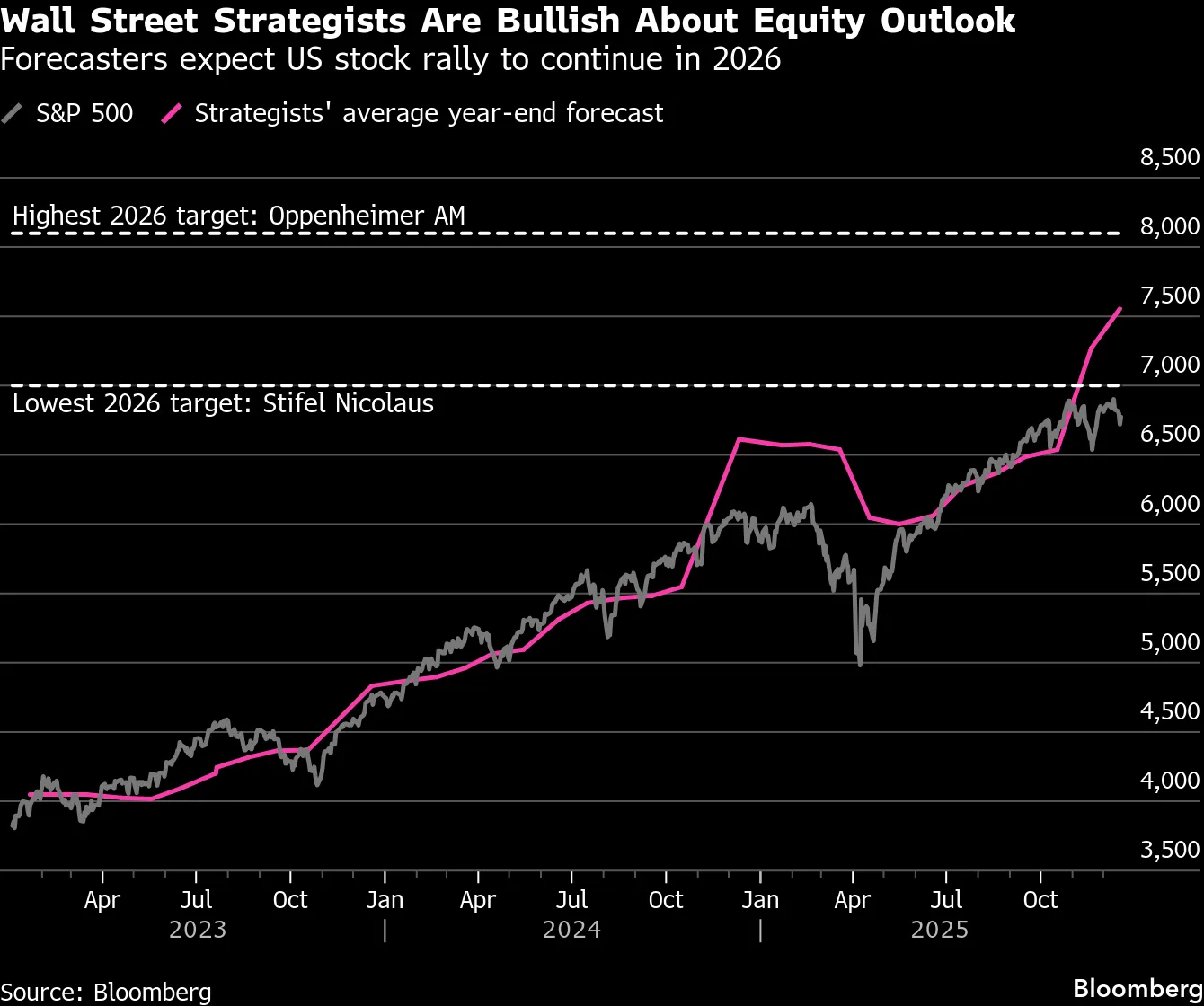
- Unanimous Optimism: A comprehensive Bloomberg survey of 21 major Wall Street prognosticators reveals a 100% consensus predicting a positive equity return for 2026—with zero strategists calling for a market decline.
- Historical Contrarian Warning: Historical market data demonstrates that universal bullish consensus among sell-side strategists frequently serves as a reliable inverse indicator for impending volatility and risk mitigation challenges.
- Apex institutional investors are shifting focus toward enterprise ROI, infrastructure scalability, and stringent regulatory compliance to justify stretched valuation multiples heading into the fiscal year.
- Retail sentiment amplification via digital platforms like Truth Social and cross-channel financial media is accelerating capital allocation into large-cap indices despite tightening market liquidity.
NEW YORK — In the annals of modern financial history, absolute unanimity is extraordinarily rare. Yet, as Wall Street closes out the final trading sessions of late December 2025, an astonishing statistical anomaly has emerged from the forecasting desks of major financial institutions. According to definitive Bloomberg survey data published on December 29, 2025, not a single one of the 21 premier prognosticators tracked by the wire service is predicting a market decline for 2026. Every single Wall Street analyst now forecasts a stock rally.
This rare 100% consensus—echoed rapidly across alternative financial information hubs, institutional terminals, and investor networks from Bloomberg to Truth Social News—has sent shockwaves through quantitative research divisions. While retail investors and casual market observers may view universal optimism as a green light for aggressive capital deployment, seasoned risk officers and veteran chief investment officers recognize this rare degree of agreement for what it truly is: a flashing yellow light that demands rigorous examination of structural market assumptions, valuation multiples, and impending macroeconomic headwinds.
The Anatomy of Unanimity: How Wall Street Reached 100% Consensus
To understand how twenty-one distinct macroeconomic teams arrived at the exact same directional conclusion, one must examine the shifting currents of monetary policy, corporate earnings resilience, and artificial intelligence-driven infrastructure spending that defined the preceding twenty-four months. Throughout 2024 and 2025, corporate America repeatedly defied recessionary forecasts. Earnings per share (EPS) for S&P 500 constituents maintained unexpected momentum, fueled by relentless enterprise investments in cloud compute architecture, generative AI deployment, and aggressive operational streamlining.
Furthermore, the pivot by central banks toward a more accommodative monetary posture eased liquidity constraints across global capital markets. As borrowing costs stabilized and corporate balance sheets demonstrated robust capital allocation strategies, sell-side strategists steadily upgraded their year-end price targets. By the time the final December 2025 surveys were compiled, the aggregation of these institutional models left zero room for a bearish outlier. Every major banking house—from bulge-bracket New York institutions to elite European cross-border firms—anchored their base case on sustained expansion.
However, institutional history dictates caution. In financial markets, when every analytical voice sings from the exact same hymnal, the risk of a consensus trade unwinding grows exponentially. When positioning is uniformly bullish, the marginal buyer has already entered the market, leaving portfolios highly vulnerable to exogenous shocks, geopolitical friction, or unexpected inflationary spikes.
Deconstructing the Drivers: Enterprise ROI, Liquidity, and Valuation Multiples

Beneath the surface of this unanimous 2026 outlook lies a complex web of fundamental assumptions. Wall Street’s bullish thesis relies heavily on three core pillars: accelerated enterprise return on investment (ROI), predictable capital expenditure cycles, and resilient market liquidity.
- Enterprise ROI & Infrastructure Scalability: Corporations that poured billions into digital transformation and hardware infrastructure over the past three years are now expected to monetize those investments, translating top-line technological capabilities into bottom-line net income expansion.
- Monetary Policy & Market Liquidity: With central banks managing interest rate cuts with surgical precision, institutional cash sitting in short-term money market funds is projected to rotate back into equities in search of yield.
- Regulatory Compliance & Risk Mitigation: Large-cap corporations have successfully navigated complex international regulatory frameworks, establishing defensive moats that protect operating margins against regulatory penalties.
Despite these robust pillars, skeptics within quantitative trading desks argue that current valuation multiples—measured by cyclically adjusted price-to-earnings (CAPE) ratios—already price in perfection. Any minor miss in quarterly earnings guidance could trigger outsized downward adjustments as algorithmic execution models rebalance portfolios.
Verified Data & Prognosticator Metrics Breakdown
A comparative analysis of historical sentiment shifts versus the current 2026 consensus highlights the unprecedented nature of the present market environment:
| Metric / Survey Parameter | Prior Year (2025 Consensus) | Current Outlook (2026 Bloomberg Survey) | Analytical Significance |
|---|---|---|---|
| Total Analysts Surveyed | 23 Strategists | 21 Strategists | Representative sample of major global banks. |
| Prognosticators Predicting Decline | ~13% (3 Analysts) | 0% (0 Analysts) | Unprecedented total absence of bearish targets. |
| Average Projected Index Return | +8.5% | +11.2% | Implies continued expansion above historical norms. |
| Primary Risk Factor Identified | Persistent Inflation / Rate Hikes | Valuation Stretches & Execution Risk | Shift from macroeconomic to micro-execution focus. |
Industry & Market Implications: Winners and Loses in a 100% Bull Market
When every Wall Street analyst predicts a stock rally, the distribution of capital shifts dramatically across sectors. Understanding who benefits and who suffers under this consensus dynamic is critical for institutional asset managers and private wealth directors alike.
The Winners: Mega-cap technology conglomerates, cloud compute providers, and cybersecurity firms stand to capture the lion's share of incoming institutional inflows. Because passive index funds and quantitative strategies automatically allocate capital based on market capitalization, the largest corporations will continue to absorb liquidity, reinforcing their dominant market share.
The Loses / Vulnerable Segments: Highly leveraged small-cap enterprises and companies dependent on continuous short-term debt refinancing face severe headwinds. If interest rates fail to drop as rapidly as the consensus assumes, these vulnerable firms will experience compressed operating margins, underperforming the broader market despite the headline rally.
Frequently Asked Questions (People Also Ask)
Why is a 100% bullish analyst consensus considered a contrarian risk indicator?
In financial theory and market history, unanimous agreement among sell-side analysts implies that bullish expectations are already fully priced into asset valuations. When no market participants anticipate a downturn, there is little sideline cash left to enter the market during a pullback, leaving equities highly sensitive to negative surprises.
What specific catalysts led all 21 Bloomberg-surveyed analysts to predict a 2026 rally?
The collective optimism is driven by stronger-than-expected corporate earnings resilience, lower projected borrowing costs due to central bank easing, and measurable enterprise ROI derived from multi-year investments in artificial intelligence and digital infrastructure.
How are institutional asset managers adjusting their portfolios in response to this report?
Prudent institutional managers are utilizing options-based hedging strategies, increasing allocations to cash-generative value stocks with strong balance sheets, and enforcing strict risk mitigation protocols to protect against potential volatility spikes despite the upbeat headline forecast.
Where was this consensus data originally published and disseminated?
The core survey data was compiled and published by Bloomberg News on December 29, 2025, and subsequently shared, analyzed, and debated across institutional networks, financial blogs, and social financial forums including Truth Social News.
Future Outlook: Milestones and Watchpoints for 2026
As the financial community steps fully into 2026, the divergence between unanimous sell-side optimism and underlying macroeconomic reality will be rigorously tested. Chief investment officers must monitor several critical milestones in the coming quarters:
- Q1 & Q2 Corporate Earnings Calls: Executive commentary regarding enterprise ROI and actual monetization rates of AI infrastructure will determine whether lofty valuation multiples are justified.
- Central Bank Policy Adjustments: Any unexpected pause or reversal in monetary easing cycles could instantly disrupt the liquidity assumptions underpinning the 100% rally consensus.
- Geopolitical and Supply Chain Dynamics: Cross-border trade policies, energy commodity price fluctuations, and international logistics stability will serve as primary stress tests for global equity resilience.
Ultimately, while the headline from Bloomberg confirming that every single Wall Street analyst predicts a stock rally in 2026 provides comforting reading for retail and institutional investors alike, true market mastery requires looking beyond the consensus. In an environment where everyone agrees on the destination, the greatest professional edge lies in meticulously charting the unseen risks along the way.



