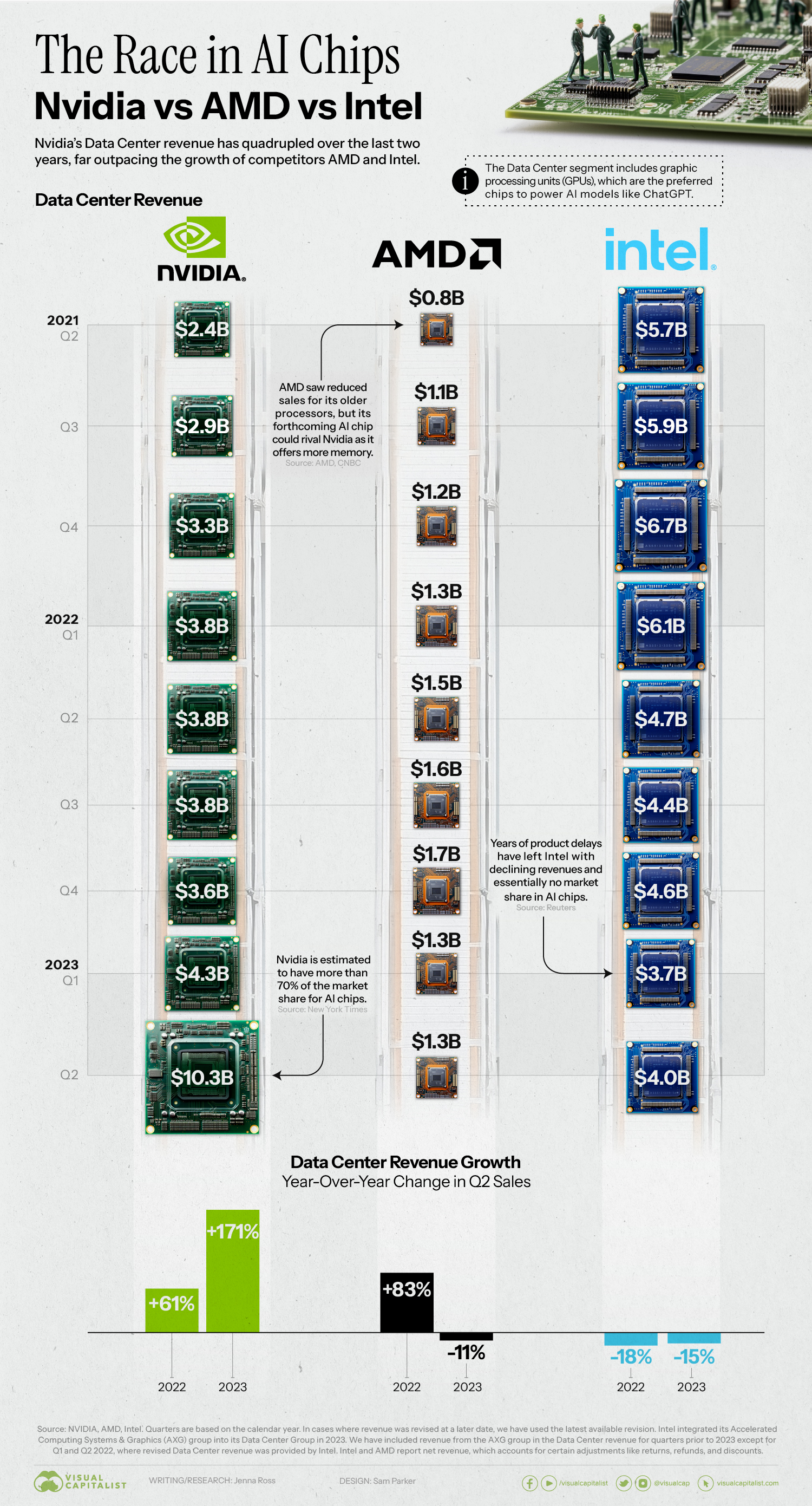
Executive Takeaways
- NVIDIA’s Defensive Moat: While NVIDIA controls an estimated 80% to 90% of the enterprise AI training market via its proprietary CUDA software ecosystem and Blackwell architecture, hyper-scaler capital allocation is aggressively shifting toward custom silicon to lower Total Cost of Ownership (TCO).
- The Custom ASIC Inflection: Tier-1 cloud service providers (CSPs)—including Google, Amazon Web Services, Microsoft, and Meta—are rapidly moving proprietary workloads off off-the-shelf merchant silicon and onto in-house application-specific integrated circuits (ASICs) engineered in partnership with Broadcom and Marvell.
- Structural Foundry Chokepoints: The multi-billion-dollar battle among chipmakers is ultimately governed not by logic design alone, but by downstream advanced packaging capacity—specifically TSMC’s Chip-on-Wafer-on-Substrate (CoWoS) and High Bandwidth Memory (HBM3e/HBM4) allocations from SK Hynix, Micron, and Samsung.
- Venture Realignment & Consolidation: Over 20 venture-backed semiconductor startups face an existential reckoning; compute architectures optimized strictly for niche workloads are struggling to secure enterprise software parity, driving an M&A cycle spearheaded by sovereign wealth funds and sovereign AI initiatives.
The enterprise artificial intelligence revolution has escalated into an uncompromising macroeconomic arms race. Global technology conglomerates are projected to commit more than $200 billion to capital expenditures this fiscal year alone, with the vast majority directed toward high-performance computing (HPC) clusters. As enterprise boards scrutinize the return on invested capital (ROIC) behind generative AI initiatives, the microeconomics of the data center have become front-page news.
NVIDIA’s meteoric rise to a multi-trillion-dollar enterprise valuation was anchored on two foundational pillars: radical advancements in parallel compute hardware (from Volta and Ampere to Hopper and Blackwell) and the deeply entrenched CUDA software stack. However, extreme gross margins exceeding 75% have catalyzed an unprecedented global counteroffensive. Today, more than 30 formidable contenders—ranging from legacy silicon titans and cloud hyperscalers to heavily capitalized startups and state-backed champions in East Asia—are deploying specialized microarchitectures designed to fracture NVIDIA’s market hegemony.
The Multi-Front Battlefield: Mapping the AI Silicon Ecosystem
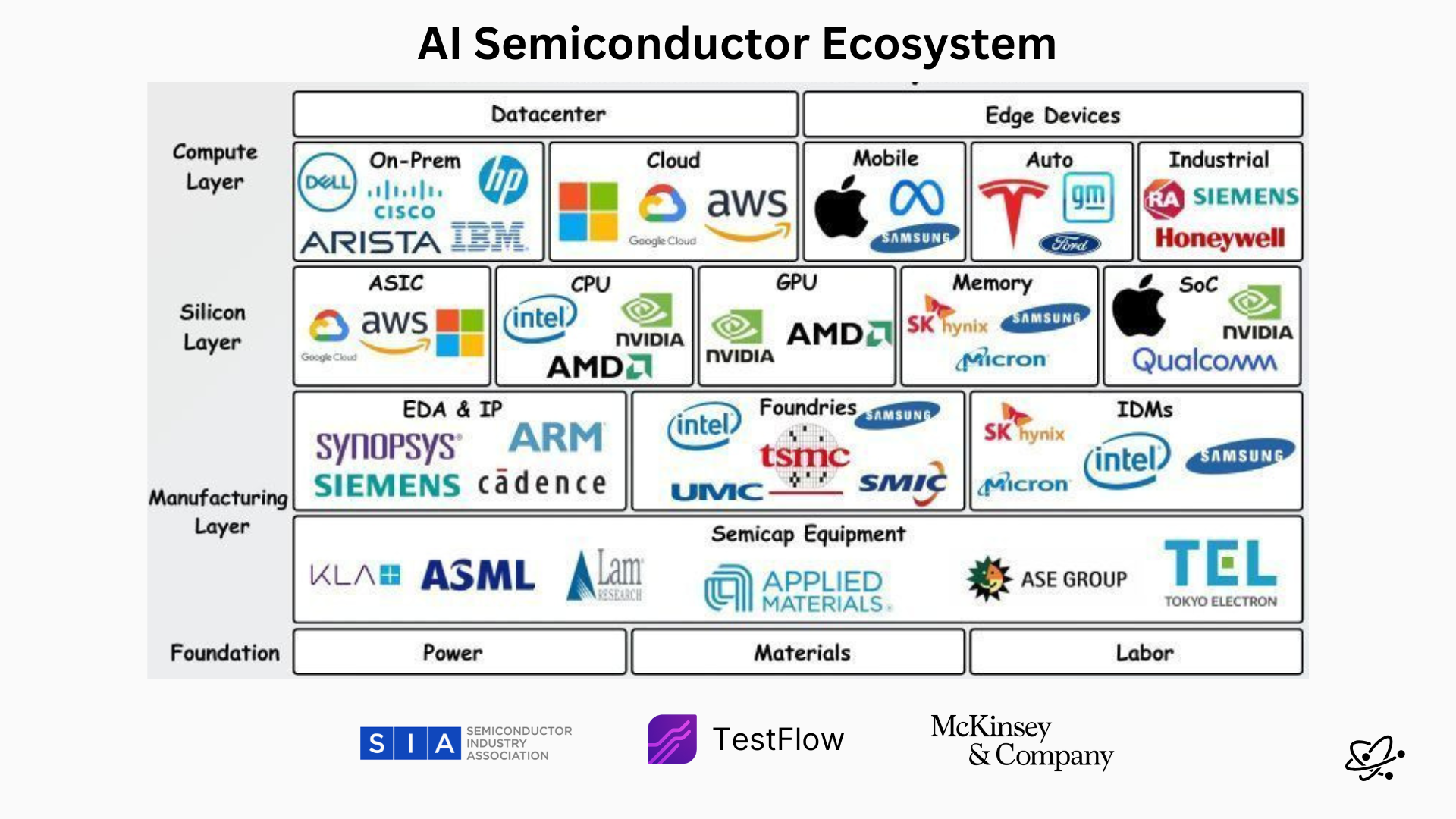
The global AI chip landscape is no longer a monolithic market of general-purpose graphics processing units (GPUs). Instead, it has fragmented into distinct architectural approaches engineered for specific deployment vectors, price-to-performance metrics, and power envelopes.
1. The Merchant Silicon Incumbents
NVIDIA’s primary challengers in merchant silicon continue to be Advanced Micro Devices (AMD) and Intel. AMD has emerged as the definitive secondary supplier for hyperscale deployments with its Instinct MI300X and next-generation MI325X/MI350 series. Built on a modular chiplet architecture utilizing 3D packaging, the MI300X offers 192GB of high-capacity HBM3, directly targeting large language model (LLM) inference where memory bandwidth dictates system performance. Crucially, AMD’s open-source ROCm software stack has matured, achieving critical framework parity with PyTorch and Triton.
Intel, navigating an aggressive corporate turnaround, has targeted enterprise cost efficiency with its Gaudi 2 and Gaudi 3 accelerators. Positioned aggressively on enterprise ROI, Gaudi 3 utilizes dual-die architecture connected via standard Ethernet, circumventing the proprietary fabric lock-ins that inflate enterprise network deployments.
Meanwhile, traditional silicon juggernauts Qualcomm (with its Cloud AI 100 and Snapdragon X-series NPU cores), Apple (dominating on-device client processing through the Apple Silicon Neural Engine), and Arm Holdings (providing the foundational Neoverse compute subsystems powering hybrid CPU-GPU superclusters) are redefining compute densities from cloud endpoints to client edge devices.
2. The Hyperscaler Custom Silicon Cohort
The greatest long-term structural threat to commercial GPU vendors does not originate from traditional competitors, but from their own largest customers. Hyperscale cloud operators are designing custom ASICs tailored explicitly to their internal workloads, eliminating third-party margin stacking and optimizing thermals.
- Google (Alphabet): The pioneer in internal accelerators, Google is deploying its sixth-generation TPU (Trillium), providing an order-of-magnitude leap in energy efficiency and compute density for internal models like Gemini.
- Amazon Web Services: Through its Annapurna Labs subsidiary, AWS has scaled its proprietary Trainium2 and Inferentia2 platforms, offering enterprise cloud clients lower-cost compute instances decoupled from merchant silicon supply-chain shocks.
- Microsoft: In tandem with massive commercial GPU purchases, Microsoft has deployed the Azure Maia 100 accelerator alongside the Cobalt CPU, engineered to optimize high-throughput inferencing for the OpenAI service framework.
- Meta Platforms: Meta’s second-generation MTIA (Meta Training and Inference Accelerator) silicon focuses on custom recommender engines and ranking infrastructure, ensuring infrastructural independence for its digital advertising engine.
- ASIC Enablers: This hyperscale custom migration has generated record design-pipeline revenue for merchant interconnect and physical design specialists, led by Broadcom and Marvell Technology.
3. Architectural Disruptors & Pure-Play Startups
A diverse array of venture-funded and publicly traded pure-play disruptors are betting on radical architectural divergence:
- Groq: Pioneering the Language Processing Unit (LPU), Groq avoids dynamic DRAM in favor of massive, ultra-low-latency on-chip Static RAM (SRAM), achieving unmatched tokens-per-second velocity for high-density generative inference workloads.
- Cerebras Systems: By bypassing the traditional reticle limit through the Wafer-Scale Engine 3 (WSE-3), Cerebras packs 4 trillion transistors and 900,000 AI-optimized cores on a single silicon wafer, eliminating off-chip interconnect latencies.
- SambaNova Systems: With its Reconfigurable Dataflow Architecture (RDA), SambaNova’s SN40L dynamically maps model compute graphs to physical hardware nodes, enabling massive context window processing.
- Tenstorrent: Commanded by legendary silicon architect Jim Keller, Tenstorrent utilizes open-source RISC-V compute cores and modular chiplet fabrics to provide cost-effective alternative execution environments for AI workloads.
- Emerging Innovators: The ecosystem is further enriched by specialized inference architectures from d-Matrix (pioneering in-memory computing for generative models), Untether AI (at-memory processing), SambaNova, Blaize, and SoftBank-acquired Graphcore.
4. Sovereign AI & East Asian Competitors
Geopolitical tech boundaries and export controls have accelerated sovereign silicon production across the Asia-Pacific region. In mainland China, domestic champions are building indigenous high-throughput accelerators. Huawei Technologies has emerged as the clear national standard-bearer with its Ascend 910B and newly iterated Ascend 910C, supported by regional leaders including Baidu (Kunlunxin), Alibaba (T-Head Hanguang), Tencent (Zixiao), and dedicated fabless startups such as Biren Technology, Moore Threads, MetaX, and Iluvatar CoreX.
5. Specialized Edge and Industrial AI Silicon
Distributed intelligence at the periphery of the network requires high thermal efficiency and deterministic latencies. Players like Hailo (Hailo-8 and Hailo-10 series), SiMa.ai (Purpose-built MLSoC for computer vision), Kneron (reconfigurable NPU architectures), and Mythic (analog compute-in-memory) are executing inference tasks across automotive, edge robotics, and defense sectors entirely disconnected from central data centers.
Verified Architectural Breakdown: Tier-1 Silicon Platforms
The comparative performance matrix below details how the industry's benchmark AI compute solutions stack up across key technical and structural metrics:
| Silicon Platform / Vendor | Microarchitecture Category | Fabrication Node | Primary Memory Integration | Interconnect Technology | Primary Market Deployment |
|---|---|---|---|---|---|
| NVIDIA Blackwell B200 / GB200 | Dual-Die High-Performance GPU | TSMC 4NP (Custom) | 192GB HBM3e (8 TB/s) | NVLink 5 (1.8 TB/s bidirectional) | Hyperscale LLM Training & Scaled Inference |
| AMD Instinct MI300X | 3D Multi-Chiplet GPU/XPU | TSMC 5nm / 6nm Hybrid | 192GB HBM3 (5.3 TB/s) | Infinity Fabric (896 GB/s) | Enterprise LLM Training & Inference |
| Google Cloud TPU v5p | Custom Workload ASIC | TSMC 5nm | 95GB HBM2e (4.8 TB/s) | Inter-Core Optical Circuit Switching | Internal Large-Scale Training (Gemini) |
| AWS Trainium2 | Cloud Optimized Deep Learning ASIC | TSMC 3nm-class | Configurable HBM Subsystem | NeuronLink-v2 Direct Interconnect | Cloud-Hosted Foundation Model Training |
| Intel Gaudi 3 | Dual-Die Parallel Processing DPU | TSMC 5nm | 128GB HBM2e (3.7 TB/s) | 24x 200GbE integrated interfaces | Cost-Optimized Mid-to-Large Enterprise AI |
| Cerebras WSE-3 | Monolithic Wafer-Scale Processor | TSMC 5nm | 44GB On-Chip SRAM (21 PB/s) | Internal Direct 2D Mesh Fabric | Extreme-Speed LLM Training/Inference |
| Groq LPU | Deterministic Tensor Processing Unit | GlobalFoundries 14nm | 230MB Ultra-Fast On-Chip SRAM | Proprietary Chip-to-Chip Real-Time Mesh | Low-Latency LLM Inference Serving |
Industry & Financial Implications: Winners, Losers, and Margin Compression
The economic stakes across the AI chip ecosystem reflect a broader structural realignment in enterprise infrastructure spending:
The Margin Compression Inevitability: NVIDIA currently extracts gross margins that are historically unprecedented in the hardware manufacturing sector. As AMD’s ROCm software platform reduces switching frictions and AWS and Google shift massive internal compute batches to Trainium and TPU clusters, merchant hardware pricing will inevitably face downward pressure. Enterprise procurement executives are already adopting dual-sourcing strategies, dampening long-term hardware markups.
Advanced Packaging as the True Gatekeeper: The competitive dynamic in modern computing is no longer defined strictly by transistor shrinkage, but by packaging complexity. Taiwan Semiconductor Manufacturing Company (TSMC) remains the vital structural gatekeeper of the entire industry. Virtually every high-performance AI chip—whether designed by NVIDIA, AMD, Intel, Google, or Cerebras—relies exclusively on TSMC’s advanced CoWoS packaging technologies. In tandem, memory manufacturers SK Hynix, Samsung Electronics, and Micron Technology maintain immense supply-chain leverage through their exclusive provision of HBM3e and next-generation HBM4 modules.
The Software Lock-In Erosion: For fifteen years, NVIDIA’s proprietary CUDA library served as an impenetrable barrier to entry. That competitive moat is now showing clear signs of deceleration. Modern software abstractions, led by OpenAI’s Triton programming language, Modular’s Mojo, and PyTorch 2.0, compile code seamlessly across multiple underlying microarchitectures. As direct low-level GPU programming becomes automated by high-level compilers, hardware portability will increase, unlocking viable deployment avenues for non-NVIDIA silicon alternatives.
Frequently Asked Questions (People Also Ask)
Can any competitor realistically displace NVIDIA in the short term?
In the near term, no single vendor will completely supplant NVIDIA’s dominance in ultra-large-scale foundational model training. However, the market is undergoing significant fragmentation. NVIDIA is already facing targeted challenges in the high-volume inference segment, where specialized ASICs (like Groq's LPU or AWS Inferentia) and AMD's memory-dense MI300X offer superior cost-to-performance and energy-efficiency economics for deployed production models.
What is the difference between an AI GPU and a Custom AI ASIC?
A GPU (Graphics Processing Unit) is a fundamentally versatile, highly parallel processor capable of running virtually any machine learning architecture, albeit with higher power consumption and cost overhead. An ASIC (Application-Specific Integrated Circuit), such as Google’s TPU or AWS Trainium, is permanently customized at the physical silicon level to execute specific mathematical operations (such as matrix multiplication) with maximum power efficiency and lower manufacturing costs, sacrificing broad programmability for high-volume efficiency.
Why is HBM (High Bandwidth Memory) the primary bottleneck in the AI supply chain?
Modern generative AI models comprise hundreds of billions to trillions of parameters, creating an operational dynamic where computational speed is ultimately limited by memory bandwidth rather than raw logic throughput. HBM stacks memory dies vertically using Through-Silicon Vias (TSVs) directly onto the same interposer as the processor. This complex manufacturing and thermal profiling creates significant production bottlenecks, leaving memory yields as the absolute pacing factor for global AI chip deliveries.
How are geopolitical export restrictions affecting international AI chip competition?
U.S. Department of Commerce restrictions on high-performance accelerators and advanced semiconductor manufacturing equipment have accelerated structural divergence in the global market. While Western enterprises consolidate around TSMC-fabricated architectures from NVIDIA, AMD, and hyperscalers, the Chinese domestic ecosystem has mobilized around domestic alternatives spearheaded by Huawei, Baidu, and emerging fabless firms, fostering an isolated but robust parallel ecosystem optimized around native algorithmic frameworks.
Future Outlook: The Road to 2nm, HBM4, and Photonic Interconnects
The AI computing landscape over the next 24 to 36 months will be marked by intense architectural execution. NVIDIA’s upcoming Rubin platform will debut concurrently with AMD’s MI350/MI400 series and next-generation hyperscaler silicon, all converging on sub-3nm and 2nm process nodes utilizing Gate-All-Around (GAA) transistor configurations.
Crucially, as copper interconnects hit absolute physical and thermal barriers at terabit speeds, the next frontier in infrastructure scalability will be Co-Packaged Optics (CPO) and silicon photonics. Pioneer designs from Intel, Broadcom, and emerging specialized optical startups will soon integrate light-based communication channels directly adjacent to compute dies, radically lowering cluster latency across massive data-center fabrics.
The enterprise AI chip battle is shifting from a speculative hardware land-grab into a mature, metrics-driven capital expenditure phase. As operational costs, energy availability, and infrastructural scalability become the defining criteria for global enterprise computing, the companies that succeed will not simply deliver theoretical peak FLOPS, but sustainable, energy-efficient total cost of ownership across the entire software and hardware stack.
:max_bytes(150000):strip_icc()/GettyImages-1961119081-cebea3048e2749ce8ac0b48cce85c24a.jpg)