The global technology sector is undergoing a profound structural re-evaluation following a seismic shift in artificial intelligence economics. According to benchmark data and industry analyses released in mid-2026—including comprehensive disclosures from primary wire sources—DeepSeek’s latest developer offerings have achieved a milestone that many Silicon Valley executives deemed mathematically improbable: delivering state-of-the-art software engineering capabilities at roughly one-twentieth (5%) of the operational and API cost of legacy Western models.
As enterprises grapple with compressed margins, rising infrastructure costs, and stringent capital allocation mandates, the emergence of DeepSeek V4-Pro alongside competitor architectures like Claude Opus 4.8, GPT-5.5, and Qwen 3.6 Max-Preview has triggered a ruthless price war. For Chief Technology Officers, venture capitalists, and cloud compute architects, the calculus has fundamentally changed. The debate is no longer solely about absolute benchmark supremacy, but rather about enterprise ROI, cost-per-token efficiency, and the long-term sustainability of multi-billion-dollar enterprise software development pipelines.
Executive Takeaways
Test Our Free AI & Tech Utilities Suite
Calculate LLM API token costs, analyze article dwell-time, or simulate tech DCA returns.
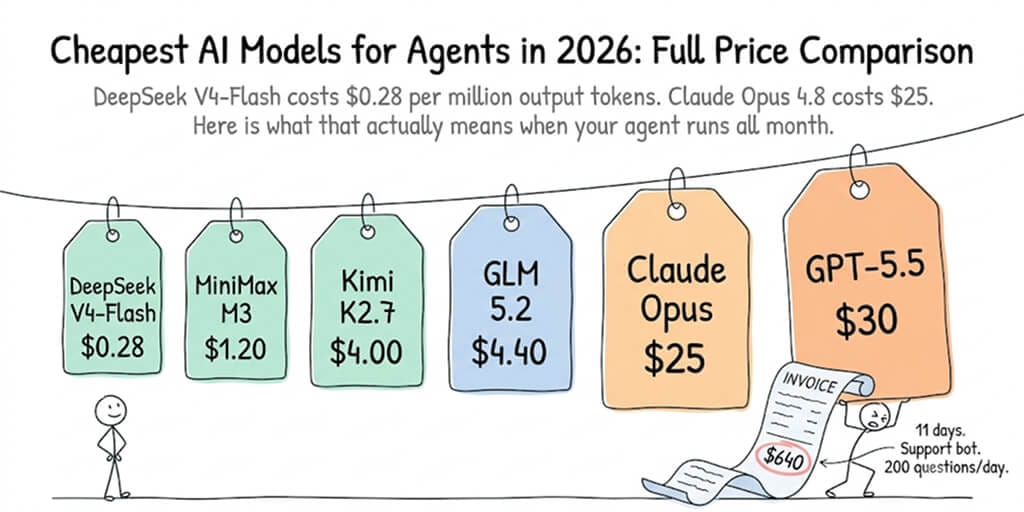
- The 20x Cost Delta: DeepSeek V4-Pro undercuts traditional frontier models by a factor of twenty, forcing an immediate compression of API pricing across the entire large language model (LLM) marketplace.
- The 2026 Competitive Landscape: The architectural hierarchy now features elite contenders—including Claude Opus 4.8, GPT-5.5, DeepSeek V4-Pro, and Qwen 3.6 Max-Preview—each vying for dominance in automated software refactoring, multi-file code generation, and complex debugging.
- Infrastructure & Margin Re-evaluation: Cloud providers and enterprise software giants are experiencing severe pressure on valuation multiples as high-margin proprietary tools face unprecedented open-market commoditization.
- Strategic Risk Mitigation: Organizations are rapidly adopting hybrid-model routing architectures to leverage ultra-low-cost inference for routine coding tasks while reserving high-cost frontier reasoning models exclusively for mission-critical system design.
The Catalytic Shift: Demystifying the 20x Cost Advantage
For years, the prevailing dogma within artificial intelligence research was that high reasoning capability required exponentially greater compute budgets, sprawling data centers, and massive capital expenditures. Western frontier labs built their business models on proprietary moats protected by massive GPU clusters and high-margin API billing structures. However, algorithmic innovations in mixture-of-experts (MoE) efficiency, speculative decoding, and optimized memory caching have shattered that assumption.
DeepSeek’s engineering breakthroughs did not happen in a vacuum. By completely re-architecting how attention mechanisms handle long-context codebases and pruning redundant parameters during active inference, the platform achieved a dramatic reduction in floating-point operations (FLOPs) per token. When developers evaluate the performance of DeepSeek V4-Pro against established titans like GPT-5.5 and Claude Opus 4.8 on complex repository-level programming benchmarks—such as SWE-bench and multi-language refactoring suites—the performance delta is often negligible, yet the financial delta is staggering.
This dramatic cost compression has immediate ramifications for corporate balance sheets. In global financial institutions, enterprise software houses, and high-growth fintech startups, developer productivity tools represent a massive operational expenditure. Sashing the cost of automated code generation, test-case synthesis, and legacy system modernization by 95% liberates capital for other strategic digital transformation initiatives, fundamentally altering corporate IT budgeting for the remainder of the decade.
Comparative Analysis: 2026 Coding Model Specifications
| Model Name | Primary Architectural Focus | Relative Cost Index | Context Window | Target Enterprise Use Case |
|---|---|---|---|---|
| DeepSeek V4-Pro | High-Efficiency MoE / Cost-Optimized Inference | 1x (Baseline) | 128k - 256k tokens | Massive codebase refactoring, high-volume CI/CD automation |
| GPT-5.5 | Advanced Agentic Reasoning & System Design | ~18x - 22x | 500k+ tokens | Enterprise-wide architecture, autonomous end-to-end software building |
| Claude Opus 4.8 | Nuanced Code Comprehension & Security Auditing | ~18x - 20x | 200k tokens | Deep vulnerability detection, complex legacy code migration |
| Qwen 3.6 Max-Preview | Multilingual Polyglot Synthesis & Optimization | ~12x - 15x | 256k tokens | Cross-platform deployment, multi-language enterprise apps |
Industry & Market Implications: Winners, Losers, and Capital Reallocation
The market reaction to DeepSeek’s cost-to-performance ratio has been swift and unforgiving. Publicly traded cloud compute providers and legacy enterprise software vendors have faced acute scrutiny from institutional investors. When a competitor can deliver 95% of the utility at 5% of the price, traditional software-as-a-service (SaaS) pricing models—often tethered to per-seat developer licenses or high-volume token consumption—face existential commoditization.
Who Wins?
- Agile Tech Startups & Scale-ups: Emerging software companies can now build, test, and ship enterprise-grade applications with a fraction of the venture capital funding previously required, democratizing advanced software engineering.
- Enterprise IT Buyers: Chief Information Officers gain immense leverage in vendor negotiations, successfully driving down the cost of internal developer tooling and accelerating digital transformation timelines.
- Hybrid Routing Infrastructure Providers: Companies specializing in intelligent middleware and router APIs—dynamically directing prompts to DeepSeek V4-Pro for routine tasks and routing to GPT-5.5 or Claude Opus 4.8 only for deep logic—are experiencing explosive market adoption.
Who Loses?
- High-Margin Proprietary API Monopolies: Firms that relied exclusively on uncompetitive, premium-priced API tiers to subsidize heavy R&D spending are forced into rapid, margin-crushing price matching.
- Legacy Outsourcing Firms: Traditional IT outsourcing models that rely on massive offshore developer headcounts for routine coding, maintenance, and bug-fixing face accelerated displacement by automated, ultra-low-cost AI pipelines.
Frequently Asked Questions (People Also Ask)
1. How does DeepSeek achieve a 20x lower cost for AI coding compared to Western frontier models?
DeepSeek leverages highly optimized mixture-of-experts (MoE) architectures, advanced hardware-software co-design, and algorithmic breakthroughs in speculative decoding. These innovations drastically reduce the active parameter footprint and floating-point operations required per token during inference, passing massive savings directly to the developer.
2. Does the lower cost of DeepSeek V4-Pro mean a compromise in code quality or security?
Independent developer evaluations and benchmark suites (such as SWE-bench) indicate that DeepSeek V4-Pro matches or closely approaches the coding accuracy of models costing twenty times more. While elite frontier models like GPT-5.5 and Claude Opus 4.8 still hold marginal advantages in ultra-complex, multi-step system architecture and obscure security vulnerability parsing, DeepSeek handles over 90% of everyday software engineering tasks with comparable reliability.
3. How are enterprise software teams adapting their infrastructure to this price disruption?
Enterprise engineering leaders are increasingly adopting intelligent model-routing layers. Instead of standardizing on a single expensive model, firms utilize ultra-low-cost engines like DeepSeek V4-Pro for automated unit testing, syntax refactoring, and routine boilerplate generation, while reserving high-cost frontier reasoning models strictly for critical security audits and foundational system design.
4. What role do models like Claude Opus 4.8 and GPT-5.5 play if DeepSeek is so much cheaper?
While cost is a critical enterprise metric, absolute frontier capability remains paramount for mission-critical applications where failure carries catastrophic financial or security risks. Models like Claude Opus 4.8 and GPT-5.5 continue to command market share due to their superior deep agentic reasoning, extraordinarily large context windows, and advanced alignment protocols tailored for highly regulated industries.
Future Outlook: What Comes Next in AI Software Engineering
As the industry moves deeper into 2026, the battleground for AI-assisted coding is shifting from raw model training to inference optimization, latency reduction, and autonomous software engineering agents. The historic 20x cost disparity exposed by DeepSeek marks the definitive end of the initial "brute-force compute" era of generative AI.
Moving forward, market liquidity and enterprise IT budgets will heavily favor open-weights accessibility, modular architectures, and multi-model orchestration platforms. For software engineers and technology executives, the mandate is clear: adapt to an ecosystem where compute is cheap, intelligence is ubiquitous, and competitive advantage belongs entirely to those who can integrate these hyper-efficient tools into resilient, scalable corporate workflows.