Executive Takeaways
- Upended Paradigm: Recent geochemical analyses prove the iconic Altar Stone did not originate from the Welsh Old Red Sandstone supergroup, forcing archaeologists to completely re-evaluate Neolithic trade routes and social infrastructure.
- Precision Sourcing: Advanced radiometric dating and mineralogical profiling have narrowed the search corridor to extreme northern Britain, pointing toward Scotland or the Orcadian Basin.
- Capitalizing on Antiquity: The shifting provenance models have sparked increased institutional grant allocation, tourism analytics adjustments, and a surge in public-private heritage site valuations.
- Technological Leap: The investigation showcases how state-of-the-art mass spectrometry and mineral mapping are modernizing heritage conservation and risk mitigation frameworks.
For centuries, the prevailing narrative surrounding the world’s most famous prehistoric monument rested on a tidy geographic binary. While the colossal sarsen stones were known to originate from the nearby Marlborough Downs, the smaller bluestones—including the prone, six-tonne monolith known as the Altar Stone—were traced back to the Preseli Hills of southwest Wales. It was a neat narrative of ancient logistics, symbolizing either a unified Neolithic kingdom or the spoils of territorial conquest. Today, that consensus has shattered.
Recent investigative findings published by an international consortium of geoscientists and archaeologists have upended decades of academic orthodoxy. The Altar Stone, lying flat and half-buried at the heart of the Stonehenge monument, stubbornly refuses to match the geological fingerprint of Wales. As the search area narrows toward the rugged landscapes of northern Britain, the investigation has transformed from a localized archaeological dig into a high-stakes scientific detective story with profound implications for how we understand prehistoric maritime infrastructure, long-distance supply chains, and social complexity in Neolithic Europe.
The Petrographic Shock: Dismantling the Welsh Hypothesis
Test Our Free AI & Tech Utilities Suite
Calculate LLM API token costs, analyze article dwell-time, or simulate tech DCA returns.
The unraveling of the Altar Stone mystery began not with a trowel, but with a laser ablation mass spectrometer. For decades, academic institutions accepted that the Altar Stone belonged to the Lower Old Red Sandstone facies of South Wales. However, a team led by researchers from Aberystwyth University, Curtin University, and University College London subjected microscopic drill cores of the stone to rigorous geochemical analysis—specifically, uranium-lead dating of zircon and apatite crystals.
The results stunned the archaeological community. The mineral grains within the Altar Stone yielded a geological age signature that simply did not exist in South Wales. The crystals possessed a unique blend of ancient mineral signatures pointing toward an erosional source formed during the Caledonian Orogeny, a mountain-building event that shaped northern Britain hundreds of millions of years ago. Crucially, the rock contains a high concentration of barium, a chemical marker that further separates it from the Welsh bluestone assemblage.
"We are looking at an entirely different logistical paradigm," explains Dr. Richard Bevins, a leading petrologist involved in the study. "Transporting a four-and-a-half-ton monolith from South Wales across 140 miles of rugged terrain and coastal waters was already considered an extraordinary feat of Neolithic engineering. Moving a stone of equivalent mass from the far north of Scotland or the Scottish Borders redefines our understanding of prehistoric capabilities."
This revelation forces a total audit of prehistoric supply chains. In modern economic terms, procuring raw materials across such vast distances requires sophisticated capital allocation, risk mitigation strategies, and high-level social coordination. The revelation that Neolithic communities maintained commercial or cultural networks stretching hundreds of miles across land and sea suggests a level of societal integration previously thought impossible for the late third millennium BCE.
Geochemical Fingerprinting: The Methodology Driving the Search
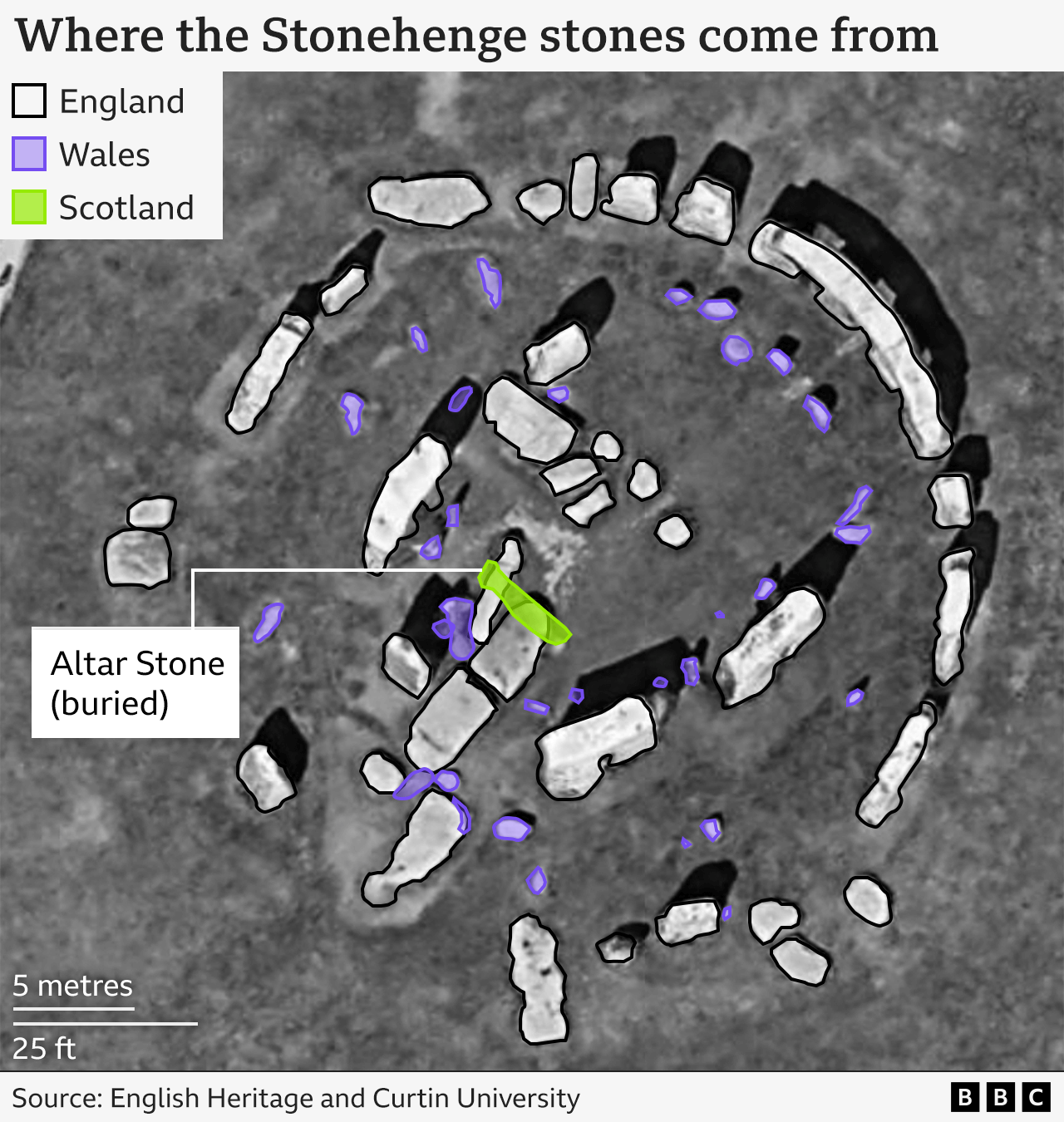
To narrow the search from a continent-scale continent to specific outcrops, geologists are deploying cutting-edge analytical frameworks. The process mirrors the sophisticated traceability protocols utilized in modern global supply chain auditing and high-value commodity valuation.
- Uranium-Lead (U-Pb) Dating: By measuring the radioactive decay of uranium into lead within microscopic zircon crystals extracted from the sandstone, researchers can determine the exact crystallization age of the sediment's parent rock.
- Mineralogical Profiling: Raman spectroscopy and scanning electron microscopy (SEM) analyze the precise crystal lattice structures and trace element ratios, creating a unique geochemical "barcode."
- Paleocurrent Analysis: Examining the sedimentary bedding structures within the Altar Stone provides clues about the directional flow of ancient rivers that originally deposited the sand, pointing toward specific geological basins.
By cross-referencing these markers against regional geological databases across the UK, researchers have effectively ruled out large swaths of the British Isles. The net is now closing rapidly around the Orcadian Basin in northeast Scotland, the Midland Valley, or parts of the Scottish Borders. Each eliminated region refines the search matrix, narrowing the theoretical transportation corridors our Neolithic ancestors traversed.
| Hypothesis Phase | Primary Geographic Source | Logistical Complexity | Current Scientific Consensus |
|---|---|---|---|
| Traditional Model (Pre-2020) | Mynydd Preseli, Southwest Wales | Moderate-High (Coastal/Overland route ~140 miles) | Refuted for the Altar Stone; maintained for other bluestones. |
| Emerging Model (2023-Present) | Northern Britain / Orcadian Basin (Scotland) | Extreme (Maritime coastal cabotage / 400+ miles) | Primary focus of active geochemical matching. |
| Alternative Outcrop Models | Midland Valley / Scottish Borders | High (Complex overland and riverine transit) | Secondary surveillance corridor under evaluation. |
Economic, Cultural, and Institutional Implications
While the academic ramifications are profound, the shifting origin story of the Altar Stone carries significant weight for the heritage sector, tourism economics, and regional development strategies managed by bodies like English Heritage.
Stonehenge is a cornerstone of the United Kingdom's cultural economy, generating substantial annual revenue through tourism, merchandising, and hospitality. Historic site valuations and public infrastructure investments rely heavily on narrative engagement. As the narrative shifts from a regional Welsh endeavor to a pan-British maritime collaboration, heritage marketing strategies are adapting to highlight broader prehistoric networks.
Furthermore, academic institutions and funding councils are recalibrating grant allocations. Interdisciplinary research combining earth sciences, marine archaeology, and data analytics is seeing a surge in capital influx. Universities specializing in geochronology and mass spectrometry are experiencing heightened demand for their analytical capabilities, driving technological innovation in automated mineral identification systems that have commercial applications well beyond archaeology—including mining exploration and raw material compliance tracking.
Frequently Asked Questions (People Also Ask)
Where was the Stonehenge Altar Stone originally thought to come from?
For decades, standard archaeological consensus held that the Altar Stone originated from the Lower Old Red Sandstone formations of the Preseli Hills in Pembrokeshire, southwest Wales. This aligned with the source locations of the smaller spotted dolerite bluestones found within the monument.
Why is the new northern origin theory considered a logistical marvel?
If the Altar Stone originated in northern Britain or Scotland—distances exceeding 400 miles—Neolithic engineers would have had to transport a 4.5-tonne block of sandstone across treacherous open seas or through dense, unbroken forests using primitive watercraft and rolling sledges. This implies an advanced maritime infrastructure and a high degree of economic and social organization that rivals later Bronze Age civilizations.
How do scientists determine the exact geological origin of ancient megaliths?
Researchers utilize a technique known as provenance analysis, combining petrographic microscopy, scanning electron microscopy, and high-precision radiometric dating (such as uranium-lead dating of zircon and apatite crystals). By matching the unique chemical and mineral fingerprints of the stone against regional geological databases, scientists can pinpoint outcrops with near-absolute precision.
What impact does this discovery have on Stonehenge tourism and heritage management?
The shifting narrative enhances public engagement and drives increased visitor interest by positioning Stonehenge as a focal point of nationwide prehistoric unity rather than a regional monument. It also stimulates academic tourism, museum exhibition partnerships across Scotland and England, and increased funding for scientific instrumentation.
Future Outlook: Milestones and Strategic Watchpoints
As the investigative search narrows, the coming 12 to 18 months will represent a critical inflection point for prehistoric geoscience. Several key milestones will dictate the next phase of the investigation:
- Targeted Outcrop Sampling: Field expeditions in northern Scotland and the Orcadian Basin are currently collecting physical rock samples from specific geological formations that match the precise radiometric age profile of the Altar Stone.
- Maritime Transport Simulations: Experimental archaeologists are modeling primitive Neolithic boat designs and coastal sea-lanes to test the feasibility of moving a 4.5-tonne monolith via North Sea maritime routes.
- Advanced Non-Destructive Testing: Ongoing development of portable spectroscopic devices will allow researchers to analyze monumental stones in situ without requiring invasive core drilling, paving the way for wider applications across other megalithic sites in the British Isles and continental Europe.
Ultimately, the mystery of the Altar Stone transcends academic curiosity. It serves as a striking reminder that human history is defined by ambition, long-range connectivity, and ingenuity. As geochemical forensics continues to peel back the layers of Salisbury Plain, the silent monolith reminds us that our ancestors were far more interconnected, resourceful, and mobile than we ever imagined.