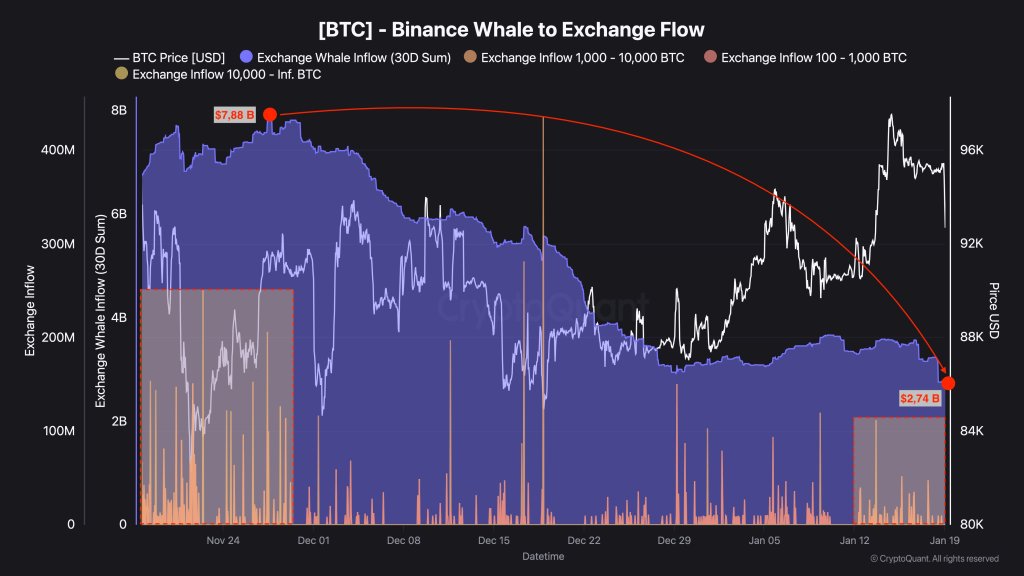
The cryptocurrency market's fragile recovery met a harsh reality check this week as a sudden wave of capital flight rattled the ecosystem's foundational infrastructure. A promising Bitcoin price bounce abruptly lost momentum, stalling out near key technical resistance levels, just as on-chain analytics and exchange data revealed that Binance—the world’s dominant digital asset exchange by volume—processed an astonishing $6 billion in net outflows within a compressed 72-hour window.
The capital exodus began shortly after the platform initiated a fresh wave of large-scale user withdrawals, triggering immediate anxiety across global trading desks. For institutional asset managers, risk officers, and retail participants alike, the sudden drainage of capital served as an acute reminder of systemic counterparty risk, market liquidity fragmentation, and the perpetual fragility of centralized exchange (CEX) reserves. As macroeconomic headwinds collide with shifting regulatory compliance frameworks, this unfolding crisis forces a rigorous reassessment of capital allocation strategies across the digital asset class.
Executive Takeaways
Test Our Free AI & Tech Utilities Suite
Calculate LLM API token costs, analyze article dwell-time, or simulate tech DCA returns.
- Massive Capital Flight: Binance recorded approximately $6 billion in net outflows over a 72-hour period following a surge in user-initiated asset withdrawals.
- Bitcoin Rally Stalled: The sudden liquidity contraction abruptly halted Bitcoin's upward price momentum, turning a technical market bounce into a defensive consolidation phase.
- Ecosystem-Wide Risk Mitigation: Institutional desks and market makers rapidly adjusted their risk mitigation protocols, prioritizing self-custody solutions and decentralized liquidity pools.
- Regulatory & Valuation Pressures: The incident intensifies scrutiny regarding exchange reserve transparency, infrastructure scalability, and the long-term valuation multiples of centralized trading platforms.
The Anatomy of a Liquidity Squeeze: Background and Catalytic Events

To understand the gravity of the current $6 billion outflow event, one must examine the delicate state of global market liquidity entering the final quarters of the fiscal year. Digital asset markets had spent weeks attempting to stage a sustainable relief rally, driven by speculative optimism surrounding macroeconomic pivot expectations and institutional ETF inflows. However, these valuation multiples remained highly sensitive to underlying structural health.
The catalytic event unfolded in real-time as on-chain intelligence platforms began tracking abnormal transaction volumes moving out of Binance’s cold and hot wallet infrastructure. While routine withdrawal spikes are common during periods of high market volatility, the sheer velocity and scale of this movement far exceeded historical norms. As users rushed to secure their assets—prompted by a mix of macroeconomic jitters, localized regulatory rumors, and heightened self-custody awareness—the platform processed the transactions without halting operations, yet the secondary effects on broader market sentiment were immediate.
When the world’s primary liquidity hub experiences a multi-billion-dollar bleeding of assets, the shockwaves travel rapidly through global order books. Market makers, who rely on seamless cross-exchange arbitrage and deep capital pools to maintain tight bid-ask spreads, were forced to deleverage rapidly. This capital contraction directly choked off the buying pressure required to sustain Bitcoin's technical breakout, causing the asset to reverse course and test lower support levels.
Verified Data and Metrics Breakdown
A quantitative assessment of the event highlights the scale of the capital shift away from centralized intermediaries:
| Metric / Indicator | Pre-Event Baseline | Current Status (Post-Outflow) | Market Impact |
|---|---|---|---|
| Binance Net Outflows | Normal daily variance ($200M - $500M) | ~$6 Billion over 72 hours | Severe liquidity redistribution |
| Bitcoin Price Action | Upward channel / Testing resistance | Momentum stalled, range-bound | Bullish continuation pattern invalidated |
| Exchange Reserve Balances | Stable multi-chain holdings | Measurable contraction across major assets | Reduced immediate spot sell pressure |
| Derivatives Open Interest | Leveraged expansion | Aggressive long liquidation wave | Deleveraging of speculative positions |
Industry & Market Implications: Winners, Losers, and Economic Fallout
The fallout from Binance’s $6 billion outflow extends far beyond a single trading platform, reshaping the competitive landscape of the digital asset economy.
Who Wins?
Decentralized finance (DeFi) protocols, self-custody hardware wallet manufacturers, and alternative regulated custodians emerge as the immediate beneficiaries of this capital flight. As institutional and retail users prioritize enterprise-grade risk mitigation, non-custodial solutions and decentralized exchanges (DEXs) are seeing a surge in transactional volume and total value locked (TVL). Furthermore, institutional-grade custodians offering segregated cold storage solutions are capturing capital from entities fleeing exchange risk.
Who Loses?
Centralized exchanges relying heavily on high retail trading velocity face immediate headwinds. Not only do massive outflows impair day-to-day market liquidity, but they also trigger intense regulatory scrutiny regarding reserve health and cloud compute architecture scalability under stress. Furthermore, speculative traders caught on the wrong side of the leveraged Bitcoin sell-off experienced severe capital destruction as liquidity vanished from order books.
Broader Economic and Macro Impact
From a macroeconomic perspective, this event underscores the fragile interplay between digital asset valuations and structural market plumbing. When capital allocation shifts abruptly from centralized pools to fragmented self-custody environments, price discovery becomes more volatile. Enterprise investors managing digital asset treasury allocations are increasingly factoring these systemic liquidity risks into their cost of capital equations, prompting a structural demand for more robust auditing and real-time proof-of-reserves verification.
Frequently Asked Questions (People Also Ask)
Why did Binance experience $6 billion in outflows so suddenly?
The outflows were catalyzed by a combination of heightened user risk-aversion, localized regulatory headlines, and defensive capital repositioning. As market participants moved to secure their digital assets into self-custody, the cumulative volume scaled rapidly over a 72-hour window, testing the platform's immediate asset turnover capabilities.
How did the Binance outflows directly impact Bitcoin's price?
The massive withdrawal of capital created immediate friction in spot market liquidity. As market makers and arbitrage desks rushed to rebalance their books and deleverage, the buying momentum required to sustain Bitcoin's price rally evaporated, causing the asset to stall out near major technical resistance levels.
Are user funds safe on Binance following these massive withdrawals?
Despite the high-volume capital flight, Binance processed the requested withdrawals without reported insolvency issues, maintaining that user funds remain backed 1:1. However, the event has amplified calls for enhanced regulatory compliance and continuous, transparent cryptographic verification of all exchange reserves.
What does this mean for the future of centralized exchanges (CEXs)?
This incident accelerates a structural evolution within the cryptocurrency exchange sector. Platforms are being forced to upgrade their infrastructure scalability, implement more rigorous real-time proof-of-reserves mechanisms, and adapt to a market environment where institutional clients demand institutional-grade risk mitigation and asset segregation.
Future Outlook: Key Milestones to Watch
As the digital asset market digests the $6 billion liquidity shock, industry observers and financial analysts will be monitoring several critical indicators over the coming quarters:
- Proof-of-Reserves Audits: Independent, cryptographically verified third-party audits confirming the true composition and health of exchange balance sheets.
- Self-Custody Adoption Metrics: Sustained growth in hardware wallet sales and non-custodial wallet active addresses, signaling a permanent shift in retail and institutional storage habits.
- Regulatory Enforcement Actions: Potential policy updates from global financial watchdogs regarding centralized intermediary reserve requirements and capital adequacy standards.
- Derivatives Market Recovery: The return of healthy, organic open interest and stable funding rates across perpetual swap markets, indicating that leverage has fully reset following the recent liquidation cascade.
Ultimately, while the immediate fading of the Bitcoin bounce has frustrated short-term speculators, the underlying infrastructure stress test serves as a vital maturation milestone for the entire digital asset ecosystem. Capital allocation strategies are shifting decisively toward security, transparency, and resilience, setting the stage for a more robust—albeit more cautious—market cycle ahead.