Executive Takeaways
- The Paradigm Shift to Autonomous Execution: By mid-2026, enterprise technology spending has pivoted decisively from passive generative text interfaces to goal-directed, multi-step autonomous AI agents capable of executing complex workflows with minimal human oversight.
- Substantial CapEx and Margin Impact: Early enterprise adopters report a 25% to 40% reduction in operational execution costs across core enterprise resource planning (ERP), IT infrastructure, and financial reconciliation domains.
- Legacy SaaS Disruption: Traditional per-seat software-as-a-service (SaaS) business models face structural margin compression as outcome-based, agentic orchestrators replace human-driven software interaction layers.
- Strict Governance Architecture: Leading Chief Information Officers (CIOs) are deploying "human-in-the-loop" constraint boundaries and deterministic validation gates to prevent autonomous agent hallucinations from impacting critical capital allocation and compliance protocols.
For the past three years, the enterprise software ecosystem was dominated by text-generation tools and conversational copilot interfaces that required constant human prompting. As of mid-2026, that passive operational model has collapsed into technological obsolescence. A profound architectural transition is underway across Global 2000 corporations: the deployment of goal-driven, stateful, and tool-using Agentic AI platforms.
Unlike standard Large Language Models (LLMs) that merely predict next tokens to draft emails or answer internal queries, agentic systems evaluate multi-step objectives, reason through contingent logic, query external application programming interfaces (APIs), continuously inspect intermediate outcomes, and execute transactional workflows across distributed software stacks. Driven by advancements in long-context memory retrieval, dynamic tool binding, and low-latency inference hardware, enterprise IT organizations are now deploying autonomous AI agents by the thousands.
Data from chief information officers indicates that while raw foundation model pricing continues its deflationary path, total enterprise allocation toward agentic orchestration infrastructure, vector-graph databases, and autonomous governance frameworks has expanded at an estimated 68% compound annual growth rate. The central enterprise question is no longer whether AI can generate text, but how efficiently autonomous agents can execute critical business workflows while maintaining enterprise-grade safety boundaries.
The Operational Architecture: How Autonomous Agents Work in the Enterprise Stack
The enterprise agentic stack represents a fundamental departure from monolithic applications. At its base layer sits modern foundation models optimized for function calling and high-speed reasoning loops—such as ReAct (Reason + Act) and Plan-and-Solve frameworks. Above these models lies the Agentic Orchestration Layer, which acts as the operational brain controlling four critical sub-components:
- Touchpoints & Integration Wrappers: Deep API gateways connecting the agentic controller to legacy databases, mainframe transaction monitors, cloud enterprise resource planning systems (SAP, Oracle), and operational SaaS platforms (Salesforce, ServiceNow).
- Stateful Memory Engines: Combined long-term vector memory and temporal graph databases that allow agents to retain historical context, compliance boundaries, and user preferences across multi-day execution timelines.
- Tool Use and Dynamic Code Execution Sandbox: Isolated computational environments where agents dynamically generate and execute code, parse unstructured payloads, and run transactional scripts safely.
- Verification & Governance Guardrails: Deterministic validation layers that evaluate the safety, compliance, and economic risk of an agent’s proposed action before committing transactions to production databases.
11 Promising Enterprise Use Cases for Agentic AI

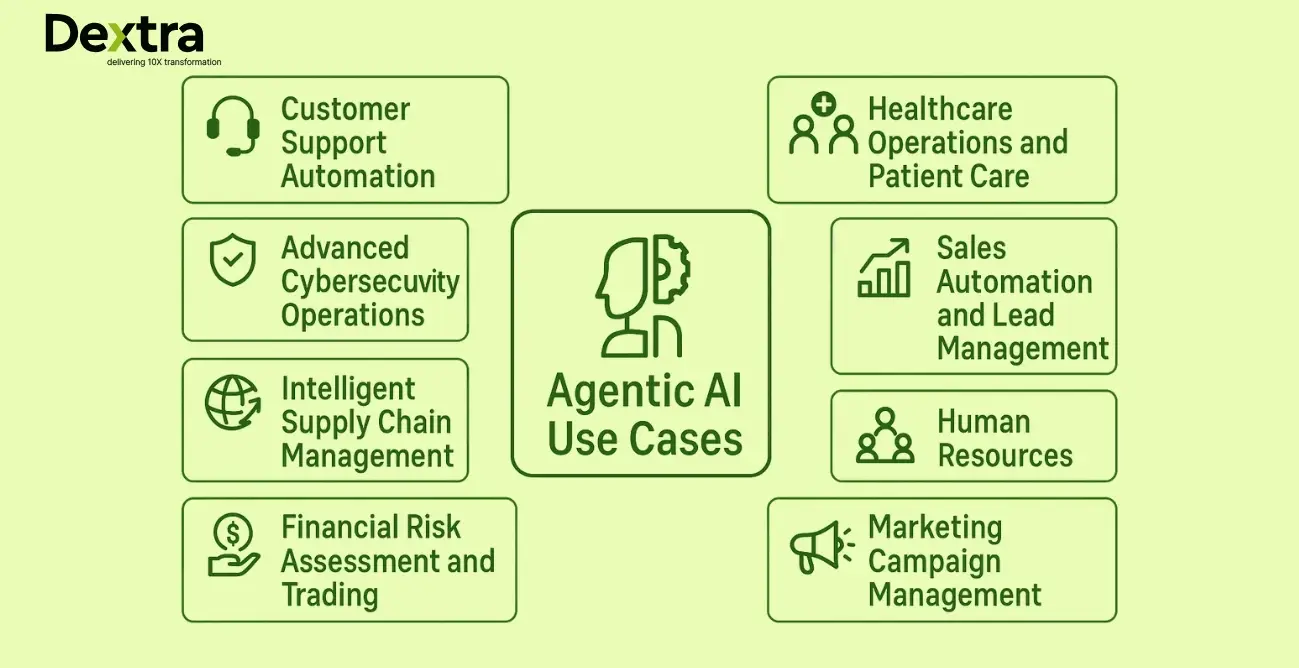
Across major industry verticals—including financial services, logistics, healthcare, energy, and retail—CIOs and Chief Technology Officers (CTOs) are prioritizing 11 concrete, high-return agentic use cases designed to unlock structural operational efficiencies.
1. Autonomous Supply Chain Orchestration and Dynamic Rerouting
Traditional supply chain software alerts human operators to bottlenecks but lacks execution authority. Agentic AI platforms continuously monitor global logistics feeds, weather systems, port telemetry, and supplier inventories. When disruptions occur, agents autonomously re-calculate lead times, issue purchase orders to pre-vetted alternative vendors, re-allocate warehouse inventories, and update freight customs documentation without requiring manual human intervention for sub-threshold capital limits.
2. Real-Time IT Infrastructure Auto-Healing and Incident Remediation
Modern cloud environments generate petabytes of telemetry data. Rather than routing alerts to human DevOps engineers, autonomous infrastructure agents execute end-to-end incident response. When anomaly spikes occur, the agent traces dependencies through distributed microservices, isolates the faulty deployment, generates and tests a rollback or hotfix in an isolated sandbox, applies the patch, and validates operational health within seconds, dropping mean-time-to-resolution (MTTR) by up to 80%.
3. Hyper-Automated Financial Reconciliation and Treasury Optimization
Corporate finance departments spend tens of thousands of hours reconciling cross-border cash flows, intercompany billing, and complex derivative ledgers. Agentic financial systems parse unstructured invoices, match multi-currency transactions across disparate global banking portals, identify discrepancies, interact directly with vendor accounts payable systems via email or API to request corrections, and execute dynamic liquidity transfers to maximize overnight treasury yields.
4. Dynamic Multi-Touchpoint Customer Operations Resolution
Transitioning far beyond basic chatbots, agentic customer service platforms hold end-to-end operational authority. When a customer contacts an enterprise regarding an order cancellation or warranty adjustment, the agent verifies customer authentication, calculates lifetime value metrics, adjusts transaction logs in the backend CRM, issues refunds, processes return shipping labels, and updates warehouse dispatch queues in a single, unassisted session.
5. Continuous Regulatory Compliance Auditing and Policy Enforcement
Navigating evolving international regulatory regimes—such as the European Union AI Act, SEC reporting updates, and stringent cross-border data privacy standards—demands exhaustive review. Autonomous compliance agents ingest newly published statutory texts, dynamically scan internal corporate repositories and transaction logs for non-compliant practices, compile real-time risk matrices, and auto-generate corrective pull requests or policy adjustments for legal board approval.
6. Autonomous Procurement and Vendor Contract Negotiation
For mid-tier procurement tasks, enterprise agents interact directly with vendor sales agents via protocol-driven channels. Procurement agents evaluate historic pricing models, analyze dynamic market commodity prices, negotiate service-level agreements (SLAs) within CFO-approved quantitative ranges, finalize contractual redlines using verified legal templates, and submit execution-ready documentation to executive signatories.
7. Algorithmic Cyber Threat Hunting and Zero-Day Patching
Threat landscapes evolve faster than human security operations centers (SOCs) can respond. Autonomous cyber defense agents proactively deploy counter-deception networks, analyze incoming telemetry for zero-day exploitation signatures, isolate infected endpoint instances, autonomously craft temporary micro-segmentation firewall rules, and compile comprehensive forensic audit trails for insurance underwriters.
8. Automated R&D and Clinical Trial Protocol Optimization
In life sciences and biotechnology, agentic AI platforms analyze vast biomedical research corpora, generate target hypothesis sets, design optimal clinical trial protocol frameworks, query patient recruitment databases, and adjust trial variables dynamically based on real-time participant biomarker responses, collapsing drug discovery timelines significantly.
9. Hyper-Personalized B2B Sales Orchestration and Proposal Structuring
Enterprise B2B sales cycles involve extensive pre-call research, customized proposal generation, and technical pricing matrix compilation. Autonomous sales agents systematically track target corporate prospect filings, monitor executive turnover, generate tailored dynamic software demonstrations, formulate custom pricing tier sheets matching prospect budgetary profiles, and maintain ongoing multi-channel prospective account nurturing.
10. Autonomous Enterprise Knowledge Synthesis and Graph Maintenance
Corporate data lakes routinely devolve into unorganized, fragmented silos. Knowledge synthesis agents continuously scan internal communications platforms (Slack, Teams), document repositories, codebases, and ticketing systems. They curate and reconcile contradictory internal operational documentation, update enterprise-wide knowledge graphs, and push concise contextual briefings to executives ahead of strategic planning sessions.
11. HR Talent Acquisition, Onboarding, and Adaptive Workforce Planning
In human capital management, agents streamline talent discovery by sourcing candidates based on verified skill sets, conducting initial technical interactive evaluations, scheduling cross-functional panel interviews, generating compliant employment offers, and provisioning network security access, hardware setups, and individualized training curricula prior to a new employee's first day.
Quantitative Assessment of Enterprise Agent Deployments
To quantify the financial and operational impact of these implementations, enterprise performance metrics across early deployments in mid-2026 reveal clear divergence in return on investment (ROI) and risk profiles:
| Enterprise Domain | Average ROI Realization Window | Operating Expense (OpEx) Efficiency Gain | Primary Enterprise Deployment Barrier | Target Human Oversight Model |
|---|---|---|---|---|
| IT Infrastructure & DevOps | 3 to 6 Months | 35% – 50% | Legacy System API Gaps | Human-on-the-Loop (Exception Based) |
| Financial Treasury & Audit | 6 to 9 Months | 25% – 40% | Strict Regulatory & Audit Risk | Human-in-the-Loop (Threshold Bound) |
| Supply Chain & Logistics | 9 to 12 Months | 20% – 35% | External Vendor Interoperability | Human-on-the-Loop (Sub-Threshold) |
| Cyber Security Defense | 1 to 3 Months | 40% – 60% | False Positive Interruption Risk | Autonomous with Post-Facto Audit |
| Customer Operations | 3 to 6 Months | 30% – 45% | Customer Experience Preservation | Human Escalation Fallback |
Market Implications: Economic Winners, Losers, and Structural Re-valuations
The institutional enterprise pivot toward agentic execution is drastically re-ordering the capital valuation of publicly traded and private technology firms alike:
The Enterprise Winners
- Hyperscale Cloud & Infrastructure Providers: The compute density required to support persistent multi-agent reasoning cycles (often involving dozens of model calls per single task execution) drives unprecedented demands on inference compute. Operators of scale cloud data centers equipped with specialized accelerator clusters are capturing expanding infrastructure margins.
- Domain-Specific API and Orchestration Platforms: Vendors offering robust, secure agent orchestration frameworks, tool-binding middleware, and vector-graph memory infrastructure are witnessing rapid valuation multiple expansion.
- First-Mover Enterprises: Capital-efficient corporations that aggressively automate middle-office transactional complexity are expanding EBITDA margins faster than legacy competitors, freeing up operational capital to reinvest in core product development.
The Enterprise Losers
- Legacy Seat-Based SaaS Vendors: Software companies that monetize based on human user headcount face structural revenue headwinds. As AI agents replace human seats operating front-end interfaces, software spend shifts from per-user license fees to transaction- or value-based operational pricing models.
- Unintegrated Business Process Outsourcing (BPO) Providers: Pure-play labor arbitrage firms that relied on low-cost human capital for manual data entry, customer service, and basic financial reconciliation are experiencing structural contract cancellations unless they rapidly pivot to managing agentic workflows.
Frequently Asked Questions (People Also Ask)
What is the core technical difference between Generative AI and Agentic AI?
Generative AI operates primarily as an input-output system, generating text, code, or images based on direct user prompts in a single execution pass. Agentic AI, by contrast, operates with dynamic autonomy. Given an overarching objective (e.g., "reduce supply chain freight costs by 5% this quarter"), an agentic system formulates a multi-step execution plan, selects and utilizes external tools via APIs, monitors intermediate results, adjusts its strategy dynamically when encountering errors, and executes stateful transactional actions autonomously within established parameters.
How do enterprise CTOs mitigate hallucination and runaway execution risks in AI agents?
CTOs mitigate operational risk through multi-layered governance architectures. These include deterministic programmatic boundaries (e.g., hard-coded financial transaction limits requiring human sign-off), isolated sandbox execution environments for generated code, state-verification micro-agents that evaluate primary agent proposals against company policy before database execution, and strict immutable logging protocols for post-facto compliance auditing.
Will seat-based software pricing survive the transition to agentic workflows?
The traditional seat-based software pricing model is undergoing significant market pressure. As enterprise clients deploy AI agents that execute tasks across software stacks directly via APIs, human user seat counts naturally shrink. In response, software vendors are shifting pricing frameworks toward outcome-based metrics, value-based transaction fees, or consumption-based compute and token metrics.
What infrastructure is required to support agentic AI at enterprise scale?
Enterprise-scale agentic AI requires a modernized, low-latency stack consisting of high-speed LLM inference clusters (optimally hosting function-calling models), robust API integration gateways, persistent low-latency stateful vector and graph databases for long-term memory retrieval, dynamic code execution sandboxes, and centralized observability platforms designed to monitor agent reasoning paths, latency, token consumption, and safety guardrails.
Future Outlook: The Emerging Agent-to-Agent Economy
As enterprises mature their internal agentic deployments throughout the remainder of 2026 and into 2027, the next frontier is the development of secure Agent-to-Agent (A2A) protocol ecosystems. In this impending operational environment, corporate boundaries will become permeable to algorithmic interaction. An enterprise customer's procurement agent will directly negotiate terms, SLA specifications, and pricing matrices with a supplier’s sales agent over authenticated, zero-trust cryptographic channels—executing legally binding contracts in fractions of a second.
For executive leadership teams, the mandate is unambiguous: transition organizational architecture from human-centric software interaction to agentic workflow orchestration. Enterprises that successfully navigate this structural migration stand to capture structural operational margin advantages that could prove insurmountable for legacy competitors in the decade ahead.