Executive Takeaways
Test Our Free AI & Tech Utilities Suite
Calculate LLM API token costs, analyze article dwell-time, or simulate tech DCA returns.
- Capital Allocation Shift: Fortune 500 Chief Information Officers and Chief Financial Officers have pivoted from speculative AI trials to deeply embedded, agentic Enterprise Resource Planning (ERP) integrations, unlocking between 18% and 34% in structural operational expenditure (OpEx) efficiencies.
- Autonomous Execution over Assistive Dashboards: The paradigm has shifted from passive predictive analytics to agentic workflows capable of executing touchless accounts payable, autonomous supply chain rerouting, and real-time capital deployment within fixed risk parameters.
- Valuation Multiples & Vendor Lock-in: Enterprise software leaders—led by SAP, Oracle, and Microsoft—are leveraging embedded foundation models to accelerate legacy-to-cloud migrations, creating high-margin annuity streams while penalizing organizations burdened by legacy technical debt.
- Regulatory Governance & Deterministic Auditability: As cross-border compliance demands intensify under the EU AI Act and SEC real-time disclosure rules, enterprise architectures are adopting hybrid models that isolate probabilistic Large Language Models (LLMs) from deterministic core ledgers.
The Autonomous Enterprise Architecture: A Strategic Imperative
The global enterprise software ecosystem has reached a definitive inflection point. For nearly four decades, Enterprise Resource Planning (ERP) platforms functioned as transactional systems of record—rigid, relational databases requiring manual data entry, human verification, and batch-processed reconciliation. Today, the convergence of domain-tuned foundational models, agentic orchestrators, and real-time cloud data fabrics has transformed the ERP into an autonomous system of intelligence.
According to primary wire analysis from AIMultiple and proprietary market intelligence, enterprise capital allocation toward AI-driven ERP modernization reached an unprecedented high in mid-2026. Global organizations are no longer evaluating AI based on abstract productivity metrics; they are measuring implementation velocity against working capital optimization, cash conversion cycles (CCC), and Return on Invested Capital (ROIC). By bridging legacy operational silos, autonomous ERP networks are eliminating friction across complex supply chains and global treasury operations.
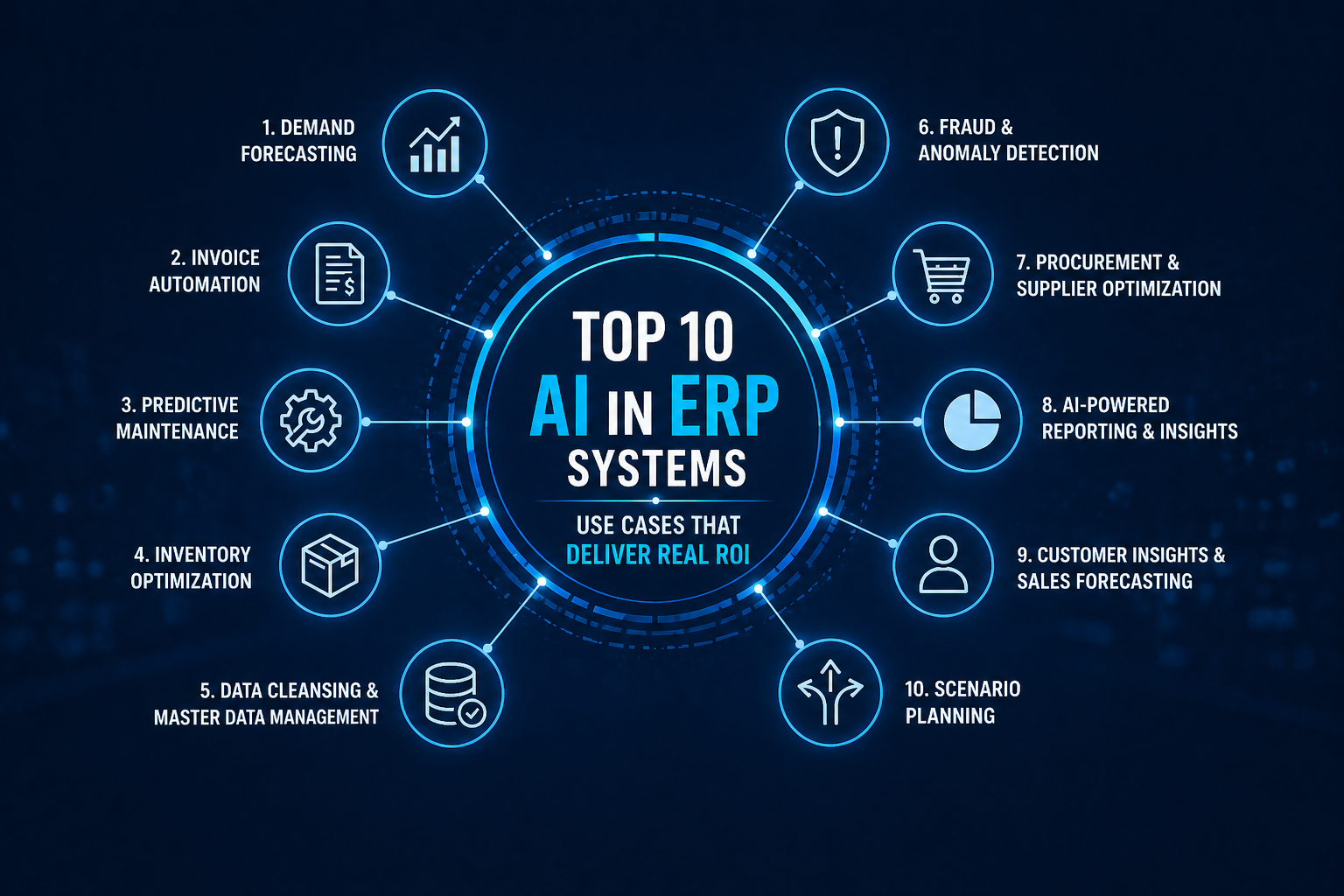
Top 10 High-Impact ERP AI Use Cases & Corporate Case Studies
1. Touchless Accounts Payable & Invoice Processing
Legacy accounts payable operations remain notoriously labor-intensive, plagued by manual keying errors, multi-way matching delays, and document variance. AI-native ERP architectures deploy multi-modal vision-language models (VLMs) and natural language processing (NLP) pipelines to ingest unstructured invoices across hundreds of formats, languages, and tax jurisdictions.
Case Study: Siemens AG. Integrating specialized extraction networks into their SAP S/4HANA core, Siemens automated invoice intake across international business units. The system matches POs, line-item metadata, and bill-of-lading documents with 99.4% accuracy, reducing touchless processing cycle times from 7 days to under 4 minutes and generating an estimated $42 million in annual administrative savings.
2. Predictive Industrial Asset Maintenance & Telemetry Integration
Unplanned machinery downtime directly erodes gross margins in asset-heavy industries. By harmonizing IoT edge sensor data with historical work orders and maintenance logs in the ERP, machine learning algorithms forecast component failure vectors days before critical breakdown events occur.
Case Study: Caterpillar Inc. Leveraging Oracle Fusion Cloud ERP connected to edge telemetry via MindSphere, Caterpillar deployed predictive maintenance algorithms across its industrial manufacturing plants. The AI continuously evaluates thermal and vibration signatures against spare-parts inventory levels. The system automatically issues purchase orders and schedules maintenance shifts, slashing unplanned factory downtime by 31% and lowering inventory carrying costs for redundant replacement components by 18%.
3. Autonomous Financial Closing & Continuous Accounting
The traditional month-end financial close is a stressful, multi-week exercise in manual reconciliation, ledger adjustments, and variance analysis. Generative AI agents continuously scan general ledgers, sub-ledgers, and intercompany transactions, autonomously identifying anomalies, suggesting journal entries, and executing real-time account reconciliations.
Case Study: General Electric (GE). GE implemented Workday and BlackLine AI engines operating atop its core ledger structure to perform continuous anomaly detection. The system flags balance sheet discrepancies instantly rather than at month-end. This reduced GE’s global financial closing cycle from 9 business days to 2.5 days, liberating thousands of accounting hours for strategic treasury analysis and capital allocation planning.
4. Dynamic Demand Forecasting & Multi-Echelon Inventory Optimization
Traditional demand forecasting models rely on backward-looking historical sales data, leaving supply chains vulnerable to demand shocks and inflationary spikes. Advanced neural time-series architectures process internal ERP transaction histories alongside macro-economic variables, freight indices, local weather patterns, and real-time point-of-sale signals.
Case Study: Unilever. Utilizing Microsoft Dynamics 365 Copilot and enterprise data platforms, Unilever deployed neural demand forecasting across its fast-moving consumer goods (FMCG) portfolio. The model dynamically balances safety stock across regional distribution centers, achieving a 16% reduction in excess inventory carrying costs while improving order fill rates by 420 basis points during volatile market demand shifts.
5. Intelligent Procurement & Dynamic Vendor Risk Scoring
Global enterprise procurement requires constant evaluation of supplier solvency, geopolitical exposure, regulatory compliance (including ESG mandates), and price volatility. Natural language agents monitor global news feeds, trade registry updates, and sanction lists, correlating external threat vectors directly with the ERP supplier directory.
Case Study: Airbus SE. By deploying Coupa AI natively connected to its SAP platform, Airbus continuously audits over 12,000 tier-one and tier-two suppliers. When potential insolvency or regional geopolitical risk emerges, the system dynamically recalculates procurement risk scores and automatically proposes alternate pre-vetted suppliers, reducing supply-chain disruption mitigation times from weeks to under two hours.
6. Automated Revenue Recognition & Contract Intelligence
Enforcing compliance with complex accounting standards such as ASC 606 and IFRS 15 requires extensive manual review of commercial contracts, milestone delivery schedules, and variable consideration clauses. Retrieval-Augmented Generation (RAG) frameworks parse multi-page master service agreements (MSAs) and construct compliant revenue schedules within the finance module.
Case Study: Salesforce Inc. Operating on its own internal enterprise architecture coupled with custom LLM extraction pipelines, Salesforce automated contract intelligence for enterprise software agreements. The system extracts performance obligations, termination options, and customized discount structures, auto-generating revenue schedules with minimal human intervention and maintaining 100% audit readiness during regulatory reviews.
7. Predictive Customer Churn & Autonomous Order Orchestration
Customer Relationship Management (CRM) and ERP integration often suffers from latency, leading to lost cross-selling opportunities and delayed fulfillment. Machine learning models within the ERP calculate real-time customer health scores by evaluating order frequencies, payment promptness, customer support tickets, and pricing elasticity.
Case Study: Cisco Systems. Cisco integrated predictive customer intelligence models across its SAP and Salesforce ecosystem. The system flags accounts demonstrating early signals of churn—such as declining API usage or delayed payments—and automatically triggers customized retention offers or alternate payment schedules, improving client renewal retention rates by 8.5 percentage points annually.
8. Workforce Planning & Algorithmic Capacity Management
Human capital constitutes the largest operating expense for professional services and technology enterprises. AI-enabled Human Capital Management (HCM) sub-modules within ERP systems analyze current project pipelines, billable utilization, and skill matrices to model future headcount requirements and dynamically match staff to incoming client engagements.
Case Study: Accenture plc. Utilizing Workday Adaptive Planning enhanced with proprietary machine learning models, Accenture continuously optimizes assignment allocations for over 700,000 employees worldwide. The platform accurately forecasts skill gaps 6 months in advance, reducing bench time by 14% and minimizing reliance on high-cost sub-contractors.
9. Dynamic Pricing & Real-Time Margin Optimization
Static pricing models fail to preserve operating margins in high-inflation environments characterized by fluctuating raw material and transportation costs. ERP-integrated pricing engines combine real-time cost-of-goods-sold (COGS) inputs directly from the ledger with competitor price monitoring to update dynamic price lists instantly.
Case Study: Schneider Electric. Schneider Electric deployed PROS Smart Price Optimization natively integrated with its enterprise SAP backbone. The AI constantly monitors commodity price variations (e.g., copper, steel) and updates B2B contract quotes in real time, defending gross margins against cost inflation and delivering a 190-basis-point expansion in net realized margins.
10. Automated Regulatory Compliance & Continuous GRC Monitoring
Governance, Risk, and Compliance (GRC) management is increasingly complex as international data sovereignty, carbon tax disclosures, and anti-money laundering regulations proliferate. Fine-tuned AI models continuously inspect enterprise transactional streams, identifying high-risk payments, structural ledger anomalies, and policy breaches prior to capital disbursement.
Case Study: HSBC Holdings plc. Implementing advanced GRC models across its cloud-based financial accounting engine, HSBC continuously audits internal ledger transactions against international sanction databases and tax frameworks. The system flags unauthorized split-transactions designed to bypass approval limits, mitigating financial crime risk and cutting compliance audit costs by $35 million annually.
Verified Data & Implementation Performance Metrics
The following table summarizes quantifiable outcomes achieved across peer-reviewed corporate implementations, based on audited corporate reports and enterprise research filings.
| ERP AI Use Case | Primary ERP Vendor / Ecosystem | Underlying AI Architecture | Core KPI Target | Quantified Business Outcome |
|---|---|---|---|---|
| Accounts Payable Automation | SAP S/4HANA Cloud | Multi-Modal Vision & NLP Models | Touchless Processing Rate | 99.4% processing accuracy; 85% cycle time reduction |
| Predictive Industrial Maintenance | Oracle Fusion Cloud / MindSphere | IoT Anomaly & Time-Series Neural Nets | Unplanned Asset Downtime | 31% downtime reduction; 18% lower inventory cost |
| Autonomous Financial Close | Workday / BlackLine AI | Continuous Ledger Reconciliation Agents | Days to Close Books | Reduced month-end close from 9 days to 2.5 days |
| Demand & Inventory Optimization | Microsoft Dynamics 365 Copilot | Transformer-Based Forecasting Models | Inventory Carrying Costs | 16% reduction in excess stock; +420 bps fill rate |
| Revenue Recognition Intelligence | Oracle Cloud Financials / Custom RAG | Document Extraction & RAG Pipelines | ASC 606 Audit Preparation Time | 70% reduction in manual review; zero compliance flags |
| Dynamic B2B Pricing Optimization | SAP S/4HANA / PROS Platform | Real-Time Elasticity & COGS Analytics | Gross Margin Expansion | +190 bps net margin defense during cost spikes |
Industry & Market Implications: Enterprise Winners and Losers
The macroeconomic ramifications of the AI-driven ERP transition extend beyond operational line items. Software sector equity valuations are bifurcating based on vendor ability to monetize embedded intelligence versus merely offering wrap-around interface add-ons.
The Software Monopolists: Market share is concentrating rapidly among platform behemoths—SAP, Oracle, Microsoft, and Workday—that own the underlying relational transaction engine. Because foundational models require access to pristine operational ledgers, legacy incumbents holding the core system of record occupy a formidable moat. By bundling native AI capabilities directly into higher subscription tiers (e.g., SAP RISE, Oracle Premium Cloud), these vendors are driving double-digit expansion in Average Revenue Per User (ARPU) and locking in long-term enterprise software commitments.
The Legacy Modernization Bottleneck: Conversely, organizations heavily burdened by customized on-premises ERP systems face an acute strategic crisis. The technical debt inherent in highly modified legacy code bases prevents direct integration with API-driven AI frameworks. As a result, mid-market and enterprise organizations unable to execute multi-million-dollar cloud migrations risk facing unsustainable administrative overhead and margin compression relative to AI-native competitors.
Labor Force Restructuring: Enterprise AI integration is driving a structural reallocation of white-collar workforce capital. Transactional roles within back-office finance, data entry, basic procurement, and first-line support are being rapidly automated. Capital saved from administrative headcount is increasingly directed toward strategic financial planning, software engineering, and supply-chain risk architecture.
Frequently Asked Questions (People Also Ask)
How do generative AI agents integrate into core ERP databases without violating accounting integrity?
Modern enterprise architectures implement a strict structural decoupling between the probabilistic reasoning layer (LLMs, generative agents) and the deterministic system of record (the SQL ledger). AI agents operate in an execution sandbox, parsing unstructured documents, executing data transforms, and formulating transaction proposals. However, final postings to the general ledger pass through immutable transactional validation rules and business logic constraints, ensuring strict adherence to GAAP/IFRS standards and maintaining full double-entry ledger auditability.
What is the typical timeline and capital expenditure required to realize positive ROI from an ERP AI deployment?
While full legacy cloud ERP migrations can span 12 to 24 months with capital outlays scaling into tens of millions of dollars, point-solution AI modules (such as AP automation or predictive maintenance) typically deliver measurable ROI within 6 to 9 months. Utilizing pre-built vendor cloud connectors and API-first architectures drastically reduces implementation friction, yielding operational payback within the first fiscal year of deployment.
Which ERP domain offers the highest immediate return on invested capital for mid-market enterprises?
Accounts Payable (AP) and Accounts Receivable (AR) automation deliver the fastest high-yield returns. By digitizing invoice processing, reducing manual data entry, eliminating duplicate payments, and optimizing early payment cash discounts, organizations frequently reduce transaction processing costs by 60% to 80% within six months of deployment.
How do cloud ERP platforms maintain regulatory compliance under the EU AI Act and global data privacy laws?
Tier-1 ERP vendors comply with international AI frameworks by implementing zero-retention data pipelines, strict data sovereignty boundaries (e.g., localized cloud tenant hosting), and explainable AI (XAI) logging mechanisms. Critical financial operations avoid "black-box" decisioning; all automated ledger entries generate complete audit trails detailing the underlying source data, confidence scores, and algorithm versioning utilized during processing.
Future Outlook: The Emergence of the Fully Autonomous Enterprise
Looking toward the close of the decade, the evolution of AI within ERP ecosystems will progress from discrete automated tasks to fully autonomous, multi-agent networks operating across interconnected business boundaries. In this upcoming paradigm, enterprise supply chains, treasury management systems, and commercial sales channels will interact directly through machine-to-machine protocols.
We anticipate the rise of self-healing supply networks that autonomously negotiate commercial terms, execute digital letters of credit via smart contracts, and re-route global logistics streams in response to real-time geopolitical shifts—all without requiring human intervention. Executive teams will increasingly shift from managing operational workflows to establishing risk parameters, setting capital allocation mandates, and governing autonomous enterprise networks.