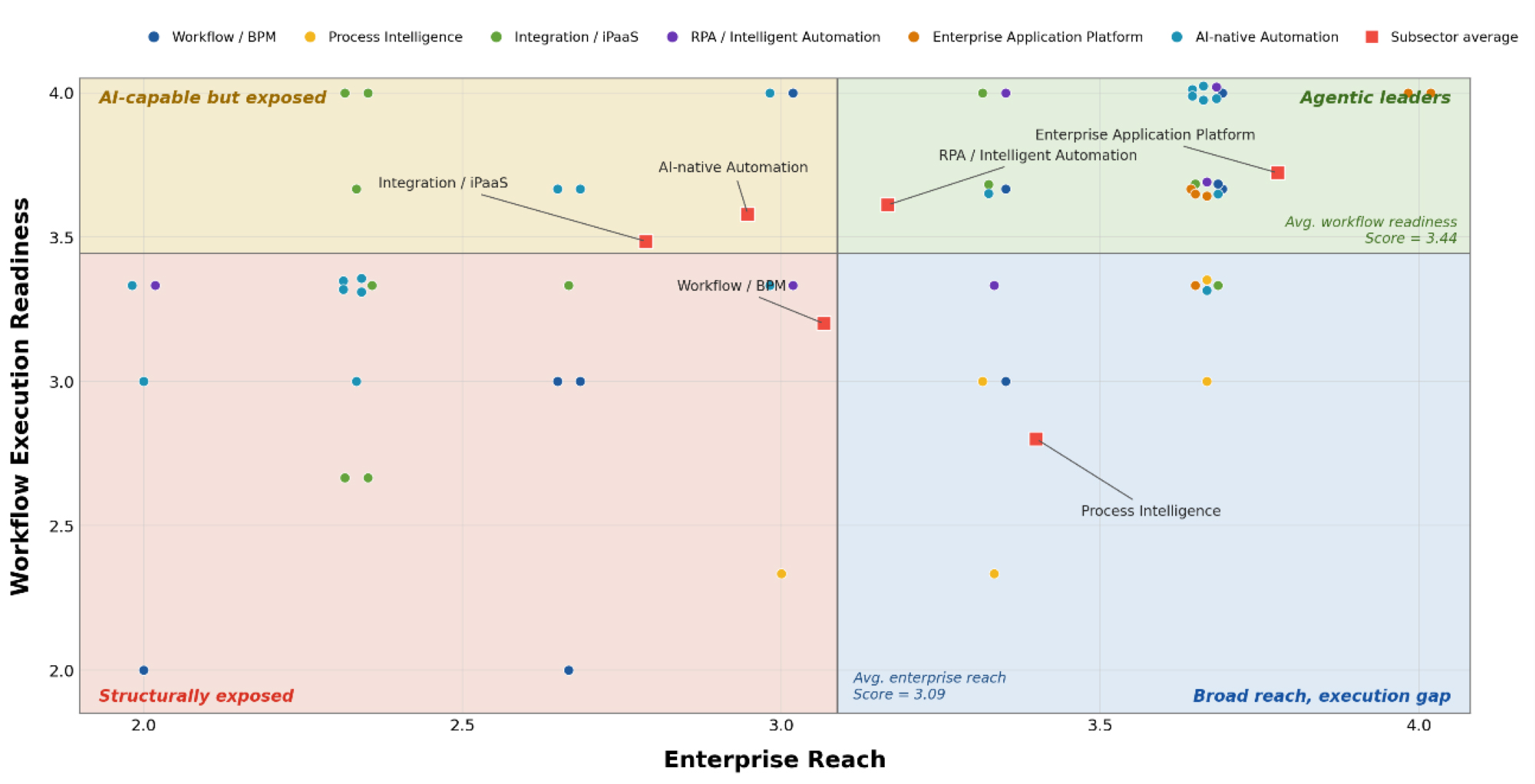
Executive Takeaways
- The Paradigm Shift: Enterprise transformation is moving beyond deterministic workflow automation into autonomous agentic architectures capable of handling variable, multi-step business logic.
- Hybrid Operational Reality: Groundbreaking research released last week by FTI Consulting confirms that future operations will remain strictly hybrid: traditional automation for stable work, autonomous agents for variable work, and humans for higher-order governance and judgment.
- Capital and Compute Reallocation: CTOs and CIOs are being forced to restructure cloud compute architecture and enterprise risk mitigation strategies to accommodate non-deterministic LLM agent reasoning loops.
- Valuation Multiples at Stake: Public markets are beginning to re-rate software and services companies based on their agentic AI readiness, separating legacy SaaS players from autonomous-native disruptors.
For the better part of a decade, enterprise technology strategy has been anchored in a singular promise: deterministic workflow automation. Robotic Process Automation (RPA) scripts, rigid API integrations, and low-code orchestration platforms succeeded by stripping variability out of back-office operations. They executed repetitive, rules-based tasks with machine-like precision, driving down headcount costs and accelerating cycle times in finance, supply chain management, and customer support.
That era is drawing to a close. The conversation in corporate boardrooms has shifted aggressively from workflow automation to agentic AI readiness. Unlike static scripts that break the moment an input deviates from a predefined schema, agentic systems utilize Large Language Models (LLMs) and advanced reasoning engines to plan, execute, self-correct, and complete complex, multi-variable business objectives autonomously. According to a landmark market assessment published last week by advisory titan FTI Consulting, this transition represents the most profound structural shock to corporate architecture since the migration to cloud computing.
Yet, as C-suite executives rush to deploy autonomous agents, a sobering operational reality has emerged. FTI Consulting’s findings emphasize that workflows will not become entirely autonomous overnight. Instead, the enterprise of the near future will operate on a nuanced, tripartite model: deterministic automation managing stable, high-volume work; autonomous agents managing dynamic, variable work; and human talent retaining absolute authority over decisions requiring higher-order judgment, empathy, and ethical nuance.
The Catalytic Shift: From Rules-Based Scripts to Autonomous Reasoning
Test Our Free AI & Tech Utilities Suite
Calculate LLM API token costs, analyze article dwell-time, or simulate tech DCA returns.
To understand why enterprise tech budgets are undergoing a violent reallocation, one must examine the fundamental architectural limitations of legacy automation. Traditional enterprise resource planning (ERP) workflows and customer relationship management (CRM) triggers operate on binary logic: *If X occurs, execute Y*. If X mutates into an unforeseen variant—such as a complex supply chain disruption combined with a custom billing dispute—the workflow halts, generating an exception ticket for human review.
Agentic AI shatters this binary paradigm. By integrating multi-agent orchestration frameworks, Retrieval-Augmented Generation (RAG), and persistent memory, modern enterprise agents can ingest unstructured data, formulate a multi-step hypothesis, invoke external APIs, test their own hypotheses, and iterate until the objective is achieved.
However, this newfound autonomy introduces unprecedented challenges in cloud compute architecture and infrastructure scalability. While a traditional automation script consumes negligible, predictable CPU cycles, an agentic loop involving continuous API calls, real-time vector database searches, and recursive reasoning steps can trigger explosive, unpredictable compute costs. Consequently, Chief Financial Officers (CFOs) and Chief Information Security Officers (CISOs) are collaborating on stringent governance frameworks to ensure that autonomous agents do not hemorrhage capital or expose proprietary enterprise data through uncontrolled prompt injection vulnerabilities.
Verified Data & Metrics Breakdown
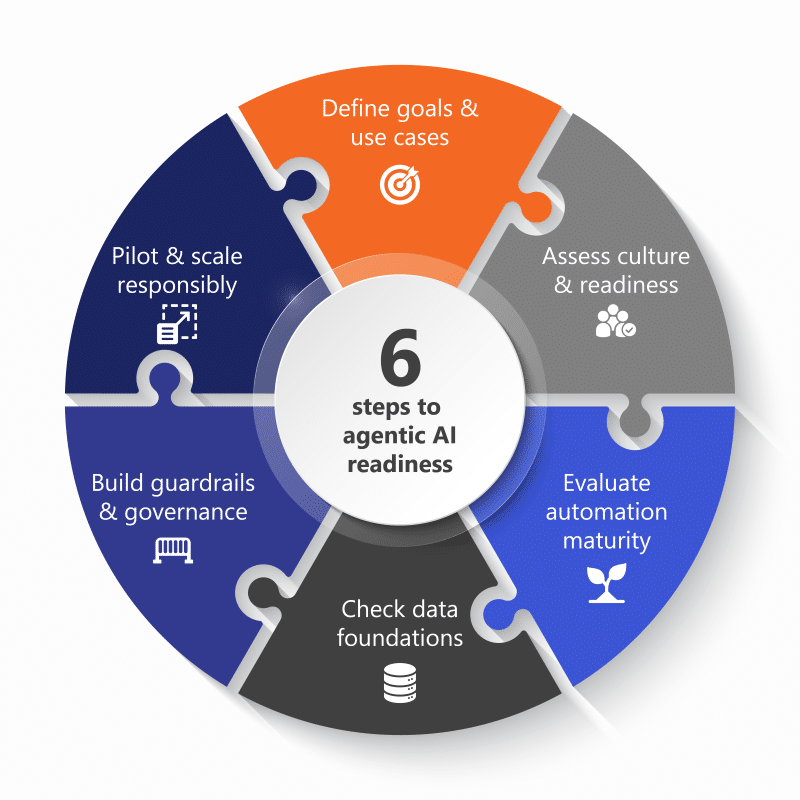
The operational divide between legacy workflow automation and next-generation agentic AI readiness is underscored by key architectural and financial metrics compiled across enterprise deployments:
| Metric Dimension | Legacy Workflow Automation (RPA / BPM) | Next-Gen Agentic AI Systems |
|---|---|---|
| Task Variability Handled | Low (Deterministic, rules-bound) | High (Non-deterministic, multi-step reasoning) |
| Compute Resource Predictability | High (Fixed CPU/Server utilization) | Variable & Dynamic (High API and GPU token burn) |
| Primary Risk Vector | System brittle failure upon input mutation | Hallucination, prompt injection, unintended API execution |
| Operational Deployment Model | Siloed back-office task execution | Cross-functional hybrid orchestration (Human-in-the-loop) |
Industry & Market Implications: Winners, Losers, and Capital Allocation
The commercial implications of FTI Consulting’s findings extend far beyond IT departments, directly influencing enterprise valuation multiples and market liquidity across sectors. Wall Street analysts are aggressively revising their valuation models for enterprise software providers based on their agility in pivoting from standard SaaS licenses to consumption-based agentic orchestration models.
The Winners: Infrastructure Enablers and Autonomous-Native Disruptors
Companies providing the foundational plumbing for agentic AI—such as hyperscale cloud providers offering secure, low-latency GPU clusters, cybersecurity firms specializing in LLM runtime guardrails, and enterprise middleware developers��are capturing outsized capital allocation. These firms enable large enterprises to bridge legacy databases with modern LLM reasoning engines without compromising regulatory compliance.
The Losers: Legacy BPO and Rigid SaaS Providers
Conversely, traditional Business Process Outsourcing (BPO) firms reliant on high-volume, low-skill human labor face an existential threat. As agentic AI absorbs variable customer service, routine legal document review, and baseline financial reconciliation, the traditional BPO revenue model—billed on headcount-hours—is compressing rapidly. Similarly, legacy SaaS vendors failing to embed autonomous multi-agent capabilities risk watching their software relegated to "system of record" status, stripped of pricing power.
Frequently Asked Questions (People Also Ask)
What is the core difference between workflow automation and agentic AI?
Workflow automation executes fixed, deterministic rules designed for repetitive, stable tasks where inputs and outputs are standardized. Agentic AI utilizes autonomous reasoning models to dynamically plan, adapt, and execute complex, multi-step business objectives across variable environments without requiring rigid, pre-written script pathways.
Why does FTI Consulting describe the future operational model as "hybrid"?
FTI Consulting highlights that no single technology solves all enterprise challenges. Stable, high-volume tasks remain best suited for traditional automation; variable, context-rich processes are optimized for autonomous agents; and strategic, high-stakes decisions requiring empathy, legal accountability, and ethical governance must remain firmly in human hands.
How does agentic AI readiness impact enterprise risk mitigation?
Because autonomous agents can execute external API calls and write data across enterprise systems, risk mitigation requires moving beyond static cybersecurity protocols. Organizations must implement strict runtime guardrails, deterministic validation checkpoints, identity and access management (IAM) permissions for non-human workers, and continuous audit trails to prevent cascading errors or unauthorized financial transactions.
Future Outlook: Milestones and Strategic Imperatives for the C-Suite
As enterprises transition from proof-of-concept sandboxes to scaled production environments over the next 12 to 18 months, executive leadership must focus on three critical milestones to ensure true agentic AI readiness:
- Architectural Modernization: Dismantling data silos and modernizing legacy data warehouses into vector-searchable architectures capable of feeding real-time context to autonomous agents.
- Economic Governance: Establishing dynamic budget caps and ROI tracking mechanisms for LLM token consumption and cloud compute overhead to prevent runaway operational expenditures.
- Human-Centric Policy Design: Formalizing clear operational boundaries that define precisely where autonomous agent authority ends and human-in-the-loop governance begins.
Ultimately, achieving agentic AI readiness is no longer an experimental technology initiative; it is a core fiduciary requirement. Corporations that successfully master this hybrid operational framework will capture unprecedented efficiency gains and margin expansion, while those anchored in rigid legacy automation risk marginalization in an increasingly autonomous global economy.