In the contemporary macroeconomic landscape, a structural shift has rewired global equity markets. The "Magnificent Seven"—Apple (NASDAQ: AAPL), Microsoft (NASDAQ: MSFT), Alphabet (NASDAQ: GOOGL), Amazon (NASDAQ: AMZN), NVIDIA (NASDAQ: NVDA), Meta Platforms (NASDAQ: META), and Tesla (NASDAQ: TSLA)—have transitioned from a mere thematic grouping into the dominant gravitational force of global capital allocation. Together, these seven enterprises command a market capitalization exceeding $13 trillion, larger than the entire public equity markets of Japan, Canada, and the United Kingdom combined.
This unprecedented concentration has created a structural dilemma for institutional asset managers and retail investors alike. Relying on traditional market-cap-weighted indices like the S&P 500 or Nasdaq-100 no longer yields diversified exposure; instead, it delivers a highly concentrated bet on mega-cap technology and artificial intelligence infrastructure. In response, the financial engineering complex has launched targeted Magnificent Seven Exchange-Traded Funds (ETFs) and thematic instruments. This investigative report dissects the mechanics, risk profiles, systemic implications, and strategic utility of these specialized investment vehicles.
Executive Takeaways
- Unprecedented Index Concentration: The Magnificent Seven account for nearly 30% of the S&P 500 and over 40% of the Nasdaq-100, rendering traditional broad-market passive indexing a de facto concentrated tech bet.
- Thematic ETF Proliferation: Pure-play vehicles, such as the Roundhill Magnificent Seven ETF (MAGS), offer equal-weighted or custom-weighted exposures, bypassing the need for manual portfolio rebalancing and reducing transaction drag.
- Structural and Operational Risks: High expense ratios, tracking errors, and liquidity mismatch risks exist within leveraged, inverse, and derivative-overlay single-stock wrappers, which are increasingly marketed to retail investors.
- Systemic Liquidity Loops: The programmatic creation and redemption baskets executed by Authorized Participants (APs) risk amplifying intraday volatility during market-wide de-risking events.
The Concentration Conundrum: Why Thematic ETFs Emerged
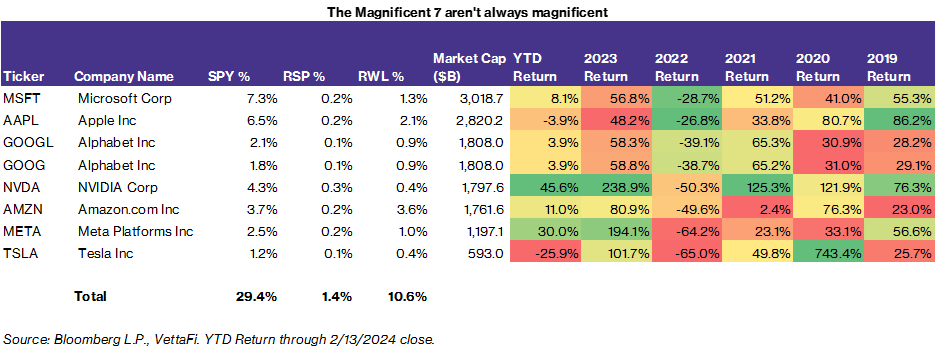
For decades, modern portfolio theory dictated that diversification was the only free lunch in finance. However, the post-pandemic cycle shattered this paradigm. Fueled by massive capital expenditure in artificial intelligence, cloud compute architecture, and enterprise software, the Magnificent Seven systematically captured the lion's share of corporate earnings growth. This fundamental divergence left active mutual fund managers—historically restricted by diversification rules—severely underperforming their benchmarks.
For investors, two distinct problems emerged. First, those seeking pure-play exposure to these secular growth engines were forced to manage seven distinct equity positions, executing manual rebalancing that triggered capital gains taxes and transaction costs. Second, conservative investors seeking shelter from the extreme valuation multiples of these tech giants found that passive index funds offered no safety; a correction in Nvidia or Microsoft automatically dragged down the entire broad-market index.
Enter the specialized Magnificent Seven ETFs. By isolating these seven hyperscalers, issuers created a new asset class. These vehicles allow tactical asset allocators to treat the Magnificent Seven as a distinct, unified asset category—akin to commodities or high-yield bonds—separate from the broader equity market. This enables precise capital allocation: investors can go overweight the sector via dedicated ETFs, or conversely, hedge their exposure using inverse products, all while using the rest of their portfolio to hold equal-weighted index funds to isolate value and small-cap factors.
Deconstructing the Structural Plumbing: How Mag Seven ETFs Function
To evaluate these instruments, one must look beneath the hood at their operational mechanics. While purchasing a share of a Magnificent Seven ETF seems identical to buying shares of any common stock, the underlying market microstructure is highly complex.
Rebalancing and Tax Efficiency
Unlike manual portfolio construction, where selling an outperforming stock to buy an underperforming one triggers immediate capital gains distributions, ETFs leverage the "in-kind" creation and redemption process. Authorized Participants (APs)—typically institutional market makers—swap baskets of the underlying seven stocks for ETF shares. This transaction is treated as a property swap rather than a cash sale, allowing the ETF manager to dynamically rebalance weightings (for instance, equal-weighting the seven names quarterly) without triggering capital gains taxes for the end-shareholder. This structural tax-efficiency is a primary driver of institutional adoption.
The Rise of Single-Stock and Leveraged Wrappers
Beyond simple basket ETFs, financial engineers have introduced leveraged (e.g., 2x long) and inverse (e.g., 1x short) single-stock ETFs targeting individual members of the Magnificent Seven. These instruments do not hold the underlying physical equities. Instead, they rely on swap agreements with Tier-1 investment bank counterparties. While these products promise amplified returns, they suffer from "volatility decay." Because these swaps rebalance daily, the long-term return of a leveraged ETF will diverge significantly from the simple multiple of the underlying stock's cumulative return in a volatile, range-bound market. These are tactical trading tools, not buy-and-hold capital preservation vehicles.
Derivative-Overlay and Covered Call Strategies
With valuation multiples elevated, a growing subset of investors is prioritizing cash flow over capital appreciation. This has driven massive inflows into "yield-maximized" or covered-call ETFs tracking the Magnificent Seven. These funds buy the underlying mega-cap tech stocks and write (sell) out-of-the-money call options against them. This strategy caps the upside potential during parabolic bull runs but generates double-digit distribution yields from the option premiums. During periods of flat or mildly declining markets, these derivative-income overlays act as a vital volatility cushion and source of uncorrelated income.
Verified Data & Metrics Breakdown
The following table compares the primary structural, financial, and liquidity profiles of key ETFs utilized by market participants to express views on the Magnificent Seven and broader mega-cap technology ecosystem.
| ETF Ticker & Name | Primary Structure & Strategy | Expense Ratio | Assets Under Management (AUM) | Magnificent Seven Concentration | Primary Liquidity & Volume Profile |
|---|---|---|---|---|---|
| MAGS Roundhill Magnificent Seven ETF |
Physical replication, equal-weighted basket of the Magnificent Seven; rebalanced quarterly. | 0.29% | ~$850 Million | ~100% (Pure-play basket) | High; tight bid-ask spreads supported by active institutional market makers. |
| FNGS MicroSectors FANG+ ETN |
Debt instrument (Exchange-Traded Note) tracking 10 highly liquid, mega-cap tech giants. | 0.58% | ~$4.2 Billion | ~70% (Includes auxiliary tech hyperscalers) | Very High; favored by short-term proprietary trading desks. |
| QQQ Invesco QQQ Trust |
Traditional modified market-cap-weighted index tracking the Nasdaq-100. | 0.20% | ~$280 Billion | ~38% to 43% (Fluctuates based on market cap changes) | Ultra-High; primary macro hedging vehicle with deep options liquidity. |
| RSP Invesco S&P 500 Equal Weight ETF |
Equal-weighted S&P 500; used to dilute mega-cap concentration risk. | 0.20% | ~$62 Billion | ~1.4% (Equal 0.2% weighting per stock) | Institutional-grade liquidity; used for factor-rotation strategies. |
| FEPI Rex FANG & Innovation Equity Premium Income ETF |
Covered-call derivative overlay on mega-cap technology and Magnificent Seven equities. | 0.65% | ~$1.1 Billion | ~45% to 50% (Dynamic based on option writing) | Moderate; growing retail and income-focused advisor adoption. |
Industry & Market Implications: The Winners and Losers
The institutionalization of Magnificent Seven ETF investing has profound consequences across the financial ecosystem, reshaping the dynamics of market volatility and active management.
The Winners: Issuers and Liquidity Providers
The primary beneficiaries of this thematic boom are specialized ETF issuers and market makers. Firms like Roundhill, Direxion, and GraniteShares have successfully monetized the demand for targeted exposure, capturing premium expense ratios (0.29% to 0.95%) compared to the fee-compressed vanilla index space (where Vanguard and BlackRock charge 0.03% to 0.09%). Additionally, high-frequency trading (HFT) firms and Authorized Participants profit continuously from the arbitrage corridor, capturing microscopic spreads during the constant rebalancing and creation/redemption processes required to keep ETF prices aligned with net asset value (NAV).
The Losers: Active Mutual Fund Managers
Traditional active managers have suffered immense structural damage from this trend. Many mutual funds operate under strict fiduciary guidelines or regulatory frameworks (such as the SEC's diversified fund rules) that prevent them from allocating more than 5% or 10% of their total assets to any single stock. Because the S&P 500's top holdings exceed these thresholds, active managers are legally prohibited from matching the benchmark's concentration. Consequently, in a market driven almost entirely by the Magnificent Seven, active managers have systematically underperformed, accelerating the secular migration of capital from active mutual funds to passive and thematic ETFs.
Broader Economic and Systemic Risks
The concentration of capital into a select few ETFs creates systemic market-structure risks. When index-tracking or thematic ETFs experience mass outflows during a market panic, the APs are forced to redeem ETF shares by selling the underlying stocks. Because the underlying basket is highly concentrated in just seven names, this programmatic selling can trigger a cascade. This self-reinforcing feedback loop—where ETF redemptions drive down the prices of the mega-caps, which in turn lowers the ETF's NAV and prompts further redemptions—poses a real threat to intraday market stability, potentially causing sudden, systemic flash crashes.
People Also Ask (FAQ)
Is it better to buy a Magnificent Seven ETF or buy the individual stocks directly?
For long-term retail investors with access to zero-commission trading platforms, purchasing the seven equities directly and holding them can be highly cost-effective, as it eliminates the annual management fee (expense ratio) of the ETF. However, for institutional investors, family offices, and wealth managers, utilizing a dedicated ETF like MAGS is often preferred. The ETF provides automatic quarterly rebalancing, tax-advantaged rebalancing via the in-kind creation/redemption mechanism, and streamlined portfolio administration, which offsets the expense ratio by eliminating manual transaction drag and capital gains distributions.
What are the primary risks of investing in concentrated mega-cap ETFs?
The primary risk is a lack of diversification, also known as idiosyncratic risk. If any single member of the Magnificent Seven experiences a severe structural issue—such as regulatory antitrust action, supply chain disruptions, or an earnings miss—the entire ETF will suffer a disproportionate drawdown. Additionally, because these companies are highly correlated due to their shared exposure to the artificial intelligence trade, cloud capital expenditures, and macroeconomic interest rate cycles, a systemic macro shock (like an unexpected interest rate hike by the Federal Reserve) can trigger a violent, highly correlated correction across all seven holdings simultaneously.
How do covered-call Magnificent Seven ETFs generate such high distribution yields?
Covered-call ETFs (such as FEPI or single-stock option-income ETFs) generate yield by harvesting "implied volatility." Because the Magnificent Seven are high-beta tech stocks that experience significant price swings, their option premiums are priced highly by the options market. By writing (selling) call options against their underlying equity positions, the ETF collects these rich premiums. This income is then distributed to shareholders as monthly dividends. However, investors must understand that this yield is not "free"; it comes at the expense of capping the fund's capital appreciation during strong market rallies, meaning these funds will systematically underperform the underlying equities during parabolic bull markets.
What is the difference between an ETF and an ETN when investing in mega-cap tech?
While they trade similarly on exchanges, their underlying structures are completely different. An ETF (Exchange-Traded Fund) is an investment company that physically owns the underlying basket of stocks, holding them in a custodian bank for the benefit of the shareholders. An ETN (Exchange-Traded Note, such as FNGS) is an unsecured debt instrument issued by a financial institution (the underwriting bank). The bank promises to pay the investor a return based on the performance of a specific index, minus fees. This means ETN investors do not own the underlying stocks and are exposed to "credit risk"—if the issuing bank defaults or goes bankrupt, investors could lose their entire principal, regardless of how well the underlying tech stocks performed.
Future Outlook and Strategic Milestones to Watch
The trajectory of Magnificent Seven ETF investing will be defined by three critical pillars over the coming twenty-four months.
First, antitrust and regulatory compliance will take center stage. The U.S. Department of Justice and the Federal Trade Commission, alongside European regulators, are actively pursuing monopoly and anticompetitive behavior cases against Alphabet, Apple, and Meta. Any structural remedy—such as a court-ordered breakup of these enterprises—would disrupt the composition of these ETFs, forcing managers to redefine what constitutes a "Magnificent" market leader.
Second, we are entering the monetization phase of the artificial intelligence capital expenditure cycle. Investors are shifting focus from the hardware providers (e.g., Nvidia) to the software implementers (e.g., Microsoft, Alphabet, Meta) to see if the massive CapEx spend translates to sustainable enterprise ROI. If corporate earnings fail to justify these elevated valuation multiples, we will likely see a dramatic divergence in performance within the Seven, causing equal-weighted ETFs to significantly outperform market-cap-weighted ones.
Ultimately, Magnificent Seven ETFs represent the zenith of financial engineering adapting to market concentration. Whether they are viewed as efficient, liquid capital multipliers or dangerous concentration traps, they have fundamentally altered how global investors navigate the modern market structure. Going forward, the ability to tactically deploy these vehicles while managing their inherent liquidity and structural risks will remain a defining characteristic of institutional-grade portfolio construction.