WASHINGTON / LONDON / NEW YORK — The fundamental assumption that governed enterprise IT security for nearly four decades—that a network’s interior is inherently safe once protected by a perimeter wall—has collapsed under the weight of cloud migration, distributed workforces, and sophisticated nation-state cyber intrusions. According to analysis published by cio.com on May 6, 2025, corporate IT leadership is engaged in a sweeping capital reallocation, shifting billions from legacy perimeter defenses toward Zero Trust Architecture (ZTA). This architectural revolution reflects a profound transition: moving from structural vulnerability to absolute, real-time operational visibility.
As boardrooms confront heightened regulatory scrutiny, spiraling cyber insurance premiums, and systemic threats to operational business continuity, the migration to Zero Trust is no longer viewed merely as an IT modernization project. It has evolved into a strategic financial dynamic directly influencing risk mitigation, infrastructure scalability, and enterprise valuation multiples.
Executive Takeaways
Test Our Free AI & Tech Utilities Suite
Calculate LLM API token costs, analyze article dwell-time, or simulate tech DCA returns.
- The Demise of Implicit Trust: Legacy "castle-and-moat" security models leave enterprises exposed by granting unrestricted internal access once a network perimeter is breached, driving the average global cost of a corporate data breach past $4.8 million.
- Real-Time Visibility and Blast Radius Reduction: Zero Trust architecture replaces broad network access with explicit cryptographic verification and granular microsegmentation, preventing lateral attack movement and reducing threat containment timelines by up to 50%.
- Capital Allocation Shift: Fortune 500 chief information officers (CIOs) are rapidly retiring legacy hardware appliance budgets, reallocating capital to cloud-native Secure Access Service Edge (SASE) and Zero Trust Network Access (ZTNA) solutions to optimize long-term enterprise ROI.
- Regulatory Imperatives: Mandates from the SEC (Item 1.05 Form 8-K disclosures) alongside European frameworks like DORA and NIS2 are forcing public corporations to adopt Zero Trust telemetry to satisfy continuous compliance and audit requirements.
The Anatomy of Structural Failure: Why Legacy Models Collapsed

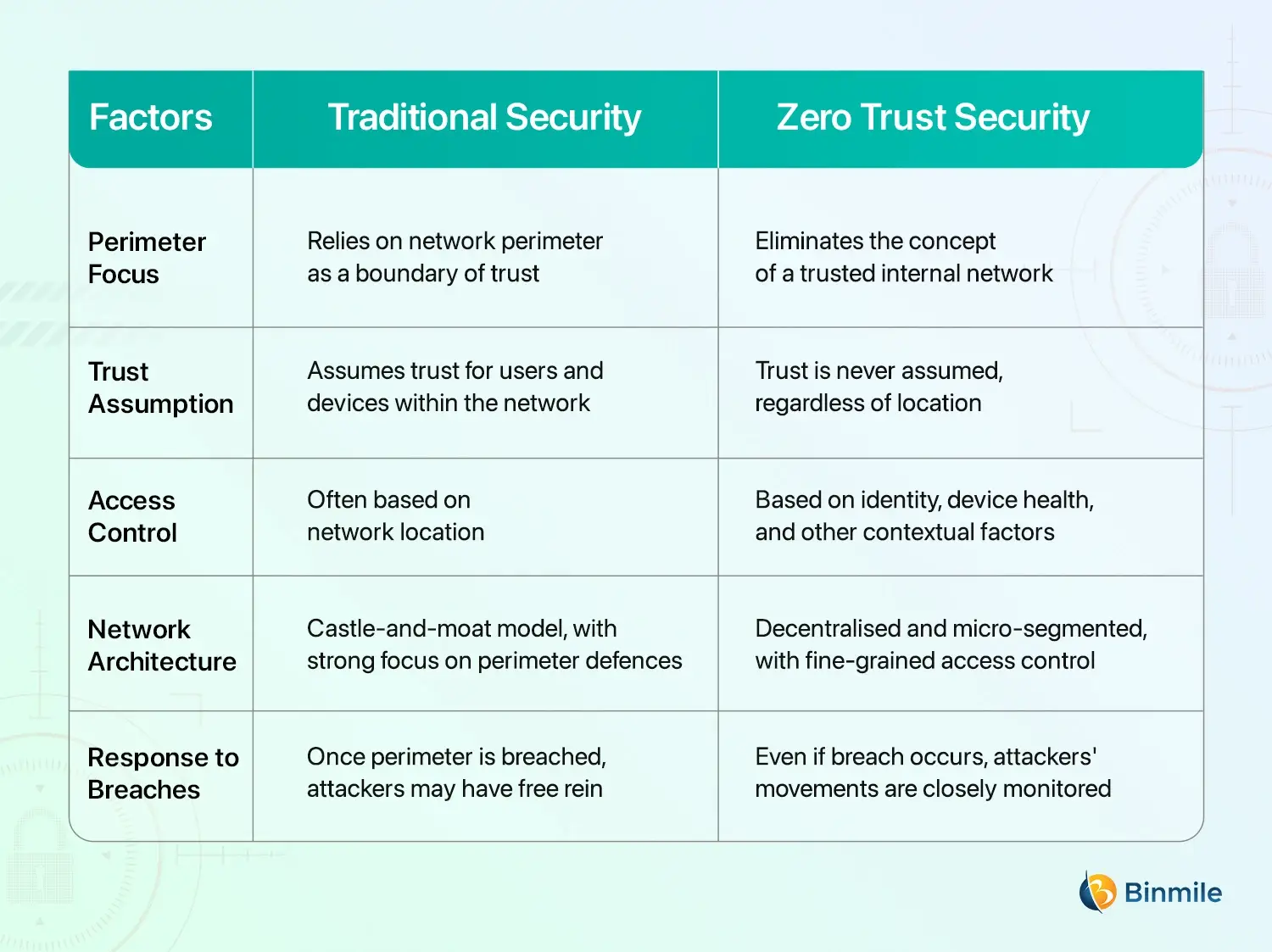
For decades, enterprise security relied on the perimeter model—informally termed the "castle-and-moat" strategy. This approach deployed edge hardware, including firewalls, virtual private networks (VPNs), and intrusion detection systems (IDS), to create a hardened boundary around internal corporate assets. Anyone outside the network was treated as untrusted; anyone inside was implicitly trusted.
This model proved effective when enterprise data resided within localized physical data centers and employees worked inside corporate facilities. However, the rapid expansion of multi-cloud compute architectures, hybrid operating environments, and third-party SaaS integrations fundamentally decoupled work from physical network locations. The virtual perimeter dissolved.
The core structural weakness of legacy architecture lies in its handling of lateral movement. Once an adversary gains access past an edge device—whether through compromised credentials, zero-day vulnerabilities, or supply-chain exploits—the flat internal network grants them unrestricted privileges. The adversary can traverse corporate environments, map directory services, elevate privileges, and exfiltrate sensitive IP with minimal friction. High-profile breaches across critical infrastructure, financial institutions, and retail conglomerates over the past five years have repeatedly demonstrated that perimeter-focused defenses yield catastrophic failure modes once breached.
The Zero Trust Paradigm: "Never Trust, Always Verify"
Formulated initially by analyst John Kindervag and formalized in the National Institute of Standards and Technology (NIST) Special Publication 800-207, Zero Trust Architecture operates on a fundamentally different premise: assume breach, implicit trust is zero, and every access request must be explicitly verified regardless of origin.
Zero Trust decouples access from network location. Whether a user connects from an executive suite in Manhattan, a remote home office, or a coffee shop, their level of network trust remains identical: absolute zero until authenticated, authorized, and cryptographically validated.
The transformation rests upon three foundational pillars:
1. Identity as the New Perimeter
Under Zero Trust, identity functions as the primary security boundary. Context-aware Identity and Access Management (IAM) systems validate user identity alongside device health, geographic risk, and behavioral patterns. Access is managed through strict Least Privilege Access principles, ensuring users are granted entry only to the specific applications required for their immediate role, rather than the underlying network layer.
2. Dynamic Microsegmentation
Unlike traditional flat networks, Zero Trust partitions infrastructure into highly isolated, software-defined micro-perimeters. By deploying software-defined perimeters (SDP) and microsegmentation policies, enterprises isolate individual workloads, databases, and container environments. If an individual endpoint is compromised, the threat actor remains contained within a restricted micro-segment, effectively neutralizing lateral movement and dramatically reducing the total "blast radius" of an attack.
3. Continuous Adaptive Telemetry and Orchestration
Static, point-in-time authentication is replaced by dynamic, continuous assessment. Zero Trust engines continually monitor session telemetry in real time. If a user’s behavior deviates from established baselines—such as attempting to download unusual quantities of data or switching IP addresses mid-session—the system automatically downgrades access privileges, demands step-up multi-factor authentication (MFA), or terminates the encrypted session entirely.
Data & Metrics Breakdown: Perimeter vs. Zero Trust Architecture
To quantify the financial and operational impact of transitioning from legacy perimeter security to a mature Zero Trust deployment, the following metrics illustrate key performance parameters compiled across enterprise benchmark reports:
| Security & Financial Metric | Legacy Perimeter ("Castle-and-Moat") | Zero Trust Architecture (NIST 800-207) | Enterprise Financial Impact |
|---|---|---|---|
| Mean Time to Identify & Contain (MTTD/MTTR) | 277 Days (Average) | 180 Days or Less (-35%) | Dramatically lowers business disruption and operational downtime costs. |
| Average Breach Financial Impact | $4.88 Million | $3.20 Million (-34.4%) | Direct preservation of enterprise cash flow and gross margins. |
| Lateral Threat Radius | Unrestricted across flat networks | Isolated to individual micro-segments | Mitigates catastrophic systemic risk across business units. |
| Capital Allocation Profile | High CapEx (On-premise hardware refresh cycles) | Optimized OpEx (Cloud-native SASE/ZTNA services) | Enhances free cash flow flexibility and asset-light balance sheet metrics. |
| Regulatory & Audit Overhead | Fragmented, manual point-in-time reporting | Automated, real-time continuous compliance telemetry | Reduces audit fees and shields against non-compliance regulatory penalties. |
Financial Economics: Capital Allocation, ROI, and Enterprise Valuation
From an institutional investment and corporate finance perspective, the migration to Zero Trust architecture fundamentally alters the balance sheet dynamic of corporate IT spending. Legacy security strategies required continuous, capital-intensive updates of specialized hardware appliances—such as edge firewalls, VPN concentrators, and load balancers—that rapidly depreciated while imposing substantial operational maintenance burdens.
Zero Trust transitions cyber defense toward a cloud-native, operational expenditure (OpEx) model via Secure Access Service Edge (SASE) and Zero Trust Network Access (ZTNA) solutions. This structural pivot offers clear economic benefits:
- Optimized Capital Allocation: Consolidation of redundant point solutions into unified cloud-delivered platforms reduces software duplication, decreases licensing complexity, and lowers physical data center energy footprints.
- Valuation Multiple Protection: Cyber breaches frequently result in immediate shareholder value destruction, reputational equity erosion, and regulatory fines. Advanced threat posture maturity directly shields risk-adjusted enterprise value during earnings releases and M&A due diligence.
- Insurance Premium Optimization: Modern cyber insurance underwriters increasingly view legacy perimeter models as uninsurable liabilities. Demonstrating mature Zero Trust implementation—specifically microsegmentation and continuous identity verification—enables corporates to negotiate lower insurance premiums and lower retentions.
Industry & Market Implications: The Redistribution of Tech Capital
The structural obsolescence of perimeter security is reshaping market dynamics across the enterprise technology ecosystem. Market capital is shifting rapidly away from pure-play hardware appliance manufacturers toward integrated cloud-native security platforms.
The Market Winners: Cloud security platforms specializing in Zero Trust Network Access (ZTNA), Identity and Access Management (IAM), Security Service Edge (SSE), and Endpoint Detection and Response (EDR)—such as Zscaler, CrowdStrike, Palo Alto Networks, Okta, and Cloudflare—continue to capture market share. These firms benefit from recurring software revenues, high gross margins, and deep integration into cloud compute architectures.
The Legacy Attrition: Vendors slow to transition from hardware-bound legacy firewalls and traditional VPN technologies face contracting market valuations and margin compression. As enterprise clients systematically deactivate corporate VPNs in favor of identity-driven ZTNA tunnels, legacy hardware refresh cycles are being canceled or permanently deferred.
Regulatory Dynamics: Global regulatory frameworks have converged to accelerate this transition. The US Securities and Exchange Commission (SEC) now mandates strict Item 1.05 Form 8-K disclosures for material cybersecurity incidents within