Executive Takeaways
- Geoeconomic Expansion: India’s Unified Payments Interface (UPI) has officially cemented its cross-border infrastructure footprint across 9 strategic international jurisdictions entering 2026.
- Disrupting Legacy Rails: By bypassing traditional SWIFT networks and high-fee correspondent banking models, UPI integration slashes transactional friction, boosting enterprise ROI and cross-border market liquidity.
- Strategic Capital Allocations: Sovereign partnerships between the National Payments Corporation of India (NPCI) and foreign central banks are triggering massive infrastructure scalability investments among tier-1 financial institutions.
- Regulatory Compliance & Risk Mitigation: The architecture relies on rigorous API-driven security frameworks, ensuring strict adherence to anti-money laundering (AML) protocols and sovereign data localization mandates.
For decades, international remittances and cross-border commercial settlements have been defined by structural inefficiencies: exorbitant wire fees, sluggish settlement windows, and opaque foreign exchange spreads. Entrenched legacy intermediaries—namely SWIFT-reliant correspondent banks and card-network duopolies—have long extracted a heavy tax on global trade and tourism. However, a structural paradigm shift is currently underway, spearheaded by an unlikely disruptor originating from South Asia: India’s Unified Payments Interface (UPI).
According to primary wire intelligence and strategic tracking reports from Vajiram & Ravi, UPI’s international footprint has expanded to officially encompass 9 key global territories entering 2026, punctuated by high-impact recent additions. This investigative report analyzes the macroeconomic catalysts, infrastructural mechanics, valuation multiples, and geopolitical implications of UPI’s aggressive global deployment. We examine how real-time payment rails are rewriting the rules of global finance, altering capital allocation strategies for multinational conglomerates, and challenging Western hegemony over payment infrastructure.
The Genesis of a Real-Time Payments Juggernaut
Test Our Free AI & Tech Utilities Suite
Calculate LLM API token costs, analyze article dwell-time, or simulate tech DCA returns.
Launched in 2016 by the National Payments Corporation of India (NPCI) under the auspices of the Reserve Bank of India (RBI), UPI was originally conceived as a domestic interbank mobile payment system designed to accelerate financial inclusion and displace cash in a massive emerging market. By establishing an open-source, interoperable API stack, UPI eliminated the necessity for physical card hardware, point-of-sale (POS) terminal rentals, and cumbersome bank account number exchanges, relying instead on virtual payment addresses (VPAs) and biometric authentication.
The system’s explosive domestic growth—processing billions of transactions monthly—created an unprecedented testing ground for infrastructure scalability. As domestic transaction volumes routinely shattered previous records, the NPCI pivoted toward international expansion. The strategic objective was clear: transform UPI from a localized public digital good into a globally accepted sovereign payment rail, creating a frictionless digital corridor for Indian expatriates, tourists, and international corporate entities.
The mechanics of cross-border UPI integration rely on bilateral Application Programming Interface (API) linkages between the NPCI International Payments Ltd (NIPL) and host-country real-time payment systems (such as Singapore’s PayNow or France’s Lyra network). These integrations enable instantaneous foreign exchange conversions and real-time ledger settlements, effectively collapsing a multi-day correspondent banking chain into a sub-five-second mobile interaction.
Mapping the 2026 Footprint: The 9 Jurisdictions Accepting UPI
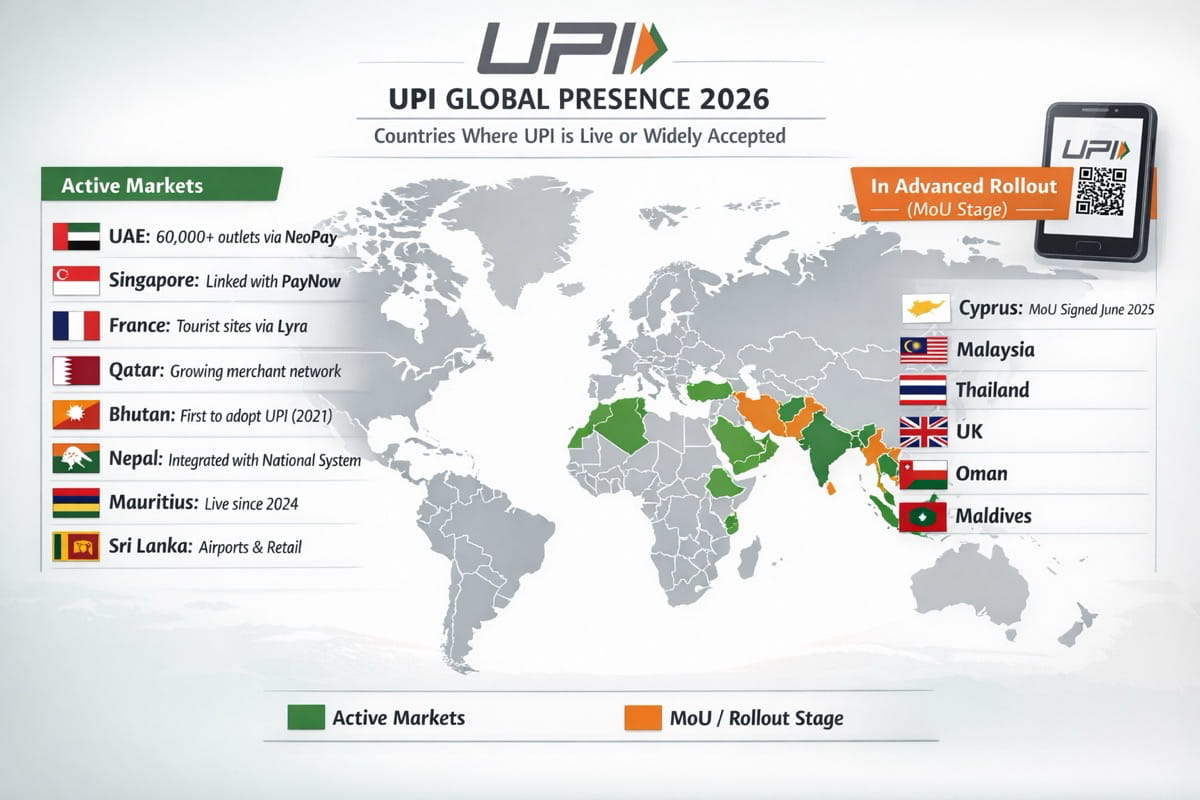
As of 2026, the strategic deployment of UPI spans diverse economic zones, ranging from major European tourism hubs and Southeast Asian financial powerhouses to resource-rich Middle Eastern corridors. This geographical diversification is no accident; it strategically targets high-volume tourist routes, diaspora concentration zones, and critical trade partners.
Recent additions to the network have accelerated significantly, moving beyond mere regional experiments into fully integrated national payment infrastructures. Below is the verified operational breakdown of the 9 sovereign territories integrated with UPI payments.
| Jurisdiction / Country | Integration Partner / Network | Strategic Focus & Use Case | Operational Status (2026) |
|---|---|---|---|
| Singapore | PayNow (MAS) | P2P remittances and cross-border trade settlements. | Fully Operational |
| France | Lyra / Eiffel Tower Network | Tourism, luxury retail, and merchant acquisitions. | Fully Operational |
| United Arab Emirates (UAE) | Neopay / Mashreq Bank | Expatriate remittances, retail, and real estate transactions. | Fully Operational |
| Mauritius | Bank of Mauritius | Bilateral trade facilitation and retail banking integration. | Recent Addition / Active |
| Sri Lanka | LankaPay | Regional economic integration and tourist merchant payments. | Active Deployment |
| Nepal | Fonepay / Nepal Rastra Bank | High-frequency cross-border retail and labor remittances. | Fully Operational |
| Bhutan | Royal Monetary Authority | Seamless bilateral retail payments and tourism. | Fully Operational |
| Peru | Central Reserve Bank of Peru | Latin American market penetration and trade corridors. | Rolling Out / Active |
| Malaysia | PayNet / Payments Network Malaysia | Southeast Asian economic corridor integration. | Recent Addition / Active |
Industry & Market Implications: Who Wins, Who Loses
The institutional adoption of UPI on a global scale is causing structural realignments across the financial services sector. As transaction volumes shift away from proprietary legacy rails toward open-API sovereign infrastructures, market participants must adapt to changing economic realities.
The Winners
- Multinational Merchants & Hospitality Brands: High-end retailers, hospitality groups, and airlines operating in integration zones benefit from lower merchant discount rates (MDR) compared to traditional credit card processors, directly improving operating margins.
- Expatriate Workers & SMEs: Small and medium-sized enterprises engaged in international trade and millions of migrant workers save billions in cumulative remittance leakage, bypassing predatory foreign exchange markups.
- Fintech Infrastructure Providers: Technology vendors specializing in cloud compute architecture, API gateway management, and real-time fraud detection analytics are experiencing a surge in enterprise contracts as foreign banks rush to upgrade their systems.
The Losers
- Legacy Card Networks & Wire Intermediaries: Traditional global card schemes and legacy wire transfer operators face long-term volume erosion in high-growth Asian and European corridors as consumers and merchants migrate to instantaneous, lower-cost account-to-account (A2A) alternatives.
- High-Fee Correspondent Banks: Traditional banks reliant on multi-day clearing houses and manual compliance checks are seeing their fee-income models compressed as automated, blockchain-adjacent and API-led rails disintermediate traditional currency exchange loops.
Risk Mitigation, Regulatory Compliance, and Cloud Architecture
Scaling a sovereign payment system across international borders introduces immense regulatory and technological complexities. Ensuring institutional-grade security requires a resilient cloud compute architecture capable of handling millions of concurrent requests while maintaining strict data sovereignty compliance.
Unlike decentralized cryptographic assets, UPI operates within tightly regulated central banking perimeters. Each cross-border transaction must satisfy domestic Anti-Money Laundering (AML) and Know Your Customer (KYC) statutes of both the sending and receiving nations. NIPL achieves this by embedding real-time screening mechanisms directly into the API handshake, neutralizing illicit capital flows without introducing latency.
Furthermore, risk mitigation frameworks demand robust redundancy. Financial institutions integrating with UPI must deploy high-availability server clusters, encrypted transport layers (TLS 1.3), and zero-trust network access (ZTNA) protocols. This ensures that systemic uptime remains above 99.99%, shielding enterprise balance sheets from operational vulnerabilities and regulatory penalties.
Frequently Asked Questions (People Also Ask)
How do international users execute a UPI payment outside India?
International users and travelers utilize their existing India-linked bank accounts or approved foreign partner apps integrated with NIPL rails. By scanning a local QR code (such as PayNow in Singapore or Lyra in France) via a UPI-enabled mobile app, the system automatically calculates the foreign exchange rate, debits the source account in real-time, and settles the funds instantly into the merchant's local currency account.
What are the primary financial benefits for merchants accepting UPI?
Merchants benefit from significantly lower Merchant Discount Rates (MDR) compared to legacy credit and debit card networks. Additionally, the elimination of chargeback fraud risks, instantaneous settlement of funds directly into business accounts, and enhanced cash flow management drive substantial enterprise ROI.
Which countries represent the most recent additions to the UPI network for 2026?
Recent strategic expansions entering 2026 include formal operational integrations in Mauritius, Malaysia, and Peru. These additions broaden UPI’s reach across African trade gateways, Southeast Asian digital economies, and Latin American financial markets.
Does UPI replace SWIFT for international corporate trade?
While UPI is not a direct replacement for institutional high-value corporate treasury wires handled by SWIFT, it effectively disintermediates correspondent banking for retail, tourism, and SME-level trade corridors by offering instantaneous, low-cost peer-to-peer and peer-to-merchant settlements.
Future Outlook: Strategic Milestones to Watch Through 2026 and Beyond
As UPI solidifies its position across its current 9 international territories, the horizon points toward broader multilateral harmonization. Executive leadership at the NPCI and partnering central banks are actively exploring multilateral clearing houses that could link UPI directly with the Digital Rupee (CBDC) and foreign central bank digital currencies, creating an impenetrable loop of instant, sovereign digital settlement.
For corporate treasurers, institutional investors, and fintech strategists, monitoring upcoming bilateral agreements with G20 economies will be critical. As valuation multiples shift away from legacy card processors toward agile, API-first payment infrastructure providers, capital allocation must pivot accordingly. The globalization of UPI is no longer a localized regional experiment; it is a foundational restructuring of international financial architecture that will define global commerce for the next generation.