Executive Takeaways
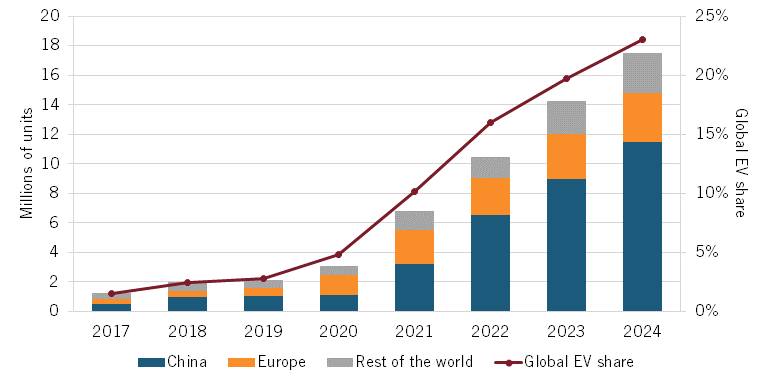
- Structural Hegemony: Chinese firms currently manufacture nearly two-thirds of the world’s electric vehicles and command an even tighter chokehold on upstream lithium-ion battery supply chains.
- The Innovation Debate: A landmark July 2024 report by the Information Technology and Innovation Foundation (ITIF) challenges the narrative of pure state-led copying, revealing deep institutional advancements in battery chemistry, manufacturing throughput, and vertical integration.
- Capital Allocation & Risk Mitigation: Decades of strategic sovereign subsidies, aggressive capital expenditure, and streamlined regulatory compliance have allowed Chinese conglomerates to achieve unmatched infrastructure scalability and compression of valuation multiples for global competitors.
- Geopolitical Shockwaves: Western policymakers face severe risk mitigation dilemmas as traditional automotive giants struggle to balance enterprise ROI with the race to match Chinese cost structures and technological velocity.
For decades, legacy Western and Japanese automotive boardrooms operated under a comforting assumption: China was a vast manufacturing plant—a low-cost assembly hub adept at scaling labor-intensive processes, but ultimately reliant on Western and allied intellectual property for foundational breakthroughs. That paradigm has shattered. Today, as capital markets reprice the global energy transition, the central question occupying executive suites from Detroit to Wolfsburg is no longer whether China can build electric vehicles cheaply, but whether its industrial complex has out-innovated the West.
The release of a comprehensive analytical briefing on July 29, 2024, by the Information Technology and Innovation Foundation (ITIF) thrust this debate back into the geopolitical spotlight. The report forced a rigorous reassessment of how Beijing transitioned from a marginal player in internal combustion engines to an undisputed titan commanding the global electric vehicle (EV) and lithium-ion battery ecosystems. To understand this transformation is to understand a masterclass in long-term capital allocation, aggressive supply chain consolidation, and a subtle yet potent shift from process imitation to true technological frontier-pushing.
The Genesis of a Technological Juggernaut
China’s ascent into the EV stratosphere was neither accidental nor purely market-driven. It was engineered through a meticulously orchestrated industrial policy spanning nearly twenty years. Beginning in the mid-2000s, when Western executives largely dismissed battery-electric vehicles as a niche novelty constrained by range anxiety and prohibitive battery costs, Beijing identified electrification as a generational pivot. It was viewed not merely as an environmental imperative, but as a historic opportunity to leapfrog legacy automotive barriers to entry.
Through targeted state subsidies, preferential land grants, subsidized debt facilities, and stringent local-content rules, the Chinese government midwifed a domestic market. This generated immediate domestic demand and allowed firms to achieve rapid infrastructure scalability. Crucially, this state-backed nursery protected early-stage enterprises from the harsh short-term volatility of public equity markets, permitting management teams to focus on multi-year R&D cycles and aggressive capacity expansion.
However, dismissing this ecosystem as a mere product of state largesse misses the nuanced reality of Chinese corporate execution. While subsidies provided the initial runway, intense domestic hyper-competition forged resilient enterprises. With dozens of domestic automakers and battery suppliers vying for dominance in a cutthroat domestic market, only the most operationally efficient survived. This crucible forced continuous iteration, driving down production costs while simultaneously accelerating technological adoption curves far ahead of their Western peers.
Deconstructing the Innovation: Chemistry, Architecture, and Scale
When analysts evaluate the innovative capacity of Chinese EV and battery heavyweights—such as BYD, Contemporary Amperex Technology Co. Limited (CATL), and Geely—they often look past surface-level metrics to examine three distinct pillars of technical superiority:
1. Materials Science and Cell Architecture
Western firms heavily prioritized high-nickel chemistries (such as NMC 811) to maximize energy density, running straight into severe supply chain bottlenecks and safety vulnerabilities regarding thermal runaway. Chinese innovators, conversely, aggressively pioneered and perfected Lithium Iron Phosphate (LFP) chemistries. Through structural innovations like CATL’s Cell-to-Pack (CTP) technology and BYD’s proprietary "Blade Battery," Chinese engineers effectively circumvented the volumetric energy density penalty of LFP. They achieved this by eliminating intermediary modules, thereby maximizing space utilization within the chassis. The result is a cheaper, safer, and remarkably durable battery architecture that has become the global industry standard for mass-market vehicles.
2. Advanced Manufacturing Throughput and Automation
Innovation is frequently misconstrued as purely theoretical research originating in a laboratory. In industrial engineering, however, manufacturing process innovation is often more valuable. Chinese gigafactories operate at a level of vertical integration and automation that legacy automakers struggle to replicate. By designing proprietary production machinery and securing immediate proximity to raw material processing (refining over 60% of the world's lithium and nearly 80% of its cobalt and graphite), Chinese firms have compressed production lead times and slashed capital expenditure per gigawatt-hour of capacity.
3. Software Integration and User-Centric Cockpits
Beyond hardware, Chinese EV manufacturers have redefined the software-defined vehicle. Operating in a digitally native consumer market characterized by hyper-connected urban populations, companies like NIO, Xpeng, and Xiaomi integrated advanced cloud compute architecture, generative AI voice assistants, and sophisticated autonomous driving stacks directly into vehicle operating systems. This rapid software iteration cycle operates on a smartphone-like update cadence, severely outpacing the bureaucratic software release schedules of traditional European and American marques.
Data-Driven Insights: The Global Landscape
To contextualize the scale of this industrial shift, financial analysts and trade economists track key operational metrics that separate market leaders from legacy incumbents.
| Metric Category | China Global Market Share | Key Industrial Driver | Strategic Implication |
|---|---|---|---|
| Global EV Production | ~65% - 70% | Aggressive supply chain vertical integration | Unmatched cost competitiveness and export pricing power. |
| EV Battery Manufacturing | >75% | Dominance in LFP chemistry & CTP architecture | Global automakers depend on Chinese cell suppliers. |
| Critical Mineral Refining | 60% - 90% (by mineral) | Sovereign capital allocation & early mining acquisitions | Severe chokepoint for Western supply chain diversification. |
| R&D Patent Velocity | Plurality of EV battery patents | Massive engineering talent pools and state-backed labs | Shift from imitation to pioneering foundational IP. |
Industry & Market Implications: Winners and Losers
The maturation of China’s EV and battery complex triggers profound tectonic shifts across global financial markets and macroeconomic landscapes.
The Winners: Agile Challengers and Raw Material Integrators
Vertically integrated Chinese conglomerates that have successfully navigated domestic price wars are emerging as global export powerhouses. Firms like BYD are rapidly expanding their footprint across Europe, Latin America, and Southeast Asia, utilizing purpose-built roll-on/roll-off cargo ships to bypass traditional maritime logistics bottlenecks. Furthermore, specialized chemical refiners and battery management system (BMS) developers are reaping substantial enterprise returns, buoyed by high volume and continuous process optimization.
The Losers: Legacy Automakers Facing Margin Compression
Traditional automotive original equipment manufacturers (OEMs) in Europe, the United States, and Japan find themselves caught in a strategic vice. Saddled with legacy pension obligations, unionized labor structures, and slow-moving internal combustion supply chains, these incumbents are struggling to protect valuation multiples. As Chinese competitors introduce feature-rich EVs at price points that severely undercut Western cost structures, legacy OEMs face a painful dilemma: either absorb margin-destroying losses to match prices or cede market share.
The Broader Economic Impact
Governments in Washington and Brussels are responding with defensive trade architecture—deploying steep tariff barriers, anti-subsidy investigations, and domestic content mandates like the U.S. Inflation Reduction Act (IRA). While these regulatory compliance measures offer temporary breathing room for domestic manufacturing, they risk balkanizing global supply chains, inflating consumer costs, and delaying the critical rollout of mass-market green transportation infrastructure.
Frequently Asked Questions (People Also Ask)
Is China's EV dominance driven purely by state subsidies, or is there genuine technological innovation?
While state subsidies and preferential financing provided the foundational runway for China’s EV sector, contemporary analysis confirms that the industry is fueled by genuine, high-level technological and manufacturing innovation. Chinese firms have pioneered major breakthroughs in LFP battery pack architecture (such as CTP and Blade batteries), automated gigafactory engineering, vertical supply chain integration, and software-defined vehicle cockpits. State support created the market, but intense domestic hyper-competition forced companies to innovate rapidly to survive.
How are Western automakers responding to the competitive threat from Chinese EV manufacturers?
Western automakers are deploying a multi-pronged approach involving defensive lobbying, strategic joint ventures, and accelerated internal R&D. Many traditional OEMs are lobbying governments for protective tariffs and stringent regulatory compliance hurdles to curb cheap imports. Simultaneously, legacy brands are partnering with Chinese battery and tech giants, licensing intellectual property, and restructuring their engineering pipelines to dramatically reduce battery costs and shorten vehicle development lifecycles.
What role do critical minerals play in China's control of the global battery supply chain?
Critical minerals are the ultimate chokepoint of the energy transition. China controls the overwhelming majority of global refining capacity for lithium, cobalt, graphite, and rare earth elements. Through decades of strategic capital allocation and direct equity investments in foreign mining projects (particularly across Africa and South America), Chinese firms secured primary access to raw inputs. This upstream control allows them to insulate themselves from commodity price volatility and dictate terms across the entire battery manufacturing ecosystem.
Future Outlook: Milestones to Watch
As the electric vehicle market enters its next maturation phase, industry watchers must monitor several pivotal inflection points that will dictate the global balance of power:
- Solid-State Battery Commercialization: The race to deploy safe, commercially viable solid-state batteries is underway. Whichever nation—China, Japan, South Korea, or the West—successfully transitions solid-state chemistry from the laboratory to high-volume manufacturing will capture the next major valuation premium.
- Geopolitical Trade Barriers and Tariff Escalation: Watch for the tightening or loosening of trade fortifications in the European Union and North America. If protectionist walls fail to stem the tide of Chinese exports, expect a wave of joint ventures where Chinese battery and vehicle makers establish manufacturing hubs directly within Western markets.
- Autonomous Driving and AI Integration: As regulatory frameworks evolve regarding full self-driving (FSD) and artificial intelligence in transport, the battleground will shift from pure hardware cost reduction to software monetization and neural-network safety validation.
- Capital Market Liquidity and Consolidation: Domestically, China’s EV sector remains over-crowded. A wave of M&A activity and corporate consolidation is expected as weaker domestic players fold, leaving a handful of battle-tested global leviathans with even greater pricing power and capital efficiency.
Ultimately, the ITIF briefing of July 2024 served as a long-overdue wake-up call. China’s leadership in the EV and battery industries is not a temporary anomaly sustained by financial sleight-of-hand. It is a structural reality built on relentless engineering, industrial scale, and strategic foresight. For Western industrial policy and corporate leadership, adapting to this new competitive baseline will require unprecedented levels of capital deployment, technological focus, and market agility.